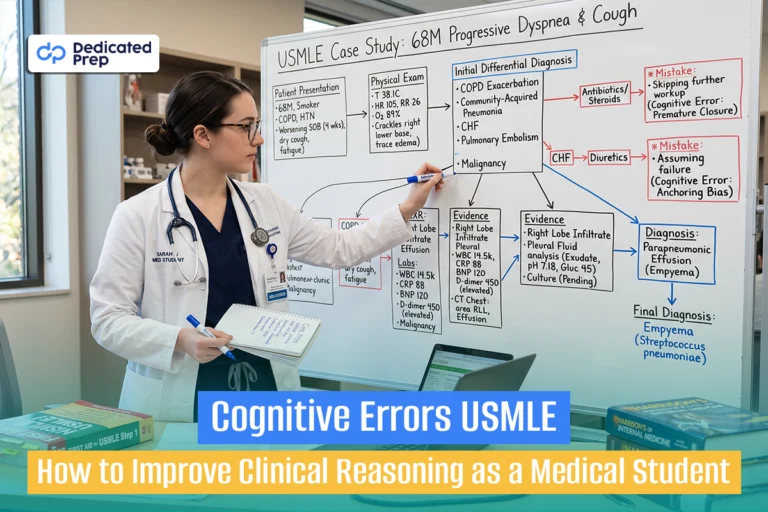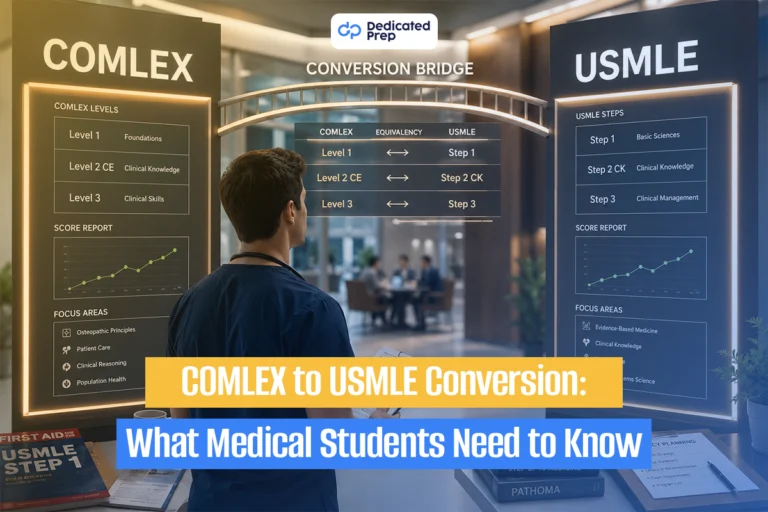

USMLE updates are coming fast, and keeping up can feel like a second full-time job. This no-nonsense guide breaks down exactly how to register for your exam, so you can stop stressing about logistics and get back to what actually matters: studying smart and acing your exam.
USMLE exam registration follows a chain of steps across different systems: a registration portal, a scheduling permit, and then Prometric scheduling, and these steps differ for U.S. students vs. international students. If you pick the wrong USMLE registration portal, choose the wrong testing region, wait too long to schedule, or miss an extension deadline, you can lose time, pay extra fees, and even risk not testing within your eligibility period.
Use this rule: U.S. medical schools → NBME/MyUSMLE; Medical schools outside the U.S. → FSMB portal. Then follow the workflow: Create account → Apply → Pay → Get permit → Schedule at Prometric → Print/confirm.
What is USMLE Exam Registration All About, and Why is it Crucial?
USMLE registration is the process of officially signing up to take the USMLE exams (Step 1, Step 2 CK, and Step 3). It involves creating a profile in the registration portal, submitting required documents, selecting USMLE Step 1 registration dates, and paying the registration fee. This step is essential as it grants you access to the exams, and failure to register properly can delay your progress toward medical licensure.
What Happens if You Miss the Deadline? Missing the registration deadline can have significant consequences. Not only does it delay your exam date, but it can also disrupt your preparation timeline, forcing you to wait for the next available testing window. This results in unnecessary delays in your medical career, and depending on the circumstances, you may incur additional fees or be required to reapply, further extending your journey to certification.
What Every Student Needs to Know Before They Start the USMLE Exam Registration
What “USMLE registration” actually includes
USMLE exam registration typically means you will:
- Select a Step exam (Step 1, Step 2 CK, or Step 3).
- Apply through the correct registration entity/portal (this is the core USMLE registration portal decision).
- Choose a three-month eligibility period (your testing window).
- Receive a scheduling permit via email/portal.
- Use Prometric USMLE registration scheduling tools to book a test date at a test center.
The 2026 change that affected the Process of Service Transition
Starting in January 2026, USMLE centralized “service functions” (registration, permits, score reports, customer support) under the co-sponsors.
The practical result for you is simple:
- Students/graduates of U.S. medical schools register for all three Steps through the MyUSMLE Portal.
- Students/graduates of medical schools outside the U.S. register for all three Steps through (via FSMB’s USMLE portal).
The Key USMLE Registration Pipeline for Students to Memorize
Which USMLE Registration Portal Should You Use: Options and Eligibility
Choose the correct registration portal first
Use this decision tree to avoid wasted time and wrong-form submissions:
- If you are a student/graduate of an LCME- or COCA-accredited U.S. program → apply for Step exams through NBME USMLE registration.
- If you are a student/graduate of a medical school outside the U.S. → apply for Step exams through FSMB (FSMB’s USMLE portal).
This is also explicitly reflected on the official “Apply for Exams” page (Step 1/2 CK/3) and the 2026 Bulletin Addendum.
Eligibility Criteria for Step 1 and Step 2 CK
The 2026 Bulletin Addendum summarizes USMLE Step 1 registration /Step 2 CK eligibility categories as:
- Enrolled in or graduated from an LCME-accredited MD program, or
- Enrolled in or graduated from a COCA-accredited DO program, or
- Enrolled in or graduated from an international medical school listed in the World Directory as meeting ECFMG registration for USMLE and meeting ECFMG criteria.
Eligibility Criteria for Step 3
Step 3 has extra requirements. The addendum states Step 3 eligibility includes:
- Passing Step 1 and Step 2 CK
- Holding an MD/DO (or equivalent MD degree from an eligible international school), and
- For IMGs, having an ECFMG Certification that is valid and unexpired, plus meeting other Bulletin criteria.
The Step 3 FAQ clarifies that the portal may block your Step 3 application until FSMB receives confirmation of ECFMG certification and that expired certificates are not acceptable for Step 3 testing dates
Attempt limit and retake spacing are important before you re-register
If you are reapplying after a fail, the USMLE attempt rules include:
- You can’t take the same Step more than three times in 12 months.
- A fourth attempt must be at least 12 months after your first attempt and at least 6 months after your most recent attempt (including incomplete attempts).
DID YOU KNOW! “Out of 100,000 USMLE applicants, local and foreign, every year, more than 30% have problems when they are registering to take the USMLE exams, either due to time constraints, like missing deadlines, or inability to understand the time limits? The wrong registration options or the delay in scheduling may not only delay your exam but also your medical career schedule, including residency applications. The following are the pitfalls that can be prevented by understanding the registration process of the USMLE exams in detail, so that your way to the exam day and beyond is a lot easier.” |
A Complete Roadmap to the USMLE Registration Exam Process: Step-by-Step Guide
Here is the complete method for medical graduates to follow, from USMLE registration to the USMLE registration login.
Step 1: Create your USMLE registration login in the correct portal
- Confirm whether you’re registering through NBME/MyUSMLE (U.S. schools) or FSMB (international schools).
- Create your account and keep your email consistent and accessible (because you’ll receive permit/score notifications by email).
Tip: Official USMLE guidance emphasizes reviewing the Bulletin before applying; treat that as part of your registration “setup.”
Step 2: Complete your USMLE registration form
Your “USMLE registration form” is the online application inside your portal. Expect to:
- Choose the Step exam (Step 1, Step 2, or Step 3).
- Choose a three-month eligibility period (your window to test).
- Select a testing region (especially relevant outside the U.S.).
- Pay the application fee using the accepted payment methods in your portal.
Step 3: Pay fees and understand surcharges before you click “submit.”
Core USMLE registration fees for 2026 are:
- USMLE Step 1 registration fee: $695
- USMLE registration step 2 fee: $695
- Step 3: $955
If you test outside the U.S. and Canada (international testing regions), the official “Apply for Exams” page lists additional region fees:
- Step 1: $205 region fee (outside U.S./Canada)
- Step 2 CK: $230 region fee (outside U.S./Canada)
If you select the India testing region, the USMLE program notes an India-specific tax collection (OIDAR) applied to Steps 1 & 2 taken in India.
USMLE Exam Registration Fees: A Quick Overview
| Exams | Which portal to use | Core 2026 fee | Key eligibility window rule | Rescheduling/ Extension |
| Step 1 | U.S. schools: NBME/MyUSMLE; International schools: FSMB portal | $695 | Choose a 3‑month eligibility period; schedule after permit; scheduling not usually >6 months ahead | Outside U.S./Canada: +$205 region fee; India region: OIDAR tax; reschedule fees apply within 45 days |
| Step 2 CK | U.S. schools: NBME/MyUSMLE; International schools: FSMB portal | $695 | Same “3‑month eligibility → permit → Prometric” workflow | Outside U.S./Canada: +$230 region fee; reschedule fees apply within 45 days |
| Step 3 | U.S. grads: NBME/MyUSMLE; IMGs: FSMB portal | $955 | Only in U.S./territories; 2-day exam must be scheduled together; Day 1 first; within 14 days | Not offered first 14 days of January; must have a valid/unexpired ECFMG certificate (IMGs); partial reschedule fees can apply |
Step 4: Get your scheduling permit and check it immediately
Once your registration is processed:
- You receive a scheduling permit via email (and you may also access it in your portal).
- Verify your name matches your ID exactly (mismatches can block test-day admission).
- Check USMLE registration and save the permit in at least two places (PDF and printed copy).
If you lose your permit, FSMB explicitly states you can download/print it from the portal and that it’s also included at the bottom of the permit-notification email.
Step 5: Schedule your exam with Prometric
After you have your permit:
- Go to Prometric to locate and schedule/confirm/reschedule your appointment.
- Book early, official guidance warns that some centers fill quickly and recommends scheduling as soon as you have your permit.
- Note: scheduling may not be available more than six months in advance.
Step 6: Print your confirmation as “registration proof”
For most candidates, your “registration confirmation” is really two documents:
- Your USMLE scheduling permit (required for test admission).
- Your Prometric confirmation (useful for reference and rescheduling; includes your confirmation number).
Step 7: Test-day check-in essentials. This is where many people fail
Every student must present:
- A paper or electronic copy of your scheduling permit, and double-check the details
- A valid, unexpired government-issued photo ID with signature, and an exact name match to the permit.
USMLE’s exam-day guidance also notes: arrive early; arriving more than 30 minutes late can mean denial of entry and a rescheduling fee.
Also, if you want expert help with your USMLE prep? Check out our USMLE tutoring services to get personalized guidance and improve your scores.
How to Avoid Common Pitfalls During USMLE Registration: Fees, Deadlines, and Rescheduling Tips
Navigating USMLE registration can be tricky, especially when you encounter issues like deadlines, registration changes, or hidden fees. The last thing you want is a surprise that derails your exam schedule. Here’s how to avoid the common pitfalls associated with USMLE exam registration and ensure a smooth experience.
Pro Tip: Always double-check the applicable regional fees, as they can add high costs to your registration, especially for international students.
Changing Your Eligibility Period vs. Rescheduling Your Exam
These are not the same:
- Rescheduling: Cancelling your appointment for the selected date of your exam and choosing another exam date. Changing the registration period usmle exams, followed by
- Fee structure: Prometric appointment inside your eligibility window (Prometric fees may apply).
- Changing eligibility period: changing the entire allowed window (often requires extension or canceling the reapply, depending on the case).
For FSMB, “changing eligibility period” rules are strict: they state they cannot change your chosen eligibility period after submission; earlier window requires cancel and new fee; later window may allow an extension or cancel and reapply (refund rules depend on approval status). Always consult the USMLE Bulletin or your registration organization for specific guidelines.
Prometric Rescheduling Fees (Effective January 2026)
USMLE publishes a fee table for appointment changes at Prometric. Key takeaways:
- 46+ days before: no fee
- 31–45 days: $35
- 6–30 days: $100
- ≤5 days: higher fees vary by region and Step (and Step 3 has special cases when rescheduling fewer than all days).
Eligibility Period Extensions: How to Get More Time to Test
The official Bulletin says: if you can’t test in your eligibility period, you must contact your registration organization about a one-time contiguous eligibility period extension, and a fee is charged. This means you can extend your eligibility period by an additional 3 months for a fee for the period immediately following your current eligibility period.
For FSMB registrations, the eligibility extension rules are explicit:
- One-time contiguous 3-month extension
- $70 processing fee (non-refundable)
- Request only after your permit is available
- Must be received no later than 25 days after the end of the original eligibility period
NBME also lists a $70 eligibility period extension for Step 1/2 CK on its examinee fee page, but the precise deadline is stated on the extension form.
Avoiding Name Mismatches and Identity Issues
The USMLE common questions page states that name change forms/documentation must be received and processed by your registration entity no later than 7 business days before your scheduled testing appointment.
Tip: Double-check your registration details before finalizing everything. A small mistake can lead to unnecessary delays.
What to Do If Prometric Closes Your Test Center
If a Prometric test center closure prevents testing, USMLE’s rescheduling guidance explains that you should contact the appropriate registration entity (NBME or FSMB) and provide specific details; closure is verified with Prometric, and a free extension may be provided if needed.
Key Takeaway: Always verify with the test center in advance if you’re concerned about closures or delays.
IMG-Specific Considerations and ECFMG Responsibilities
Even though IMGs now register through FSMB after the service transition, it still determines whether your school meets certification eligibility, and certification remains required for Step 3 eligibility.
Practical IMG checklist before you register:
- Confirm your medical school listing includes an ECFMG Sponsor Note and that your graduation year is covered (this affects certification eligibility).
- Understand the exam requirements for ECFMG certification (Step 1 and Step 2 CK as the medical science exam requirement; Pathways/OET for clinical skills/communication).
- Track ECFMG’s seven-year time limit for completing exam requirements (ECFMG warns you must track your own deadlines).
Why This Is Important: IMGs should be aware of the set rules and regulations by ECFMG in order to obtain Step 3 registration. Failure to get documentation in time or at all may lead to rejection of registration.
While this guide covers the USMLE exam registration process, students preparing for other exams, such as the MCAT, can also benefit from our detailed how to register for the MCAT guide.
Conclusion: A Smooth Registration Process Starts Here
USMLE registration does not have to be a big problem; it only requires a clear plan of action, the appropriate time, and a watchful eye. It doesn’t matter whether you are a first-time Step 1 test-taker or a clinical student, ready to take Step 2 CK, or you are an international medical graduate going through the registration process with ECFMG and FSMB; early planning is the key. The correct order and planning put you out of expensive errors and restore to yourself precious study time.
Ready to convert registration clarity into exam success?
At Dedicated Prep, we offer expert guidance beyond registration, from creating your customized study plan to mastering high‑yield content, test‑taking strategies, and score improvement.
FAQ
1. Are there extra charges for USMLE registration for international students?
Yes. The USMLE “Apply for Exams” page lists region fees for testing outside the U.S. and Canada: $205 (Step 1) and $230 (Step 2 CK).
2. What photo can I use for USMLE registration?
For test-day admission (what most students mean by “photo requirements”), USMLE requires a valid government-issued photo ID with a signature, and your name must match your scheduling permit.
3. Where to go to print off the registration confirmation for the USMLE?
Print (or save) your scheduling permit and your Prometric confirmation. FSMB explicitly says you can download/print the permit in the portal, and it’s also included in the scheduling-permit email.
4. Can I get GMC registration with USMLE?
It can be, but it’s separate from USMLE exam registration and is governed by routes. The GMC has a specific “acceptable overseas registration exam” guide for applicants using overseas exams as evidence (separate from PLAB routes).
5. Does USMLE registration depend on GPA?
No, the examination for Step USMLE registration does not depend on your GPA. However, your eligibility for certain exams may depend on your medical school status or other academic requirements.
6. How to register for the USMLE for foreign medical graduates?
Foreign Medical Graduates (FMGs) need to register through the ECFMG portal for usmle step one registration, Step 2 CK, and Step 3. You must meet ECFMG certification requirements and submit the necessary documentation.
7. How to test the mental status exam registration for the USMLE?
The Mental Status Exam (MSE) is part of the clinical skills test for Step 2 CS (Clinical Skills). Registration is included when you apply for Step 2 CS through the NBME or ECFMG portal, depending on your school status.