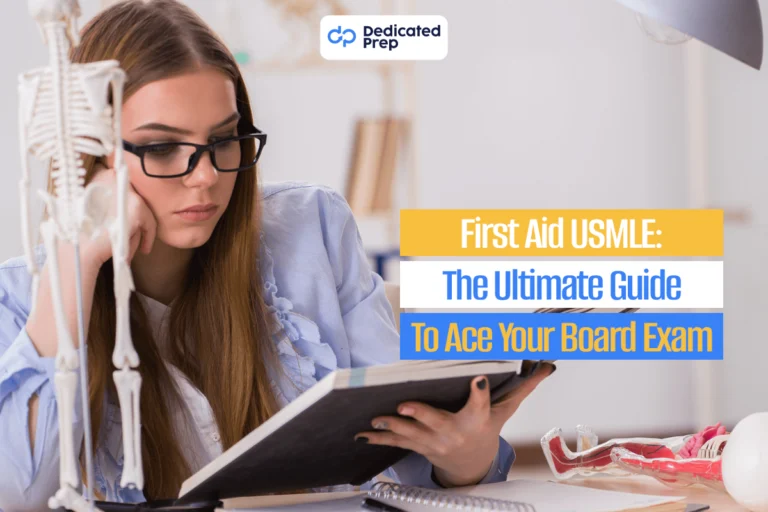

If USMLE prep feels overwhelming, you are definitely not alone. Between endless resources, constant updates, and the pressure to get it right, it’s easy to feel stuck before you even start. It’s impossible to talk about USMLE Step 1 without talking about First Aid– it’s the backbone of prep and the book nearly every student swears by. First Aid for USMLE has become the gold standard review resource used by tens of thousands of medical students and international medical graduates (IMGs) because it condenses the most frequently tested topics into a high‑yield format that’s easy to digest and revise.
In this guide, we will walk you through how to use First Aid USMLE effectively across Step 1, Step 2 CK, and Step 3, what mistakes to avoid, and the proven strategies that help you maximize retention and scores, including a look at the ABC method of First Aid and how rapid review works.
What Is First Aid for the USMLE
First Aid for the USMLE is a collection of high-yield review content that helps streamline and focus on what you need to know to take your board exams. Often called the holy grail of USMLE prep, it’s continuously refined using student feedback and exam trends, emphasizing the topics most likely to appear on test day. First Aid provides you with summaries, mnemonics, illustrations, and strategic tips relevant to basic science knowledge needed for Step 1 or clinical knowledge in the Step 2 CK.
The editions are also revised every year to meet the exam priorities of the time, and the quick review bits at the end of the books are useful quick reference material when the exam time is close at hand.
First Aid vs UWorld vs Pathoma: A Quick Comparison
| Feature | First Aid | UWorld | Pathoma |
| Content Type | High-yield summary, concise notes | Practice questions and explanations | Pathology-focused, detailed |
| Best For | Organizing concepts and memorization | Practice and application of concepts | Understanding pathology in depth |
| Recommended Use | Review material | Active practice for recall | Pathology study support |
| Integration | Works well with UWorld & Pathoma | Supports active learning with practice | Enhances First Aid study |
First Aid for the USMLE Step 1 — The “Bible” of Board Prep
First Aid for the USMLE Step 1 is the most widely recommended USMLE review book, covering all major systems and basic science disciplines: biochemistry, anatomy, physiology, microbiology, pathology, pharmacology, behavioral science, and more. Its bullet‑point format, organized by organ systems and general principles, allows for efficient reading and retention.
✔ High‑yield facts organized clearly
✔ Tables, flowcharts, and diagrams for visual learning
✔ Mnemonics to make recall easier
✔ Rapid review section for last‑minute cramming
Many students annotate their USMLE Step 1 First Aid book with notes from question banks like UWorld and supplemental resources like Pathoma to expand understanding.
First Aid for the USMLE Step 2 CK and Step 3 — Beyond Basic Science
When you are done with Step 1USMLE Exam, your focus shifts from foundational science to clinical knowledge, reasoning, and real‑world patient scenarios. That’s exactly where First Aid for the USMLE Step 2 CK and First Aid for the USMLE Step 3 shine.
First Aid for USMLE Step 2 CK — Clinical Knowledge and Real Patient Care
Unlike First Aid for the USMLE Step 1, which centers on basic sciences, First Aid for Step 2 CK emphasizes the clinical application of that knowledge, how diseases present, how you diagnose them, and how you manage patients effectively under supervision. Step 2 CK questions are based on real-world clinical scenarios, such as internal medicine, surgery, pediatrics, psychiatry, obstetrics and gynecology, and preventive care, all put in the context of patient care issues you will encounter during clerkships and beyond.
High-yield clinical facts have been condensed in this edition in a concise, system-based format in bullet points, mnemonics, and embedded clinical mini-cases, which reinforce important patterns and decision pathways. However, First Aid for Step 2 CK seems to be less popular with students, who often prefer to supplement their prep with First Aid from Step 1instead.
First Aid for USMLE Step 3 — Decision Making and CCS Prep
The last USMLE obstacle is Step 3, and it is not only knowledge but also a way of thinking as a practicing doctor. First Aid Step 3 is a variation of the high-yield, fast-reference methodology for more complicated clinical reasoning and decision making. The USMLE exam spans two days: multiple‑choice questions focused on patient care and diagnosis, and Computer‑based Case Simulations (CCS) that mimic real patient encounters where you actively choose labs, therapeutic steps, and management plans.
This edition condenses high-yield clinical facts into a concise, system-based format with bullet points, mnemonics, and embedded clinical mini cases that reinforce key patterns and decision pathways. Most students, however, tend to lean towards using Q banks as their primary learning resource for Step 3.
Why These First Aid USMLE Editions Matter
Together, the Step 2 CK and Step 3 First Aid books help bridge the gap from memorizing facts to applying them in clinical settings, exactly what the USMLE expects you to do as you progress through your exams. They build on the foundation you laid with Step 1 and help you develop a more patient‑centered mindset, making them essential companions for the later stages of your USMLE journey.
What Is the ABC Method of First Aid for the USMLE
The ABC method is a strategic approach many top scorers use to extract maximum value from USMLE First Aid:
A refer to Annotate: Add key information from question banks and lectures directly into your First Aid. Tip: Remember to annotate info in your own words for maximum retention.
B refers to Build connections: Link concepts across sections for deeper understanding (e.g., integration of pharmacology with physiology).
C refers to Consolidate: Review and condense information repeatedly (using rapid review sections and mnemonics) so it becomes second nature.
This method shifts first aid for USMLE from a static book to a dynamic cheat sheet personalized to your strengths and weaknesses.
How to Use First Aid USMLE Effectively: Key Factors to Consider
1. Establish a Study Foundation First
First Aid is not intended to reteach you medicine. It is brief and high-yield. Rather, apply it once you have discussed core material in lecture notes, video materials, or textbooks. When you have a background, you have your guide to quick knowledge and memorization, First Aid.
2. Annotate Strategically
It is more personal and effective to add your notes to your USMLE First Aid based on the question banks and some additional materials. Mark all significant additions using various colored pens or computerized highlights so that the pages are not crowded. Make sure to add only new content in your own words.
3. Integrate Rapid Review
The Rapid USMLE First Aid review section at the end of the book is pure gold! It is the perfect resource to reinforce must‑know facts shortly before exam day. Treat this like your high‑yield “flashcard” list when time is limited.
4. Pair with Question Banks and Q&A Resources
Using First Aid alongside a solid question bank reinforces your learning. After studying a section, apply it through practice questions to solidify knowledge and identify gaps. You can then annotate back into First Aid.
Read our complete blog on USMLE Step 1 Blocks Breakdown.
Common Mistakes to Avoid with First Aid for Maximizing Exam Success
- Treating First Aid as the only resource: It’s meant to summarize key concepts, not teach everything from scratch. Always supplement with videos, textbooks, and question banks for a deeper understanding.
- Over‑highlighting every sentence: Highlighting indiscriminately dilutes focus on the most high‑yield facts and makes it harder to see what truly matters.
- Reading cover to cover without integration: Passive reading won’t stick. Pair First Aid with practice questions and spaced‑repetition techniques to reinforce memory.
- Using First Aid before learning the basics: Jumping into First Aid too early can lead to confusion. Build foundational knowledge first, then use it as a review and consolidation tool.
- Reading it only once or superficially: A single pass through the USMLE First Aid usually isn’t enough. Multiple focused passes alongside exam-style questions help cement recall under test pressure and understand how concepts are tested.
- Memorizing instead of understanding concepts: Memorizing isolated facts without linking them to deeper principles or clinical reasoning can backfire, especially when you’re faced with complex, application‑based questions.
First Aid USMLE Comparison for Step Exams With Estimated Cost
| Edition / Resource | Focus | Best Use | Rapid Review Available | Approx. Cost ($) |
| First Aid for the USMLE Step 1 Book | Foundational basic sciences high‑yield | Early core review & exam prep | ✔ | ~$50–$85 |
| First Aid for the USMLE Step 2 CK Book | Clinical knowledge & management | Clinical reinforcement | ✔ | ~$60–$70 |
| First Aid for the USMLE Step 3 Book | Advanced clinical & CCS prep | Final licensure step review | ✔ | ~$50–$60 |
| First Aid USMLE Q&A Resources | Practice questions tied to First Aid content | Assess understanding & gap analysis | ✘ | ~$60–$65 |
Note:
- Prices vary by edition, retailer, and region, but typically fall in the ranges above for new paperback copies.
- You can often buy first aid USMLE bundled editions or international editions at lower prices in some markets.
Conclusion: First Aid USMLE Simplified
First Aid for USMLE isn’t just another textbook; it’s the backbone of efficient board exam prep. From high‑yield summaries to quick‑reference diagrams and rapid review strategies, it helps you organize massive medical content into memorable, testable facts. Remember to use it after building foundational knowledge, annotate with supplemental resources, and pair it with question practice for the best results.
✔ First Aid delivers concise, high‑yield content.
✔ Use the ABC Method to maximize retention.
✔ Integrate with QBanks and spaced repetition.
Ready to take your USMLE prep to the next level? Explore personalized tutoring and study strategy support with Dedicated Prep to turn your First Aid review into a winning roadmap for exam success!
FAQs
1. How to best use First Aid for Step 1?
Use First Aid for the USMLE Step 1 after you have built a basic content foundation, annotate it with key insights from question banks, and focus on rapid review close to exam day.
2. Is First Aid a good study tool for the USMLE?
Yes, it’s widely considered the most essential USMLE review tool, particularly for Step 1, due to its concise, high‑yield facts, diagrams, and mnemonics.
3. What is First Aid for the USMLE Step 1?
It’s the number 1 high‑yield review book organized by system and concept, designed to help students focus on what’s most likely to appear on the Step 1 exam.
4. What are the 4 B’s of First Aid?
In the context of learning with first aid USMLE step exams, the “4 B’s” refer to focusing on Basics, Board Facts, Bullet Points, and Balanced Annotation to keep your study efficient and high‑yield.
5. What do the 3 P’s stand for in first aid?
In the context of the study, the 3 Ps include Prioritize, Practice, and Personalize, which give priority to high-yield facts, practice with questions, and personalize annotations.
6. What are the 3 C’s of First Aid?
The above Annotate, Connect, and Consolidate are the 3 Cs that summarize the ABC approach that you have just watched, making First Aid a personalized study guide.