

If you are panicking about learning countless lab values for your USMLE exam, look no further. For the USMLE Step 1, Step 3, NBME self‑assessments, and clinical rotations, students often wonder: “What normal lab ranges do I need to know for the exam and for clinical practice?” In this guide, we will explain:
- What USMLE laboratory values are and why they matter
- How NBME/USMLE presents lab values in exam content
- A normal USMLE lab values chart you can reference
- Mnemonics and study strategies (including USMLE lab values, Anki use)
- How to interpret lab results in clinical scenarios
- Common pitfalls students make with laboratory testing for the USMLE
Whether you are memorizing electrolytes, liver enzymes, kidney tests, or hematology values, this is your strategic, exam‑ready resource to master lab data and improve your clinical reasoning.
What Are USMLE Laboratory Values and Why Do They Matter
USMLE laboratory values refer to the standard reference ranges for common blood tests, metabolic panels, hematologic measurements, arterial blood gases, and other clinical diagnostic values seen in practice and on exams. These values are used in NBME self‑assessments and sample materials and form a foundation for interpreting clinical scenarios. Familiarity with these values helps you discern normal from abnormal laboratory results, normal values quickly, and with confidence.
For your USMLE Step 1, USMLE Step 2 CK, and USMLE Step 3 exams, a table of normal lab values is available to test takers during the exam, so your focus should be on interpretation, not memorization.
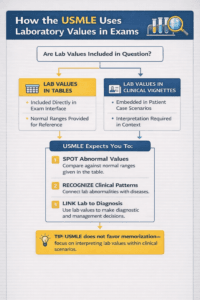
How the USMLE Uses Laboratory Values in Exams: Normal Ranges You Must Know
When the lab values are presented in the USMLE and NBME practice questions, they are not just some arbitrary numbers; they are exam hints you are being tested on to use your clinical reasoning and pattern recognition. Lab values are used in two significant ways in the USMLE Step exams preparation (particularly Step 1, Step 2 CK, and Step 3):
1. Values given directly in the question.
In NBME as well as USMLE sample test questions, ranges of normal laboratory values are given in a table within the question or supporting materials, so that when you solve clinical problems, you can consult the table when you need it. This helps the exam evaluate not what you have learned by heart, but how well you can put those figures into context.
- USMLE official sample PDFs (Step 1 and Step 2 CK) attest to the fact that:
- There is a table of lab values that is part of the exam interface and may be referenced in questions.
- Step exams include normal ranges so that you can focus on interpretation rather than recall under pressure.
2. Lab Values Embedded Within Clinical Scenarios
Many clinical questions do not list a table but instead include lab data as part of a scenario. These are typical in Step 2 CK and Step 3 questions, where you must interpret multiple findings together to make a diagnosis or management decision.
In these scenarios, your task is to:
- Identify which values are normal vs abnormal
- Determine the pattern of abnormality
- Link lab changes to disease states or clinical trends
For example, you might see lab values that test your ability to interpret:
- Electrolyte imbalances (e.g., hyponatremia vs hypernatremia)
- Kidney dysfunction (elevated BUN and creatinine)
- Liver injury (elevated AST/ALT)
- Hematologic abnormalities (anemia subtypes from CBC values)
- Acid‑base disorders using arterial blood gas components
The purpose here is not just memorizing ranges; it is about using values to solve clinical problems the same way you would in real patient care.
Clinical vs Foundational Focus Across Steps
- Step 1 involves using lab values to explore physiology, pathophysiology, biochemistry, and mechanisms behind abnormalities. The emphasis is on foundational understanding that explains why values change.
- Step 2 CK & Step 3 emphasize clinical application. Here, lab values more often appear within patient scenarios, testing your ability to diagnose, manage, or prognosticate using lab data.
Although you should ideally know normal lab ranges, your exam success actually depends on interpreting lab patterns in the context of the clinical vignettes given.
Normal USMLE Lab Values Chart: A Quick Overview
Below is a consolidated table of normal USMLE laboratory values you should know for clinical reasoning and exam questions. This chart integrates common ranges seen in NBME and clinical reference data.
| Test Category | Test Name | Normal Range |
| Electrolytes | Sodium (Na⁺) | 136–145 mEq/L |
| Potassium (K⁺) | 3.5–5.0 mEq/L | |
| Chloride (Cl⁻) | 98–106 mEq/L | |
| Bicarbonate (HCO₃⁻) | 22–28 mEq/L | |
| Kidney Function | Creatinine | 0.6–1.2 mg/dL |
| BUN (Blood Urea Nitrogen) | 7–20 mg/dL | |
| Liver Enzymes | ALT | 8–37 U/L |
| AST | 10–34 U/L | |
| Alkaline Phosphatase | 44–147 IU/L | |
| Glucose & Metabolism | Glucose (fasting) | 70–100 mg/dL |
| Hematology | Hemoglobin (Hb) | M: 13.5–17.5 g/dL F: 12.0–16.0 g/dL |
| Hematocrit (Hct) | M: 41–53% F: 36–46% | |
| WBC Count | 4,000–10,000 /µL | |
| Platelets | 150,000–450,000 /µL | |
| ABG (Arterial Blood Gas) | pH | 7.35–7.45 |
| PCO₂ | 33–45 mm Hg | |
| PO₂ | 75–105 mm Hg | |
| Proteins & Lipids | Total Protein | 6.3–7.9 g/dL |
| Albumin | 3.9–5.0 g/dL |
Note: Successfully mastering these frequently tested laboratory values helps you interpret clinical conditions such as renal failure, hepatic disease, anemia, acid‑base disorders, and electrolyte disturbances.
NBME Lab Values PDF and Study Tools to Maximize the Exam Scores
Many students use downloadable reference materials like NBME Lab Values PDF lists to drill lab ranges before exams. These PDFs compile reference ranges for electrolytes, enzymes, hormones, and more in compact formats. Similar reference materials are available across commonly used Qbanks for the USMLE exams to familiarize students with what they will see on exam day.
Other common study aids include:
- Anki decks for spaced repetition
- Flashcards combining lab values with clinical scenarios
- Study guides focusing on laboratory testing, biochem, and USMLE interpretation
Using active recall tools ensures you understand patterns instead of just memorizing numbers. Download the official NBME Laboratory Values PDF for a complete list of normal reference ranges used in NBME and USMLE practice questions.
How to Interpret Lab Results on USMLE Questions: Step‑by‑Step Approach
Reading lab data in a question isn’t just about seeing numbers; it’s about turning those numbers into clinical meaning. Exam writers don’t give lab values to slow you down; they give them to guide you toward a diagnosis, management decision, or next best step. Here’s how to do that effectively:
1 Compare Each Value to the Normal Range Chart
Before anything else, establish what’s normal vs abnormal:
- Is the value above or below the expected range?
- Is it a mild or extreme deviation?
- Are multiple values abnormal?
Example:
If Na⁺ is 126 mEq/L (normal 136–145), you immediately know this is hyponatremia, not just “a low sodium value.”
This first step quickly narrows your differential.
2 Identify Abnormalities (High vs Low)
Don’t just note the abnormality, categorize it:
- High vs low
- Acute vs chronic patterns (based on question context)
- Single abnormal value vs multiples
Example patterns:
- High BUN and high creatinine → suggest renal impairment
- High AST/ALT → suggests liver injury or hepatocellular damage
- Low pH with high CO₂ → indicates respiratory acidosis
Understanding direction adds meaning to the lab number itself.
3 Associate Patterns with Potential Disorders
Normal lab values rarely exist in isolation clinically. Look for patterns that match known disease processes:
✔ Low Na⁺ (hyponatremia)
- Could be due to SIADH, dehydration, CHF, renal disease
- Look for additional clues in urine osmolality or symptoms
✔ Elevated BUN and Creatinine
- Points to acute or chronic kidney dysfunction
- Evaluate hydration status, drug history, or post‑renal obstruction
✔ High AST and ALT
- Indicates hepatocellular injury
- Think hepatitis, alcoholic liver disease, and drug‑induced liver injury
Clinical laboratory USMLE context always matters; these lab clues unlock the narrative of the question.
4 Use Trends & Relationships Rather Than Isolated Numbers
Good clinicians and high scorers on the USMLE don’t just see a single value; they detect trends and relationships between labs:
- Rising AST/ALT over multiple values suggests ongoing liver damage
- A widening anion gap with metabolic acidosis points toward toxic ingestion, DKA, or lactic acidosis
- Low hemoglobin plus low mean corpuscular volume (MCV) suggests iron deficiency anemia
By thinking in patterns and trends, not just single values, you move from memorization to clinical reasoning.
Why This Approach Works Best for Medical Students
USMLE exam writers design lab questions so that:
- The first abnormal value directs your attention
- The second and third abnormalities confirm or refine your differential
- Normal Lab values help to rule out similarly presenting conditions
- Lab trends tell the story of how one organ system affects another
By following this method:
✔ You avoid random guesswork
✔ You connect labs to disease processes
✔ You improve accuracy under time pressure
Ready to level up your lab value interpretation and exam performance? Explore our USMLE tutoring services and let us help you unlock your best score.
Mnemonic and Study Strategies for Normal Lab Values
Memorizing lab values can seem overwhelming, but memorizing common values can save time on test day. It is, however, more important to focus on patterns and integrate values into the clinical context..
Tips to Memorize Values
- Use Anki flashcards organized by system (electrolytes, hepatic panel, renal tests)
- Create laboratory values chart mnemonics for electrolyte ranges
- Link lab values to diseases (e.g., high AST/ALT → liver injury)
- Practice interpreting abnormal values in question banks
The high-scoring students emphasize that focusing on interpretation patterns saves more time than memorizing USMLE laboratory values, every number individually.
Common Mistakes Students Make with Lab Values
Even students who memorize numbers can falter if they misinterpret patterns. Avoid these pitfalls:
Memorizing Without Context: Only learning numbers without understanding clinical significance leads to slow exam performance.
Ignoring Units: Lab values often use different units (mg/dL vs mmol/L), so always pay attention to units on NBME items.
Mixing Pediatric & Adult Normals: Some values differ in children versus adults. Clarify age context on exam prompts.
Forgetting ABG Interpretation: ABGs test both respiratory and metabolic components; don’t just read numbers without context.
Conclusion: Mastering Lab Data for USMLE Success
Understanding normal laboratory values, USMLE, and how to interpret lab results is a foundational skill for both exam success and clinical practice. Focus on active interpretation strategies, use reference charts, and integrate lab values into clinical scenarios rather than memorizing numbers in isolation.
If you want guided help mastering lab interpretation, timing, and pattern recognition, and want to see how these values show up in real NBME practice questions, our expert coaches at Dedicated Prep can personalize your study strategy and increase your confidence for Step 1, Step 3, and clinical assessments.
FAQs
- Does USMLE give lab values in exam questions?
Yes. The USMLE laboratory test values provide normal ranges or reference tables so you focus on interpretation rather than recalling every number. - What do lab values mean in a clinical context?
USMLE normal laboratory values reflect physiological and biochemical functions; abnormalities can indicate disease, organ dysfunction, or metabolic imbalance. - How to memorize lab values easily?
Use active recall tools like USMLE lab values, Anki decks, combined with clinical question practice for pattern recognition. - What are the most frequently tested on the USMLE Step 1 laboratory values?
Commonly tested laboratory values in the normal range include electrolytes (Na⁺, K⁺), kidney function (BUN, creatinine), liver enzymes (AST, ALT), and CBC parameters. - What are the basic laboratory tests I should know?
Know components of CBC, basic metabolic panel (BMP), liver function tests, arterial blood gases, and coagulation profiles, as these form a core part of laboratory techniques in the USMLE exam interpretation.