
The USMLE Step 1 blocks format can feel overwhelming when you first start studying, but understanding the structure is half the battle. This guide breaks down exactly what you face on test day from the 7 blocks in Step 1 to the clinical scenarios of Step 3 so you can walk into the testing center with confidence.
Navigating the path to becoming a licensed physician in the United States requires clearing three major hurdles. Whether you are a US medical student or an international graduate, knowing how the computer-based examination works for each step is crucial for managing your time and anxiety.
The USMLE Step 1 is a one-day computer-based test that assesses whether you understand and can apply important concepts of the sciences basic to the practice of medicine. It emphasizes principles and mechanisms underlying health, disease, and modes of therapy.
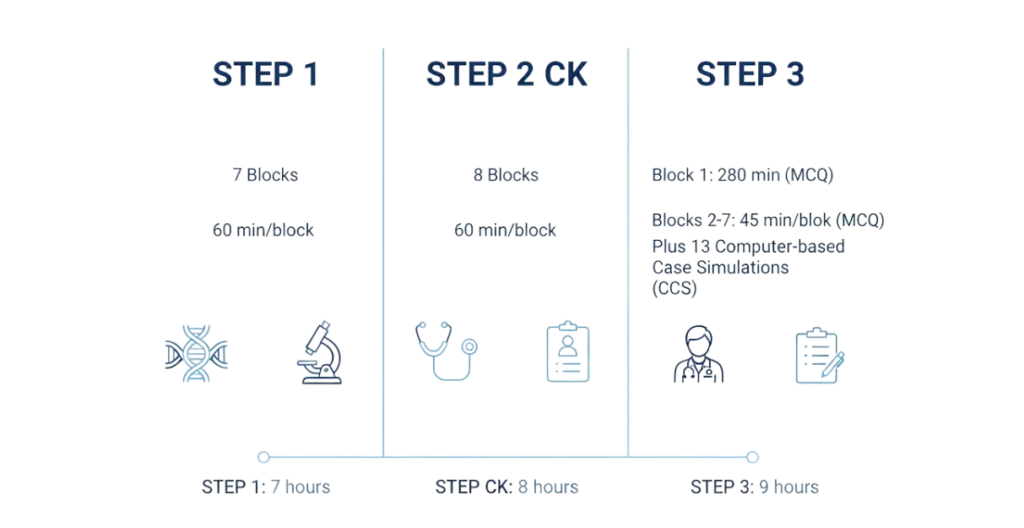
The exam day is divided into seven 60-minute blocks. The number of questions per block is a maximum of 40. This means the total number of items on the overall examination form will not exceed 280. You will have a total of 8 hours to complete the exam, which includes a 45-minute break time that you can use between blocks.
While Step 1 focuses on basic science, the USMLE Step 2 CK (Clinical Knowledge) assesses your ability to apply medical knowledge, skills, and understanding of clinical science essential for the provision of patient care.
Step 2 CK is slightly longer. It consists of eight 60-minute blocks administered in a single 9-hour testing session. The total number of items will not exceed 318. Unlike the pass/fail nature of Step 1, Step 2 CK remains a numerically scored exam, making it a critical metric for residency programs.
Step 3 is the final examination in the USMLE sequence and leads to a license to practice medicine without supervision. It is a two-day examination.

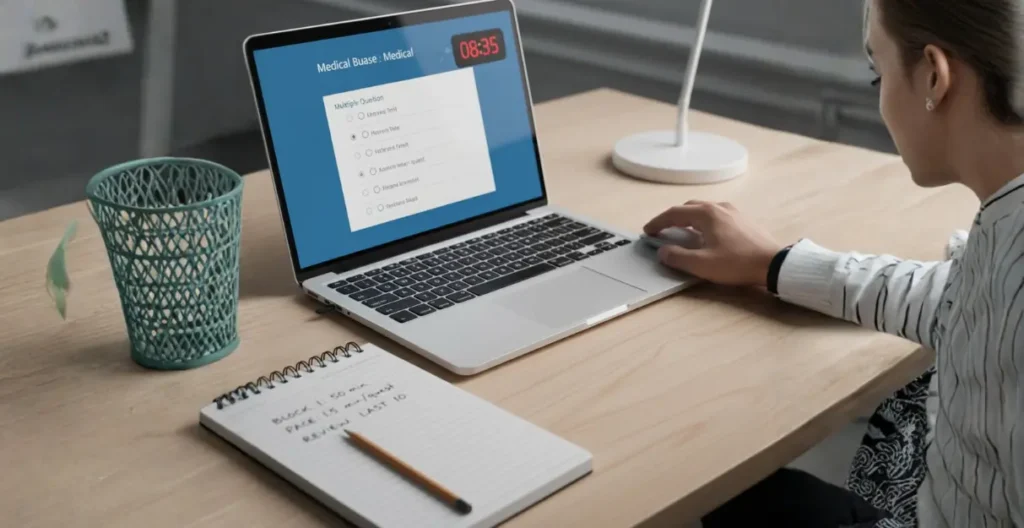
Pacing is everything. On USMLE Step 1 blocks, you have roughly 90 seconds per question. If you spend 5 minutes on a difficult genetics question, you compromise your ability to answer three easier questions later in the block.
Pro Tips for Test Day Success:
Conquering the USMLE Step 1 blocks requires stamina as much as intelligence. By understanding the format 7 blocks, 280 questions, 8 hours you remove the fear of the unknown. Start practicing with timed blocks early to train your brain for the endurance required on test day.
Ready to test your stamina? Sign up for a free practice test today.
The USMLE Step 1 exam consists of 7 blocks. Each block is 60 minutes long, and the entire exam session lasts 8 hours.
Yes, as of January 2022, Step 1 reporting changed from a three-digit numeric score to a reporting of Pass/Fail. This shifts the emphasis for residency programs onto Step 2 CK scores.
Yes. You have a minimum of 45 minutes of break time. If you finish a block early or skip the tutorial, that time is added to your total break time. You can take breaks between any of the blocks.
Content includes anatomy, behavioral sciences, biochemistry, microbiology, pathology, pharmacology, and physiology, as well as interdisciplinary areas like genetics, aging, and immunology.
Most US medical students take Step 1 at the end of their second year of medical school, after completing the basic sciences curriculum and before starting clerkships.