
Failing USMLE Step 1 does not end your medical career. It changes your timeline and raises the stakes on everything that comes next, but it does not close the door.
First-time pass rates for US MD students dropped from 95% before the pass/fail transition to 89% in 2024, meaning roughly 1 in every 10 MD students now fails Step 1. You are not an outlier. You are part of a growing cohort of students who need a clear recovery plan, not a pep talk.
According to the 2024 NRMP Program Director Survey, 77% of program directors considered failed attempts on either the USMLE Step exam when deciding whom to interview. That number matters. It means a failed attempt is visible, and it means the way you recover from it matters more than the failure itself.
This guide covers what officially happens after you fail USMLE Step 1, the exact retake rules, how your residency chances shift, and the specific steps that give you the best path forward.
Quick Answer: Failed USMLE Step 1 in 2026
- Pass rate: 89% for US MD students in 2024, down from 95% before pass/fail transition
- Retake wait: minimum 60 days before your next attempt
- Attempt limit: maximum 4 lifetime attempts, maximum 3 within any 12 months
- Score report: your failure is permanently visible on your transcript to all residency programs
- Residency impact: 77% of program directors factor in failed USMLE attempts when deciding on interviews
- Recovery lever: a strong Step 2 CK score is the primary tool to offset a failed Step 1
What Is the USMLE Step 1 Pass/Fail Percentage and Why Is It Getting Harder
USMLE Step 1 pass or fail rates have declined every year since the exam transitioned to pass/fail. About 95% of US and Canadian test-takers passed Step 1 until the scoring system changed in 2022.
The Numbers Every Failing Student Needs to See
| Year | US MD First-Time Pass Rate | US DO First-Time Pass Rate |
| 2021 (pre-pass/fail) | 95% | 94% |
| 2022 | 91% | 89% |
| 2023 | 90% | 86% |
| 2024 | 89% | 86% |
The reason for the declining pass rate is likely multifactorial. The threshold for passing increased on the previous three-digit scale; the cutoff was 194, and when the exam went pass/fail the passing cutoff increased to the equivalent of 196.
Following a December 2024 review, the USMLE Management Committee voted to maintain the current recommended Step 1 minimum passing standard. The bar is not coming down.
What Appears on Your Score Report When You Fail
When you fail USMLE Step 1, your score report shows performance broken down by discipline and organ system, specifically which areas fell below the passing threshold. This breakdown is your study map for the retake.
Residency programs have no way of knowing whether a passing score would have reflected a 196 or a 270, but they do know that a failing score reflects less than a 196. A failed attempt is included on the score transcript attached to every residency application.
The Fail Report Is Permanent but Not the Whole Story
The fail stays on your transcript permanently. What program directors also see is what came after it: your Step 2 CK score, your clinical evaluations, your letters of recommendation. A strong recovery tells a more compelling story than a clean record with a mediocre Step 2 CK.
IMPORTANT“The USMLE program limits Step 1 to a maximum of 4 lifetime attempts as of July 1, 2021. You may not take the same examination more than three times within 12 months. Your fourth attempt must be at least 12 months after your first attempt and at least six months after your most recent attempt. Every attempt counts, including incomplete ones.” |
What are the Official Rules for retaking after you fail USMLE Step 1
If you do not pass Step 1 on your first attempt, you must wait at least 60 days before retaking the exam. You cannot take Step 1 more than three times in 12 months.
Exact Eligibility Rules from the Official USMLE Bulletin
| Rule | Detail |
Minimum wait after failing | 60 days |
| Maximum attempts in 12 months | 3 |
| Lifetime maximum attempts | 4 |
| 4th attempt requirement | At least 12 months after 1st attempt and 6 months after the most recent attempt |
| Fee to reapply | Full registration fee required for each retake |
| State rules | Some states impose additional attempt limits; check FSMB for your state |
For full eligibility details, review the official USMLE Bulletin of Information before scheduling your retake.
Note: Do not rush back to the exam in 60 days unless your practice exam scores are consistently above the passing threshold. A second failure carries significantly more weight with residency programs than a first failure. Most students need 8 to 12 weeks of targeted preparation before they are genuinely ready to retest.
What Happens to Your Residency Chances After Failing USMLE Step 1
The Honest Data for US Medical Grads and IMGs
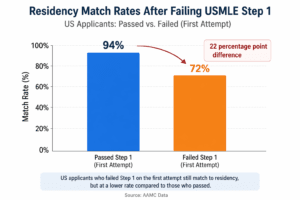
A failed USMLE Step 1 is not disqualifying, but it changes your match landscape in concrete ways. According to AAMC data, the USMLE Step 1 fail rate is 72%. Of US applicants who failed Step 1 on the first attempt went on to a residency, compared to 94% of applicants who passed on the first attempt.
For IMGs, the gap is wider. Failing either Step 1 or Step 2 CK once decreases an IMG’s absolute probability of matching by roughly 20 to 25%.
In 2024, the USMLE Step 1 fail report shows 30% of programs required applicants from MD-granting medical schools to meet a target Step 2 CK score to secure an interview. For IMGs, that figure was slightly higher at 36% of programs requiring a specific Step 2 score.
This is the key implication: Step 2 CK becomes the primary quantifiable signal on your application after a failed USMLE Step 1 attempt. Program directors cannot compare Step 1 performance numerically anymore, but they can compare Step 2 CK scores. Your Step 2 CK score is now the number that does the most work.
According to the AMA’s analysis of post-pass/fail residency trends, Step 2 CK scores are now the fourth most important factor program directors consider when evaluating applicants for interviews.
KEY TAKEAWAY“A failed USMLE Step 1 reduces your match probability but does not eliminate it. The students who recover most successfully treat Step 2 CK preparation as the strategic priority, not just a box to check after the retake.” |
How to Pass USMLE Step 1 After Failing: A Recovery Framework That Addresses the Real Reasons Students Fail
Most failed USMLE Step 1 attempts share one of three root causes: passive studying instead of active recall, not enough timed practice exam simulation, or ignoring the score report breakdown and repeating the same preparation.
Step 1: Analyse the fail report before opening a single resource:
Your score report identifies which organ systems and disciplines fell below the passing line. Study that document before making any decisions about resources or timeline. The report tells you specifically what failed, not generally that you studied the wrong things.
Step 2: Change the preparation method, not just the content:
Most students need 6 to 12 weeks before they are ready for a retake. Weeks 1 to 2: review your score breakdown and set goals. Weeks 3 to 6: deep-dive into weak content areas using focused materials. Weeks 7 to 8: ramp up question-bank practice and simulated tests. Final weeks: focus on clinical integration and exam-style pacing.
Step 3: Treat practice exam scores as your only reliable readiness signal:
NBMEs and UWorld self-assessments predict real performance more accurately than your subjective sense of preparation. Many candidates focus on a single strong NBME. What matters is consistency. For example: One NBME at 78%. Another at 59%. Another at 65%. This indicates knowledge gaps.
The exam doesn’t care about your highest score. It tests everything. A safer pattern is multiple passing assessments performed consistently over time. Do not schedule your retake until practice scores are consistently above the passing threshold, not once, consistently.
Step 4- Get expert diagnosis of what specifically went wrong:
Repeating the same preparation methods after a failure almost always produces the same result. Targeted tutoring identifies the reasoning errors and timing issues that self-study cannot see from the inside.
Students who failed USMLE Step 1 twice should follow a structured retake schedule to improve their passing probability significantly. Download the 8-Week USMLE Step 1 Recovery Plan Free PDF to follow a week-by-week strategy built specifically for students retaking Step 1.
PRACTICAL TIP“After reviewing your fail report, identify your three lowest-performing organ systems. Spend the first four weeks of your retake preparation exclusively on those three areas using UWorld in tutor mode, not timed. Once those weak areas reach passing performance in practice, switch to timed mixed blocks to rebuild stamina and integration.” |
For a step-by-step walkthrough of how to structure your full USMLE preparation after a setback, read the Dedicated Prep USMLE Step 2 CK strategy guide.
What Should IMGs Do Differently After Failing USMLE Step 1: The IMG-Specific Recovery Strategy
For IMGs, a failed USMLE Step 1 carries specific consequences that US grads do not face to the same degree. Since USMLE Step 1 transitioned to pass/fail in 2022, Step 2 CK scores have factored more heavily into residency admissions. In 2024, the average Step 2 CK score for non-US IMGs who matched into their preferred residency specialities was 245.
For a failed USMLE Step 1 IMG, the recovery strategy has three non-negotiable components.
- Step First: Pass the retake before applying to residency. An IMG with a failed Step 1 and no Step 2 CK score has almost no application to send. The retake is not optional.
- Step Second: Treat Step 2 CK as the primary competitive lever. A 250 or above on Step 2 CK signals to program directors that the Step 1 failure was a preparation problem, not a competence problem. For a complete breakdown of how to build the Step 2 CK score that offsets a failed attempt, visit the Dedicated Prep for USMLE Exam tutoring services and also residency services built specifically around IMG match strategy.
- Step Third: Build the rest of your application in parallel. Show growth. Show improvement. US clinical experience, strong letters of recommendation, and research activity become proportionally more important when your Step 1 transcript shows a failed attempt. Do not wait until after the retake to start building those.
Final Verdict: Recover Fail USMLE Step 1 in 2026
A failed USMLE Step 1 is a documented setback. It stays on your transcript, program directors see it, and it reduces your match probability, especially for IMGs.
It is also recoverable. One US allopathic school found that 92% of students who had failed the USMLE still matched. The students who recover are the ones who change their approach, not just their effort level.
The minimum wait for a retake is 60 days. Use that time to build a fundamentally different preparation strategy, not to repeat the one that already failed. Your Step 2 CK score is now the most important number on your application. Treat it accordingly.
If you want a structured retake plan built around your specific fail report and a preparation strategy that addresses the actual root cause, book a strategy session with Dedicated Prep and walk away with a plan designed for your specific situation.
FAQs about Pass/Fail USMLE Step 1
1. What is a 90% chance of passing Step 1?
Consistent NBME or UWorld self-assessment scores 10 to 15 points above the passing threshold, not a single high score but three consecutive practice exams showing stable above-passing performance, represent the strongest readiness signal before scheduling your USMLE Step 1 attempt.
2. How soon can you retake Step 1 after failing?
The official minimum wait is 60 days after you fail USMLE Step 1. You may attempt the same exam no more than three times within any 12 months, and your fourth lifetime attempt requires at least 12 months from your first attempt and 6 months from your most recent attempt.
3. What happens if I fail USMLE Step 1? Is 8 weeks enough to pass?
Eight weeks is enough time if used correctly: the first two weeks analysing your fail report, the middle four weeks targeting your weakest organ systems in tutor mode, and the final two weeks shifting to timed mixed-block practice and full NBMEs. Eight weeks of passive re-reading is not enough.
4. Is USMLE Step 1 the hardest test out of all?
Step 1 is widely considered the most content-dense exam in the series. The USMLE Step 1 change to pass-fail increased the minimum passing threshold from 194 to 196, and pass rates have declined every year since. Step 2 CK has higher first-attempt pass rates across all groups but carries more weight in residency applications.
5. Can I retake USMLE Step 1 if I fail?
Yes. You can retake USMLE Step 1 up to four times total over your lifetime. You may not take the same examination more than three times within 12 months, and your fourth attempt must be at least 12 months after your first attempt and at least six months after your most recent attempt. You must reapply and pay the full registration fee for each retake.