
As an International Medical Graduate (IMG), you are likely trying to understand which U.S. medical residency programs are truly receptive to applicants like you and how to organise your rank list to maximise your chances in the Main Residency Match.The residency match process is highly competitive, and historically, IMGs have a lower match rate than U.S. M.Ds. Without a clear strategy, many capable applicants go unmatched or end up in less ideal positions. Strategic planning backed by past NRMP data, speciality patterns, and rank list methodology increases your visibility to programs and enhances your chances of matching, especially in IMG-friendly tracks where match rates are higher than average.This guide walks you through identifying IMG-friendly medical residency programs, understanding match statistics, using data tools, and building a solid, strategic rank order list tailored to your credentials and goals.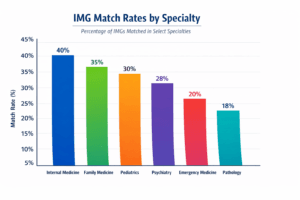
These states also mirror where community and university programs have historically matched IMGs more frequently, making them strategic geographic priorities for many candidates.
What Are Medical Residency Programs and Why “IMG-Friendly” Matters
A post-graduate physician training in a speciality that is accredited by the ACGME (American Council for Graduate Medical Education) is known as a medical residency program. These programs determine the process of becoming a graduate of medical school and becoming a specialist, providing a planned experience under control.- Why IMG-friendly matters:
- IMG match rates:
| As shown in the IMG Match Rates by Speciality graph above, certain specialities consistently demonstrate higher IMG integration. Applicants who align their rank list strategy with these historical trends while still ranking by preference can significantly improve match probability. |
IMG Match Data — By the Numbers
According to the American Medical Association (AMA), international medical graduates make up approximately 25% of the U.S. physician workforce. Understanding match statistics helps you build realistic expectations and tailor your rank list:- U.S. IMG match rate: ~67.8 % matched (PGY-1).
- Non-U.S. IMG match rate: ~58 % match rate (PGY-1).
- Overall match dynamics show that IMGs still face significant competition, but many succeed, especially in targeted specialities.
How to Conduct an Effective Residency Program Search
When performing your residency program search:✔ Use FREIDA and Residency Explorer ✔ Review program websites for IMG percentages ✔ Confirm visa sponsorship history ✔ Check current resident rosters ✔ Contact coordinators when necessaryA thorough residency program application strategy begins with filtering programs based on data, not assumptions.Strategic States and Types of Residency Programs for IMG Success
Some states consistently match more IMGs than others, based on historical residency data:| State (Highest IMG Matches) | Notes |
| New York | Over 1,700 matched IMGs in the 2025 cycle. |
| Florida | High IMG acceptance and program diversity. |
| Pennsylvania | Strong representation in primary care. |
| Michigan | Consistent IMG placements. |
| Texas | A large number of residency positions. |
| California | Broad program availability. |
How to Find IMG-Friendly Residency Programs
Identifying IMG-friendly medical residency programs takes research and the right toolset. Here’s how to do it:1. Use Program Search Tools
FREIDA & Residency Explorer™: AAMC’s databases allow program filtering by IMG percentages, visa sponsorship, and more, helping you quickly shortlist programs that historically match international graduates.2. Revise Visa Sponsorship Policies
Confirm that a program is a sponsor of J-1 or H-1B. Regular support programs that underwrite these visas tend to be more considerate of IMG applicants.3. Look at Program Data
Such sites as Residency Match AI or Residency Advisor summarise the IMG match data by speciality, rank the data by friendliness, and provide visa support that provides actionable intelligence.4. Consider Program Culture
Search Mentoring, academic support, and alumni success in supportive settings are likely to result in improved match and training outcomes.5. Factor in Observerships & USCE
There are programs where U.S. clinical experience (USCE) is valued, and thus, taking into account rotations that expose applicants can create a difference.Explore Dedicated Prep’s residency and match services for applicants targeting the best medical residency programs and maximise your chances of matching with confidence.Step-by-Step Guide: Building an IMG-Friendly Rank List
Your Rank Order List (ROL) is the core of your match strategy. The NRMP algorithm prioritises your preference order, but it works most effectively when your list is optimised based on data and personal goals. Here’s a proven step-by-step approach:Step 1 — Honest Self-Assessment
Evaluate your:- USMLE scores (Step 1, Step 2 CK)
- Clinical experience, especially USCE
- Research, publications, and leadership
- Letters of Recommendation
- Visa eligibility
Step 2 — Shortlist Programs Based on Match Data
To make a shortlist:- Focus on programs with documented IMG match histories.
- Ensure visa sponsorship policies align with your needs.
- Filter out programs that rarely match IMGs if they are not worth the effort.
Step 3 — Segment into Reach/Target/Safety Buckets
Define your categories:- Reach: Programs with high competition, but possible if your profile is strong.
- Target: Programs where your credentials align well with historical match data.
- Safety: Programs with higher past match rates for applicants like you.
Step 4 — Prioritise Based on Fit
Within each bucket, rank programs based on:- Specialty interest
- Location and lifestyle
- Training focus (academic vs. community)
- Research opportunities
- Faculty mentorship
Step 5 — Put Preference First
NRMP guidelines state: rank programs in order of preference, not perceived chance of matching. This ensures the algorithm has your true preferences first, improving outcomes when multiple programs are viable.For a complete breakdown of timelines, documents, and submission strategy, read our detailed ERAS application guide to avoid costly mistakes and apply with confidence.Common Rank Order List Mistakes IMGs Should Avoid
After the interview process, most of the applicants inadvertently narrow down their prospects of matching due to the common pitfalls of ranking. These pitfalls can be avoided to make your IMG-friendly rank list in line with the NRMP strategy and personal objectives.- Ranking Based on Fear of Not Matching: Some applicants rank the safest programs high as they believe that they have a chance of getting a match. This defeats your results since the algorithm is applicant-favouring; you should always rank based on a true preference and not based on anxiety.
- Leaving Interviewed Programs Off the List: Leaving programs you interviewed in implies you will not be able to match there, even in case the circumstances change. In case you would really attend the program, mark it; you are not losing any match opportunities in doing so.
- Reading Too Much into Post-Interview Hints: There are occasions when the applicants interpret ambiguous remarks (We would love to see you here) as an assurance. The real ranking feedback is not always disclosed in the residency programs, and therefore, do not allow your list order to be influenced by vague cues.
- Ranking Programs Based on Competitiveness Instead of Preference: Placing yourself in a higher-ranking program due to your perceived competitive position in that program negates the real purpose of your intentions. The algorithm of NRMP will first consider what you prefer; hence, list according to where you want to be, and not where you believe you will be matched.
- Not Including Enough Programs on Your List: By restricting your rank list to just a few medical residency programs, you cut down on the matchability of the algorithm. Wider lists allow the Match to have more options for finding a placement that suits your tastes, particularly important to IMGs.