
How you score on your USMLE can make or break your residency prospects. Yet, most students don’t truly understand how the USMLE scoring system works or what percentiles actually mean. Another important thing students miss is understanding how the recent USMLE changes impact their path to residency.
Whether you are prepping for Step 1, Step 2 CK, or Step 3, this guide breaks down everything you need to know, backed by data from official USMLE score interpretation sources, and gives you practical strategies you can implement right away.
To maximize your chances of scoring well on the USMLE, here are 3 things you need to know:
- How scoring differs across Step 1, Step 2 CK, and Step 3
- How to build a repeatable performance system
- How the USMLE scoring system works
Let’s break this down properly.
What Is the USMLE Scoring System
The United States Medical Licensing Examination (USMLE) scores are on a scaled system rather than based on the percentage of correct answers.
According to official USMLE documentation, the pass outcomes are given based on the proficiency standards established before the exam and reviewed regularly. There is no specified raw percentage to pass; to pass the exam, you have to answer an average of 60% of the questions correctly across any Steps with scored questions.
Step-Specific Breakdown of USMLE Scoring
The USMLE Score Interpretation Guidelines provide official percentile data, for example, showing that a Step 2 CK score of 240 corresponds to approximately the 24th percentile among first-time U.S. and Canadian test takers.
USMLE Step 1 Scoring System
Current:
- Pass/Fail only
- No 3-digit reporting
However:
- Internally scaled
- The passing threshold was maintained statistically
The USMLE Step 1 scoring system still exists mathematically; you just don’t see the number.
USMLE Step 2 Scoring
This is now the primary numeric metric.
Key Features:
- 3-digit score
- Pass/Fail outcome
- Scaled range typically 1–300
- Passing standard: 218 (current)
USMLE Scoring Percentile
Percentiles compare you to:
- First-time LCME-accredited U.S./Canadian test takers
Important:
A 240 does not mean 80% correct.
It means you performed at a specific percentile relative to peers.
USMLE Step 3 Scoring System
The USMLE Step 3 scoring system includes:
- 3-digit score
- Passing standard: 200
- Two-day format
USMLE Step 3 CCS Scoring
Step 3 includes CCS (Computer-Based Case Simulation).
Scoring components:
- Diagnostic efficiency
- Timely interventions
- Avoidance of harmful actions
- Appropriate follow-up
Many students underestimate the importance of the USMLE Step 3 CCS, but poor CCS performance can lead to failure even with strong MCQ performance.
Understanding the USMLE Scoring System: Before You Try to Improve It
Before discussing strategy, you must understand the structure.
The USMLE Scoring System Explained
The USMLE scoring system is scaled, not percentage-based.
That means:
- Your raw percent correct is converted
- Scores are equated across forms
- Statistical adjustments maintain comparability
This prevents easier forms from inflating results.
Scaled Score vs Percent Correct
Many students ask:
What percent correct is a 240 on Step 2 USMLE?
There is no fixed percent.
Typically, around 60% correct may pass, but higher scores depend on difficulty and scaling. A 240 is not tied to a universal percent.
That’s because USMLE scoring uses psychometric equating.
Old USMLE Scoring vs the New USMLE Scoring System
Understanding the history of USMLE scoring changes provides context.
Old USMLE Scoring
- Step 1 had 3-digit scoring
- Passing standard historically 196
- Heavily weighted in residency screening
USMLE Pass-Fail Scoring (Step 1)
As part of major USMLE changes in scoring, Step 1 became pass/fail.
This shifted weight toward:
- USMLE Step 2 scoring
- Clinical performance
- Research
- Letters
This is why Step 2 CK now carries more strategic importance.
USMLE Scoring Percentiles and What They Mean
Unlike simple pass/fail markers, percentiles tell you how you performed relative to other examinees.
Percentiles help you visualize where you stand:
- Top performers often land above higher percentile thresholds
- A higher percentile often correlates with stronger residency competitiveness
For a deeper breakdown of how USMLE scoring impacts your preparation and residency goals, check out the USMLE scoring guide.
MCAT Scoring vs USMLE Scoring: A Quick Comparison
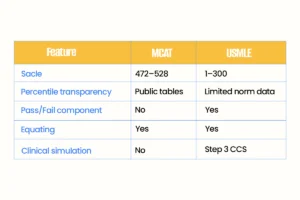
USMLE scoring is more clinically integrated and psychometrically equated for licensure, not admissions.
How to Maximize Your USMLE Scoring: Top 10 Proven Strategies to Ace Your Exams
Improving your USMLE score isn’t about rote memorization; it’s about building a systematic approach that integrates knowledge, strategy, and self-assessment. Here’s how top performers approach this:
1. Understand the Scoring Mechanism Before You Study
Do not chase raw percentages! Focus on how the exam is measured. Before diving into content, understand how the USMLE scoring works, including scaling, equating, and percentiles. This foundational understanding allows you to adjust your strategy rather than chase arbitrary numbers.
2. Focus on Percentile Growth, Not Just Raw Score Increases
Since tiny raw score changes (e.g., a few points on Step 2 CK) may not correspond to meaningful percentile shifts, aim for percentile improvement. This helps you target meaningful growth instead of stressing over minor numerical differences.
3. Build a Review-First Question Strategy
Doing more questions isn’t enough. The most effective performers use a review-first approach:
- Complete questions systematically
- Deeply review explanations
- Extract decision logic and common patterns
Use questions as a primary learning tool, not just practice sets!
4. Target Weak Systems with Structured Drills
Once practice exam data gives you weak systems (e.g., cardiology or ethics), create mini-modules that only focus on improving those areas. Targeting your weaknesses over time helps you build proficiency in time for your exam.
5. Apply Clinical Reasoning Early
For Steps 2 CK and 3, clinical reasoning determines how you apply knowledge. Practice case scenarios, simulate clinical decisions, and focus on diagnostic logic, not just content recall. By avoiding rote memorization and instead truly applying clinical context during the learning phase, you can set yourself up for success for the real deal.
6. Practice Time Management Skills
These exams are as much about managing pressure under time as they are about knowing how to apply your knowledge! Simulate timed blocks so pacing becomes second nature rather than a stress factor on exam day.
7. Master the CCS Format for Step 3
Computer-based case simulation scoring is unique to Step 3. Practice CCS regularly; test makers weigh elements like time management and sequencing of actions. Familiarity will equip you with the confidence you need to tackle your exam.
8. Develop a Smart NBME Practice Plan
NBME self-assessments help benchmark your performance. If you are consistently above realistic targets on NBME forms, your core knowledge and exam approach are on track. Use NBMEs as learning checkpoints, not just score predictors.
9. Build Stamina and Psychological Readiness
It is very important to build stamina with full blocks, practice stress-management techniques, and manage sleep and nutrition leading up to test day.
10. Integrate Strategy with Personalized Support
For many students, especially those who see scores stagnate, expert guidance drastically accelerates progress. Personalized tutoring allows you to interpret scoring trends, identify gaps, and tailor study plans that translate into real score improvements.
If you want targeted coaching around strategy and score maximization, explore DedicatedPrep’s USMLE tutoring services, where expert mentors guide you through scoring logic, exam strategy, and personalized improvement planning.
Practical Scoring Insights You Shouldn’t Ignore: Students Checklist
- You Need Around 60% Correct to Pass: USMLE official guidance notes that while correct percentages required to pass vary from form to form, examinees typically need to get approximately 60% right to pass. DO NOT aim for exactly 60% on practice! Aim higher to build a buffer.
- Scores Are Scaled, Not Straight Percentages: A score of 240 on Step 2 CK isn’t 80% correct; it’s a scaled result showing you performed better than 24% of your peer cohort (per official norms). Percentiles matter more than raw percentages.
- Official Score Reports Expire from Portals: Your score report remains in the secure portal for about 365 days, after which it can only be obtained via official transcript requests (and fees may apply). Keep copies early.
Conclusion: Your USMLE Scoring Success Starts with Strategy, Not Stress
Only knowing USMLE scoring is not merely knowing the number; it is knowing how to read it, its relation to your performance, and how that information can help you become even better. A solid scoring plan based on official interpretation and intelligent preparation would put you in control of your performance on any USMLE exam.
Always Remember: Getting the most out of USMLE scoring does not mean learning more. It is about:
- Understanding the USMLE scoring system
- Adapting to the USMLE’s new scoring system realities
- Targeting percentile movement
- Building a repeatable improvement loop
Students who treat scoring as a system outperform those who chase arbitrary numbers.
Ready to Turn Strategy into Higher Scores?
Personalized guidance can make all the difference. At DedicatedPrep, we help students like you translate USMLE scoring logic into a targeted action plan, identify your real gaps, and build a study system that improves performance week by week, not just hour by hour.
FAQs
How does scoring work for the USMLE?
USMLE scoring converts your raw correct answers into a scaled score so performance is comparable across different exam forms. Raw correct → Scaled score → Percentile → Performance interpretation.
Where should I be scoring on UWorld USMLE?
UWorld percentages are not directly proportional to the USMLE scores. Rather than a set percentage, aim for trend improvement and control of poor systems.
What score do I need to pass the USMLE?
- Step 1: Pass/Fail
- Step 2 CK: 218
- Step 3: 200
Always verify official announcements for updates.
Where can I find my USMLE score report?
Log in to the NBME/MyUSMLE portal or the FSMB portal, depending on your registration path. Reports are typically available for about one year beforea transcript request is required.