
If you are considering pursuing a medical residency in the United States, you need to know how exactly the medical residency match process works. Additionally, understanding how the USMLE exams fit into the residency match process is essential, especially for USMLE matching and residency outcomes.
After years of classroom learning and licensing exams, medical graduates step into real patient care, where they refine clinical judgment, build procedural skills, and begin the transition from student to independent physician. Yet despite its importance, many aspiring doctors are unclear about what medical residency actually is, how long it lasts, and how USMLE scores, NRMP Match, and specialty choice all factor in.
In this guide, we break down everything, with information and advice backed by current data. We cover everything, including the residency timeline, average resident salaries, the USMLE, and the residency match process, key requirements for international medical graduates (IMGs), and strategies to increase your chances of matching into competitive programs.
What is a Medical Residency Program
Medical residency refers to a stage of practical training that physicians undertake upon completion of medical school. Throughout the residency period, you train in hospitals or clinics and are supervised by senior physicians to develop clinical competency in your chosen specialty and to transform into a fully independent physician.
How Long Is Medical Residency: Duration by Specialty
The timing of medical residency is based on your chosen specialty, usually 3 to 7 years or even more in higher specialized fields.
| Specialty | Typical Residency Duration |
| Family Medicine | 3 years |
| Internal Medicine | 3 years |
| Pediatrics | 3 years |
| Emergency Medicine | 3–4 years |
| Psychiatry | 4 years |
| Obstetrics/Gynecology | 4 years |
| Anesthesiology | 4 years |
| General Surgery | 5 years |
| Orthopedics | 5 years |
| Urology | 5 years |
| Plastic Surgery | 6 years |
| Neurosurgery | 7 years |
Most specialties begin training at the Postgraduate Year 1 (PGY‑1) level and advance yearly. Some residents choose to pursue fellowship training after residency, which adds 1–3 years of subspecialty training.
Medical Residency Training: What Residents Do Each Day
Life as a medical resident is intense, hands‑on, and full of variety. Residents may:
- Conduct patient histories and physical exams
- Order, interpret, and manage lab tests and imaging
- Discuss diagnosis and treatment with patients and families
- Participate in rounds with attending and medical teams
- Perform procedures (depending on specialty)
- Attend educational conferences and case discussions
The majority of the residency programs require up to 80 working hours a week, and the daily shifts may have 10-12 hours.
Residency Match USMLE: How the Medical Residency Process Works
In order to gain a medical residency, the majority of U.S. physicians and IMGs attend the National Resident Matching Program (NRMP), the usual abbreviation being the Match. The Match pairs applicants to residency programs according to preferences made by both programs and applicants.
Important steps include:
- Register with ERAS (Electronic Residency Application Service).
- Submit your application, letters of recommendation, personal statement, and CV through ERAS.
- Register with the NRMP to participate in Match Week.
- Attend interviews with residency programs.
- Rank programs by preference; programs rank applicants.
- The matching algorithm determines placements.
- Results are announced on Match Day.
For International Medical Graduates (IMGs), the Educational Commission for Foreign Medical Graduates (ECFMG) must certify your qualifications before you can participate in the match process. Explore expert guidance and personalized support with Dedicated Prep’s resident medical consultancy and mentorship services designed to help you cross every milestone with confidence.
USMLE and Residency Match: What You Need to Know
The USMLE score and residency match are closely linked. Competitive specialties often have score expectations, especially for USMLE Step 1 and Step 2 CK performance, that influence interview opportunities and match success. Higher scores may improve your competitiveness, though programs also value clinical experience, letters of recommendation, and personal attributes. The NRMP’s match data shows USMLE scores hold high importance, though holistic review practices are emerging in many programs.
USMLE Eligibility and Match Participation
To be eligible to receive a U.S. residency match under the National Resident Matching Program (NRMP), most applicants require:
- Medical degree in an accredited school: It has to be either a U.S. MD/DO or an international medical graduate (IMGs) certified by ECFMG.
- Attempts at USMLE Step 1 and Step 2 CK: Step 1 is a pass/fail exam, but both Step 1 and Step 2 CK have to be passed before commencing any residency in the majority of programs.
- US clinical experience (USCE): IMGs must be able to demonstrate their knowledge of the U.S. healthcare systems, as well as their willingness to work in that environment.
- ECFMG certification (IMGs): IMGs are required to have their certificate issued by the Educational Commission of Foreign Medical Graduates to participate in the match.
Also taken into account are clinical experience, Letters of Recommendation (LORs), and personal statements, with programs becoming more and more focused on a holistic overview of the applicants, in addition to USMLE results.
How Programs Use USMLE Scores
Residency programs often classify USMLE Step 1 and residency matching USMLE scores into screening tiers rather than strict cutoffs:
- High‑score tier (e.g., >250)– Often reviewed more carefully for interviews and interview slots in competitive specialties.
- Mid‑range scores (e.g., 230–249)– Generally considered competitive for many core specialties.
- Lower scores– May still match successfully, especially in primary care or less competitive programs, particularly when paired with strong clinical evaluations and personal strengths.
Althoughprograms don’t publicly declare exact targets, applicants can find approximate score expectations through NRMP data, USMLE residency match forums, alumni networks, and interview feedback. also you can read our guide on residency personal sattement to maximize the results.
The Important Components of Medical Residency: Quick Checklist
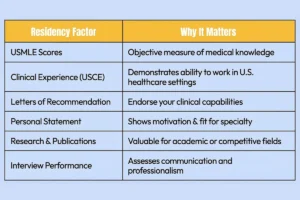
Residency program directors assess applicants holistically. Other influential components include:
✔ Clinical assessment and clerkship scores– These are especially relevant in specialties in which performance in rotations is valued.
✔ Letters of Recommendation- Difficult to counterfeit, specialty-specific letters by clinical supervisors can make or break the interview opportunities. Letters by US Physicians help illustrate how well the applicant fits into the US healthcare system.
✔ Personal Statement– An opportunity to discuss the motivations and illustrate professionalism, along with the specific experiences that explain why you chose the specialty.
✔ IMGs Clinical Experience in the United States– Adapts to the norms of the U.S. healthcare and can increase credibility in the application.
✔ Research and Scholarly Activity– Particularly applies to such specialties as dermatology, radiology, or academic paths.
An application can be enhanced by higher scores in the USMLE, but other weaknesses can seldom be covered by it. On the other hand, compelling personal qualities and good clinical experience can occasionally be used to counter low scores.
Medical Residency: What Programs Medical Students Typically Look For
Factors to consider that Affect Medical Residency Program
Several elements influence how likely you are to match into your desired residency:
- Specialty competitiveness (e.g., dermatology vs family medicine)
- IMG vs U.S. graduate status
- US clinical experience
- Strength of your application materials
- Number of programs applied to
IMG applicants may need to be strategic with program selection and maximize US clinical exposure and recommendation letters for better match outcomes.
Strategic Insight:
A good match strategy cannot be constructed with a single factor. The USMLE scores, specialty choice, clinical experience, recommendation letters, and personal storytelling, as well as application planning, all collaborate with each other. A holistic review is incorporated into considering an applicant for a program, looking beyond test scores. However, objective measures such as Step 2 CK can still serve as an initial screening mechanism to help get your foot in the door.
Practical Tips to Maximize Your Medical Residency Match Odds
- Start early with USMLE preparation to achieve competitive scores.
- Complete clinical electives in the U.S. if possible.
- Request strong letters of recommendation from clinical supervisors.
- Craft a personal statement that explains your journey and aspirations.
- Apply broadly, especially as an IMG, to increase interview opportunities
- Prepare thoroughly for residency interviews.
How Much Does a Medical Resident Make
While USMLE residencies are training programs, residents do earn a salary, though it’s modest compared to that of fully licensed physicians. Residents are paid stipends to cover basic living expenses while they train. Here’s a snapshot:
- Average PGY‑1 (first year) salary: ~$63,000‑$66,000/year
- Salaries rise incrementally with each year of training
- Salary range varies by institution, cost of living, and specialty
For example, some USMLE residency match programs may offer small housing allowances or meal stipends, but overall, resident salaries reflect their trainee status rather than full physician pay.
Conclusion: Navigating Your Medical Residency Journey Successfully
Medical residency is a life-changing phase, where knowledge acquired in classrooms is converted to patient care and clinical skills. Although the path between the USMLE exams and the residency match is challenging, it is possible to plan your course of action with the help of learning about the process, timing, and expectations, and be sure you can succeed. Residency training is not only a way to develop professionally, but also personally, as you develop to become a qualified physician who can make a difference in people’s lives.
Whether you are eager to become an MD, a DO, or a foreign medical graduate, this guide provides you with the roadmap on how to manage your residency. You can start early, plan, and use all the available learning resources that your future patients will appreciate.
Ready to strengthen your preparation and boost your residency match success? Visit our website Dedicated prep today, and book your free consultation call.
FAQs
How long does medical residency usually take?
The majority of medical residency programs take 3 to 7 years, depending on the choice of specialty.
What is an average medical resident salary?
The salary of the medical residents in the U.S. averages between 60,000 and 75,000 USD a year, with a slight rise in salaries after every postgraduate year.
What is residency in medical school?
Supervised clinical training occurs after completing medical school and is known as matching for USMLE residency, whereby you are taught how to practice medicine in your specialty of choice.
How do USMLE scores affect residency match?
Step 1 and Step 2 CK scores in the USMLE are still a significant objective point of many programs and may affect invitations to interview and match.
Can I change my name as a medical resident after marriage?
Yes, a medical resident’s name change after marriage is possible with residency programs, Match services, and licensing boards: make sure all the institutions (ERAS, ECFMG, NRMP) are informed of the corrected documentation.