
Taking your NBME Self-Assessments can be intimidating. Students often encounter a lot of anxiety leading up to self-assessments since these exams don’t only as a learning tool, but also as a predictor of how you will likely perform on test day.
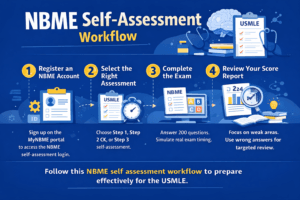
So, how can you take an NBME self-assessment? Students need to create an account through the NBME self-assessment login portal (MyNBME), choose the appropriate exam form for Step 1 or NBME self-assessment Step 2 CK, complete the exam under timed conditions, and review the score report to identify weak subjects and improve their study strategy.
Most NBME self-assessments contain 200 multiple-choice questions divided into four blocks of 50 questions, designed to simulate the real USMLE testing environment.
Students typically use these exams to:
- Measure readiness for the USMLE
- Identify weak topics
- Practice NBME-style clinical reasoning
- Track score progress over time
The reason these assessments are so valuable is that they provide predictive insight into exam readiness. NBME self-assessments contain multiple-choice questions that mirror real USMLE content and provide detailed feedback about strengths and weaknesses.
In this guide, you will learn:
- What the NBME self-assessments are and how they work
- How to take the NBME self-assessment step by step
- How to interpret the score report
- How to review your exam for maximum learning
What Is an NBME Self-Assessment
The NBME self-assessment refers to practice exams developed by the National Board of Medical Examiners to help students evaluate their readiness for the USMLE.
These exams simulate the structure and difficulty of the real licensing exam and help students:
- Assess readiness for the USMLE
- Identify strengths and weaknesses
- Practice answering NBME-style questions
- estimate potential exam performance
For example:
- Comprehensive Basic Science Self-Assessment → Step 1 preparation
- Comprehensive Clinical Science Self-Assessment → Step 2 CK preparation
- Comprehensive Clinical Medicine Self-Assessment → Step 3 preparation
Each exam typically contains 200 multiple-choice questions divided into four blocks of 50 questions, closely mirroring the real exam format.
This makes the NBME self-assessment for Step 2 CK and Step 1 among the most widely used practice tools for USMLE preparation.
Why NBME Self-Assessments Are Important for USMLE Preparation
Preparing for the USMLE requires more than just reading textbooks or completing question banks. NBME Self Assessments are often the final tool for students to evaluate whether their knowledge and test-taking skills are strong enough for the real exam.
Students rely on NBME self-assessments because they provide realistic exam conditions and predictive score data.
Key benefits include:
- Predicting USMLE Readiness: NBME assessments provide estimated exam readiness and diagnostic score reports that highlight knowledge gaps.
- Identifying Weak Topics: The score report breaks down performance by content area, allowing students to focus on weak subjects.
- Practicing Real Exam Conditions: Standard-paced exams simulate the same time pressure students experience on test day.
- Reinforcing Learning: Each assessment includes answer explanations that allow students to review concepts and strengthen knowledge.
Because of these advantages, many students take multiple NBME practice exams during their study period. Our mentors provide an expert USMLE preparation tutoring team to help students improve their NBME scores and exam strategy.
NBME Self-Assessments for Step 1, Step 2 CK, and Step 3
The NBME self-assessments are designed for different USMLE exams. Each self-assessment corresponds to the content and difficulty of a specific step exam.
The three major types include:
- Step 1 NBME self-assessment
- Step 2 CK NBME self-assessment
- Step 3 NBME self-assessment
Each exam focuses on different medical knowledge and clinical reasoning skills.
NBME Self Assessment for Step 1
The NBME self-assessment for Step 1 is called the Comprehensive Basic Science Self-Assessment (CBSSA).
This exam focuses on foundational medical sciences such as:
- physiology
- pathology
- pharmacology
- microbiology
- biochemistry
The CBSSA helps students evaluate readiness for the Step 1 exam and even provides an estimated probability of passing if the real exam is taken within a week.
Key Features
- Designed for basic science knowledge
- Approximately 200 questions
- 4 blocks of 50 questions
- Provides score reports and diagnostic feedback
Students typically take multiple CBSSA forms during preparation to track improvement in their NBME practice exams.
NBME Self Assessment for Step 2 CK
The NBME self-assessment step 2 CK is known as the Comprehensive Clinical Science Self-Assessment (CCSSA).
Unlike Step 1 assessments, this exam focuses on clinical knowledge and patient management.
Topics include:
- internal medicine
- surgery
- pediatrics
- obstetrics and gynecology
- psychiatry
The CCSSA helps students evaluate readiness for USMLE Step 2 CK and provides diagnostic feedback highlighting strengths and weaknesses in clinical reasoning.
Key Features
- Focus on clinical decision making
- About 200 multiple-choice questions
- 4 timed blocks
- Score report comparable to the Step 2 CK scale
Many students use the NBME self-assessment Step 2 forms to predict their Step 2 exam performance.
NBME Self Assessment for Step 3
The NBME self-assessment for Step 3 is called the Comprehensive Clinical Medicine Self-Assessment (CCMSA).
This assessment focuses on advanced clinical reasoning and patient management in real clinical scenarios.
Topics often include:
- diagnosis and treatment planning
- patient management decisions
- clinical guidelines and protocols
The CCMSA helps students evaluate readiness for USMLE Step 3 and provides diagnostic feedback to guide final exam preparation.
Key Features
- Designed for advanced clinical decision-making
- Multiple-choice questions based on real patient encounters
- Diagnostic score reports showing strengths and weaknesses
Each form contains approximately 200 questions and can be taken in standard-paced or self-paced format.
NBME Self-Assessments by Exam
| Exam | NBME Assessment Name | Focus | Questions |
| Step 1 | Comprehensive Basic Science Self-Assessment | Basic sciences | ~200 |
| Step 2 CK | Comprehensive Clinical Science Self-Assessment | Clinical knowledge | ~200 |
| Step 3 | Comprehensive Clinical Medicine Self-Assessment | Patient management | ~200 |
These NBME self-assessments help students determine whether they are ready for their exam and identify areas that need additional study.
Best NBME Self-Assessment Strategy for USMLE Preparation
Many successful students follow a structured plan when using my NBME self assessment results.
Example strategy:
Week 1 → baseline assessment
Week 4 → second NBME exam
Week 6 → third assessment
Week 8 → final readiness check.
Often, students struggle with the idea of ‘wasting’ an NBME Self assessment on baseline assessment, but this is essential to identify if your study patterns are effective in improving your score over time. Many students convert repeated NBME mistakes into flashcards using the strategy explained in our complete guide to Anki for USMLE.
How to Take NBME Self Assessment: Step-by-Step Guide
Understanding how to take the NBME self-assessment correctly is essential for maximizing its value.
Step 1: Create an NBME Account
Visit the NBME website and register through the NBME self-assessment login portal. This portal is called the MyNBME Examinee Portal, where all assessments are purchased and accessed.
Step 2: Choose the Correct Assessment
Depending on your exam, select NBME login self-assessment:
- Step 1 → Basic Science Self-Assessment
- Step 2 CK → Clinical Science Self-Assessment
- Step 3 → Clinical Medicine Self-Assessment
Students preparing for Step 2 often search for NBME self-assessment Step 2 CK forms.
Step 3: Choose Exam Format
NBME exams offer two formats:
Standard paced
- Simulates real exam timing
- Each block is timed at 75 minutes
Self paced
- allows extended time for each question
- helpful for learning and review.
Step 4: Complete the Exam
The exam contains:
- 4 blocks
- 50 questions per block
- 200 total questions
This format closely resembles the real USMLE exam.
Step 5: Review Your Score Report
After completing the exam, NBME provides:
- percent correct score
- content area breakdown
- explanations for questions
This diagnostic feedback helps guide further study.
NBME Self Assessment Overview
| Feature | Details |
| Total questions | 200 questions |
| Blocks | 4 blocks |
| Questions per block | 50 |
| Standard pace | 1 hour 15 minutes per block |
| Purpose | Evaluate USMLE readiness |
| Access | MyNBME Examinee Portal |
These features make the NBME self-assessments one of the most reliable indicators of USMLE readiness.
How to Review NBME Self Assessment: Quick Overview
Taking the exam is only half the process. The real learning happens during the NBME review. Here is an effective review process.
Step 1: Identify Incorrect Questions
Start by reviewing questions you answered incorrectly.
Ask yourself:
- What concept was tested?
- Why did I miss this question?
Step 2: Identify the Mistake Type
Common mistake categories include:
- knowledge gap
- reasoning error
- misreading the question
Understanding the reason behind the error helps prevent repeating the same mistake. Identifying knowledge gaps is important to guide your study plan leading up to your exam. Sometimes, the error isn’t due to a lack of knowledge but due to an error in reasoning, which can cost you valuable points on exam day.
Step 3: Review the Concept
Use trusted resources such as:
- USMLE Qbanks
- Amboss/ Uworld library
- Recommended video lectures or podcasts
- NBME review books
Focus on understanding the underlying concept.
Step 4: Reinforce the Concept
Convert repeated mistakes into learning tools, such as:
- flashcards
- practice questions
- concept notes
This reinforces long-term memory. After finishing the exam, follow a structured process for reviewing NBME mistakes effectively so that each incorrect answer becomes a learning opportunity.
Common Queries of Students regarding NBME Self-assessment Explained
How Students Typically Use NBME Self-Assessments
Most students take multiple NBME self-assessments throughout their preparation.
Typical strategy:
- Baseline assessment – early in the study period
- Mid-study checkpoint – measure improvement
- Final readiness exam – confirm readiness before test day
This approach allows students to track progress and refine their study strategy based on performance trends.
How Long Are NBME Self-Assessments
. In the standard-paced format:
- each block = 75 minutes
- total testing time ≈ 5 hours
Self-paced versions allow significantly more time per block. The structure is designed to mimic the real exam environment, so students become comfortable with USMLE pacing. How Many Questions on NBME Self Assessment
Most NBME self-assessments contain:
- 200 questions total
- 4 blocks
- 50 questions per block
It is important to note that NBME Self Assessments have 50 questions per block with each block lasting 75 minutes, but on the actual exam, each block has 38-40 questions with each block lasting 60 minutes. Even though the NBME Self Assessments are slightly shorter overall than the real USMLE, they still provide a strong measure of readiness.
Free NBME Self Assessment Options
Students frequently search for free NBME self-assessment Step 1 and Step 2 exams. While most official NBME forms require purchase, students sometimes access free resources such as:
- Free 120 practice questions from the USMLE
- Promotional self-assessments offered by question banks
- Sample questions from NBME self-assessment answers
These resources can help students familiarize themselves with exam style before taking full assessments.
Common Mistakes Students Make With NBME Self-Assessments
NBME self-assessments are not always used as effective diagnostic tools in the USMLE preparation because even the motivated students do not use them properly. This is why it’s so important to use the NBME Self Assessment properly to use it effectively, since every exam brings valuable feedback and contributes to the improvement of your studying plan.
1. Premature Taking of NBME Self-Assessments
Other students complete a self-test of NBME before reading most of the content of the exams. This may result in demoralizing scores that fail to depict preparedness.
Rather, one should start with a basic level of knowledge base and then rely on NBME exams to assess progress and the areas of weakness.
2. Disregarding Score Report Feedback
Having completed an NBME exam, most students do not even look at their score reports and instead fixate on their score. Nevertheless, the score report includes meaningful information about the performance by subject area.
A close examination of this feedback will guide you to recognize aspects of the system that are weak and tailor the plan of your study to better suit.
3. Passing Over Review of Incorrect Questions
Missing the opportunity to check wrong answers in detail is one of the most serious mistakes. The actual learning occurs when you know how you have failed to answer a question.
The incorrect answers can be analyzed to identify the knowledge gaps and errors of reasoning that can be corrected before the actual test.
4. Relying on a Single NBME Exam
Other students believe that a single NBME self-assessment would be sufficient to determine their final score. The performance may, however, be different with the form of examination and level of preparation.
The majority of students have the advantage of taking several NBME exams within their study time to keep track of progress and guarantee steady improvement.
5. Taking NBME Exams as Practice rather than Diagnostic
Another frequent error occurs when one uses them to practice questions without analysis of the outcomes. These exams are not meant to be more questions but to test preparedness.
As diagnostic tools, they enable the students to know their weak points and how to study better. Research highlights that practice tests are useful since they assist in identifying the areas of weakness and influence preparation changes.
Conclusion: Using NBME Self-Assessments to Improve Your USMLE Score
One of the most effective techniques for raising the performance of the USMLE is to understand the correct way to take the NBME self-assessment. The exams offer close-to-real conditions of practice and benefit the students with diagnosis information that can guide students in their area of weaknesses as well as to improve their study plan.
When used properly, NBME self-assessments allow you to:
- measure readiness
- track progress over time
- strengthen weak subject areas
- build confidence before the real exam.
If you want personalized guidance on NBME self-assessments, study planning, and USMLE preparation strategies, explore our website, Dedicated Prep. Our High Score mentors help students analyze their assessments, identify weaknesses, and develop targeted study plans that lead to higher USMLE scores.
FAQs
Can you review NBME self-assessments after finishing them?
Yes. After completing an assessment, NBME provides a score report and explanations that allow you to review questions and analyze your performance.
Should I review NBME the same day?
Ideally yes. Reviewing the exam within 24 hours helps reinforce concepts while the questions are still fresh. Most questions are still fresh in your mind, allowing you to save time on reviewing without having to thoroughly reread the questions.
Can you retake the NBME self-assessments?
Students often ask this question, but it is generally not recommended. Once you have taken a specific form, you may remember questions and artificially inflate your score. Instead, students typically take different NBME forms to track progress. However, if you have run out of practice tests close to your exam, it may be useful to retake a practice exam to simulate exam conditions and review concepts without relying on the score to predict your score.
How much time does it take for NBME self-assessments?
Most assessments take about 5 hours in standard-paced mode, with four blocks of 50 questions each.
Are NBME self-assessments accurate predictors?
Yes. Many students use these assessments to estimate their readiness for the USMLE because they closely resemble the exam format.