
Shelf exams are 110-question NBME assessments taken at the end of each core clinical clerkship, completed in 2 hours and 45 minutes, scored as an Equated Percent Correct (EPC) that converts to a national percentile. Most schools require the 5th percentile to pass and the 70th to 80th percentile for honors. Shelf exam tutoring matches you with a tutor who has scored in the top percentile on that specific shelf, builds a rotation-length study plan around your clinical schedule, and drills the question interpretation patterns the NBME rewards most.
Here is what most tutoring providers do not tell you: the shelf is not just a knowledge test. It rewards a specific kind of clinical reasoning under time pressure, at 1.5 minutes per question, across 110 vignettes designed to expose exactly the gaps your rotation may not have covered in depth.
This guide breaks down everything: what shelf exams actually test, how scoring and percentiles work, which rotations hit hardest, how UWorld fits in, and what a tutor actually does that self-study cannot replicate.
Quick Summary: Shelf Exam Tutoring
| What are shelf exams? | 110-question NBME subject exams, 2 hr 45 min, taken at the end of each core clerkship |
| How are they scored? | Equated Percent Correct (EPC) converted to national percentile, not a raw percentage |
| Passing score? | 5th percentile at most schools; honors typically requires 70th to 80th percentile |
| Hardest shelves? | Internal medicine and surgery broadest content and the tightest percentile distributions |
| How does tutoring help? | Rotation-specific study plan, NBME question strategy, and weekly score tracking |
| Best resource? | UWorld Step 2 CK QBank paired with NBME subject-specific practice exams |
| Step 2CK Exam relevance? | Shelf performance predicts Step 2 CK score, medicine, and surgery, covering up to 90% combined |
What Is Shelf Exam Tutoring and Who Actually Needs It
Most students figure they can self-study their way through shelves. Many can pass. But a pass is not why you want a tutor.
Honors on a shelf exam is roughly in the 70th to 80th percentile nationally, depending on your school’s cutoffs. The surgery shelf exam honors threshold at most programs sits around 84 to 85 EPC. Psychiatry is higher, around 91 to 92 EPC for the 90th percentile. That gap between “studied hard” and “honors” is almost always a question of an interpretation problem, not a content gap.
A shelf exam tutor who scored in the top decile on that specific exam knows exactly how the NBME frames clinical vignettes for internal medicine versus surgery versus family medicine. That knowledge is not in any textbook. It comes from having done the exam, dissected the wrong answers, and taught the pattern to dozens of students afterward.
Tutoring works best for three types of students. The student who passed their last shelf but cannot break into honors despite putting in the hours. The student who has a critical rotation coming up in medicine or surgery, where their residency specialty depends on a strong result. And the student who failed a shelf and has a retake within weeks on a fixed timeline.
If you are preparing for an upcoming rotation and want a personalized study plan built around your clinical schedule, Dedicated Prep’s shelf exam tutoring program pairs you with a tutor who scored at the 90th percentile or higher on your specific shelf.
How Shelf Exam Scoring Actually Works and Why Most Students Misread Their Score
What does your EPC score really mean?
Most students look at their shelf score and think it is a percentage. It is not. The EPC Equated Percent Correct is a scaled score that adjusts for the difficulty of your specific exam form. Two students can answer the same raw number of questions correctly and receive different EPC scores if their exam versions have different difficulty profiles.
The NBME continuously refreshes its question bank, so not every group of students takes the identical shelf. The equating process ensures that a 74 EPC on one version means the same level of clinical knowledge as a 74 EPC on a harder version. Your score reflects ability, not just how many questions you happened to get right.
How the EPC converts to a national percentile and why the quarter matters
Your percentile is not fixed. The NBME divides the academic year into four quarters and compares your EPC against a national reference group of students who took the same exam in the same quarter. A score of 76 on the medicine shelf places you at the 65th percentile in Q1 but only the 55th percentile in Q4, when the national cohort is more experienced.
Most schools use the score corresponding to the 5th percentile as the pass cutoff. For internal medicine, that is typically a 58 to 63 EPC depending on the quarter and the institution. For honors, most programs require either the 70th or 80th percentile, which corresponds to roughly 73 to 80 EPC on medicine and 74 to 81 EPC on surgery, based on current TTUHSC and Icahn School of Medicine at Mount Sinai published grading tables.
Percentile thresholds tend to decrease slightly as the year progresses Q4 thresholds are lower than Q1 thresholds for the same EPC. Students who take a shelf in Q1 face a tougher percentile conversion than those who take it in Q3 or Q4, even with the same raw ability.
Published grading data sources: TTUHSC School of Medicine AY 2025-2026 percentile tables and Icahn School of Medicine at Mount Sinai AY 2024-2025 shelf grading cutoffs confirm these ranges. The NBME uses rolling three-year averages across its national reference cohort to stabilise percentile benchmarks year over year.
How to study for the Shelf Exam in the current academic year: Score Reference Table
| Shelf Exam | Pass Cutoff (5th %ile EPC) | High Pass (~60th %ile) | Honors (~80th %ile) | Time / Questions |
| Internal Medicine | 58–63 | ~70 | ~78 | 165 min / 110 Qs |
| Surgery | 61–64 | ~71 | ~80 | 165 min / 110 Qs |
| Psychiatry | 73–75 | ~80 | ~87 | 165 min / 110 Qs |
| Pediatrics | 63–65 | ~71 | ~78 | 165 min / 110 Qs |
| OB/GYN | 64–66 | ~72 | ~79 | 165 min / 110 Qs |
| Family Medicine | 58–61 | ~69 | ~76 | 165 min / 110 Qs |
| Neurology | 67–70 | ~75 | ~82 | 165 min / 110 Qs |
Sources: TTUHSC AY 2025-2026 grading tables, Icahn/Mount Sinai AY 2024-2025 cutoffs, NBME percentile reference data. Exact cutoffs vary by institution and quarter; confirm with your clerkship director.
| KEY TAKEAWAY: Your EPC is not a percentage, and your percentile shifts depending on which quarter you sit the exam. A student who scores 76 EPC in Q1 may need to score 74 to hit the same percentile in Q3. Know your school’s exact cutoffs before your rotation begins. |
Which Shelf Exams Are Hardest and Why It Is Not About Memorization
Students consistently report internal medicine and surgery as the two most difficult shelf exams. Both are difficult for the same reason: breadth. The medicine shelf spans cardiology, pulmonology, nephrology, GI, endocrinology, hematology, oncology, and more. Surgery adds trauma, acute abdomen, wound management, and perioperative medicine on top of general medicine content.
Together, the medicine and surgery content covers up to 90 percent of Step 2 CK material. That is why your performance on these two shelves is the strongest predictor of your Step 2 score and why they get the most tutoring attention.
Psychiatry has the highest EPC thresholds for honors, but is considered more predictable because the content scope is narrower and the clinical reasoning patterns are consistent. Neurology is a narrow but demanding on localization and stroke management accuracy.
Family medicine is broad in a different way. It combines primary care, preventive medicine, and outpatient management across every system. Students who did well on internal medicine sometimes underperform on the family medicine shelf exam because the management priorities shift, chronic disease prevention and screening recommendations replace acute inpatient decision-making.
| PRO TIP: Start your UWorld shelf exams Step 2 CK question blocks on the first day of your internal medicine rotation, not the week before the exam. Students who integrate 20 to 30 questions daily across the rotation score an average of one full percentile tier higher than those who cram in the final two weeks. |
How to Use UWorld for Shelf Exams Without Burning Out
UWorld is the most widely used question bank for shelf exam preparation and the most commonly misused. The problem is not the resource. It is the strategy.
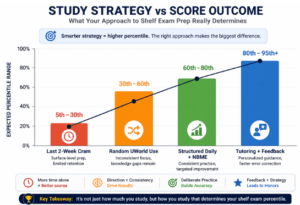
UWorld’s Step 2 CK QBank maps directly onto shelf content because shelf exams draw from the same clinical reasoning framework as Step 2. The internal medicine shelf exam and the surgery shelf draw the most direct overlap. Using UWorld in tutor mode, reviewing every explanation, right and wrong, builds the clinical pattern recognition that the NBME rewards. Doing it in timed mode without reviewing explanations builds speed without understanding.
The rotation-specific filter is underused. UWorld lets you filter by system and topic. For your medicine rotation, filter to cardiovascular, pulmonary, and renal in the first three weeks. Save mixed-system blocks for the final two weeks when your clinical exposure has broadened your frame of reference.
The NBME’s Clinical Science Subject Examination page lists the official content blueprints for each shelf. Match your UWorld filter to the blueprint for your specific rotation, not a general Step 2 filter, and you eliminate the content drift that burns study time on low-yield material.
What a Shelf Exams Tutor Does That Self-Study Cannot Replicate
The difference between studying for a shelf and being tutored for one comes down to feedback latency. When you study alone, your wrong answers accumulate over days before you notice the pattern. A tutor sees the pattern in your first session.
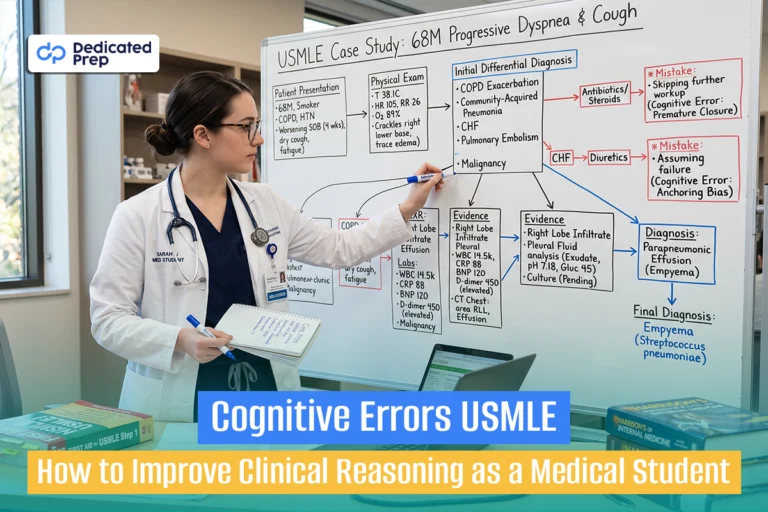
In our experience working with MS3s across all core rotations, the students who struggle most with shelves are not the ones who studied the least. They are the ones who studied efficiently but reasoned incorrectly, making the same cognitive error across 20 different questions without realizing it was the same error.
Shelf exam tutors who scored in the top decile on that exam read your wrong answer pattern and name it: anchoring bias, premature closure on the most prominent symptom, or systematically misreading NBME’s “best next step” questions as diagnosis questions. Once named, it is fixable in days, not weeks of solo review.
The second thing the tutor for the medical school shelf exam that self-study cannot provide is accountability built around a clinical schedule. Rotations are unpredictable. A post-call day destroys a study plan. A tutor adjusts the plan in real time, shifts priority topics based on how many weeks remain, and tells you honestly whether you need to compress your timeline or accelerate your question volume.
For a detailed breakdown of how shelf exam performance feeds into your Step 2 score and residency application, read Dedicated Prep’s complete USMLE Step guide.
| WARNING: Do not wait until the last two weeks of your rotation to start shelf exam preparation. NBME subject-specific practice exams score within plus or minus 5 to 10 points of your real shelf score, but only if taken with at least two weeks of preparation time remaining to act on the results. Taking an NBME the night before the shelf gives you data with no time to use it. |
How to Use NBME Shelf Practice Exams Strategically
There are currently 29 NBME subject-specific practice exams available across all core shelf specialties. Each practice exam is 50 questions, timed at 1 hour 15 minutes, the same 1.5 minutes per question pace as the real exam.
The official NBME practice exams are the closest predictor of your actual shelf score available. Most students report a plus or minus 5-point range between their final practice exam score and their real shelf EPC. The caveat is that predictive accuracy depends on taking the practice exam under timed, full-focus conditions, not as a casual review tool.
Timing matters. Take your first NBME practice exam approximately halfway through your rotation. This gives you a baseline and six to eight weeks to act on the gaps. Take a second exam in the final 10 to 14 days. The delta between your two scores tells you whether your preparation is working and where to focus the remaining days.
A 2024 PMC review of clinical reasoning curriculum confirms that deliberate practice with immediate feedback, exactly what structured NBME review provides, produces greater diagnostic accuracy improvement than content review alone. The mechanism matters: reviewing why each wrong answer is wrong, not just memorizing the right one.
Final Verdict: Shelf Exam Tutoring Is a Strategic Investment
If your goal is to pass, self-studying with UWorld and one NBME practice exam will usually get you there. But if your goal is honors or if you have a rotation where a strong result matters for your specialty, the calculus changes completely.
The shelf exams that matter most for residency applications are internal medicine and surgery. Both are broad, both reward clinical reasoning over memorisation, and both have honors thresholds that separate students who prepared strategically from those who just studied hard.
A tutor who has earned top-percentile scores on your specific shelf, who understands how the NBME writes questions for that rotation, and who can adjust your study plan around an unpredictable clinical schedule is not a shortcut.
It is the most efficient path from “studied hard” to “scored well.” Dedicated Prep works with medical students across all core shelf rotations, starting with a free consultation before your next clerkship begins.
FAQs
1) How hard is it to pass shelf exams?
Passing requires reaching the 5th national percentile, which most prepared students achieve. The harder challenge is that shelf exams are taken during active clinical rotations, balancing 50 to 60 clinical hours per week with daily question blocks, which is where most students struggle, not the content itself.
2) How many minutes per question for shelf exams?
The answer to the question of how long shelf exams are is simple. Each shelf exam gives you 1.5 minutes per question, 165 minutes for 110 questions. This is the same pace as USMLE Step 2 CK blocks, so if you are doing timed UWorld blocks during your rotation, you are already training at the correct pace.
3) Is the shelf harder than Step 2 CK?
Step 2 CK is broader and longer, with 318 questions across eight blocks, versus 110 on a shelf. Individual shelf exams are narrower in content scope but are taken under real-world time pressure during clinical rotations. Most students find Step 2 CK harder overall, but the internal medicine and surgery shelves are the closest in difficulty and content to Step 2.
4) Is a 257 a good Step 2 score?
A 257 on Step 2 CK places you in approximately the 90th percentile nationally, which is competitive for most specialties, including general surgery, orthopaedics, and emergency medicine. Your shelf exam percentiles pattern across core rotations is reviewed alongside your Step 2 score of 257, with weak shelf scores, which raises questions about consistency.
5) Which is the toughest shelf exam?
Internal medicine is most commonly reported as the toughest shelf, due to its breadth across every organ system and its direct overlap with Step 2 CK content. Surgery is a close second. Both require active daily preparation across the full rotation, not a final-week cram.