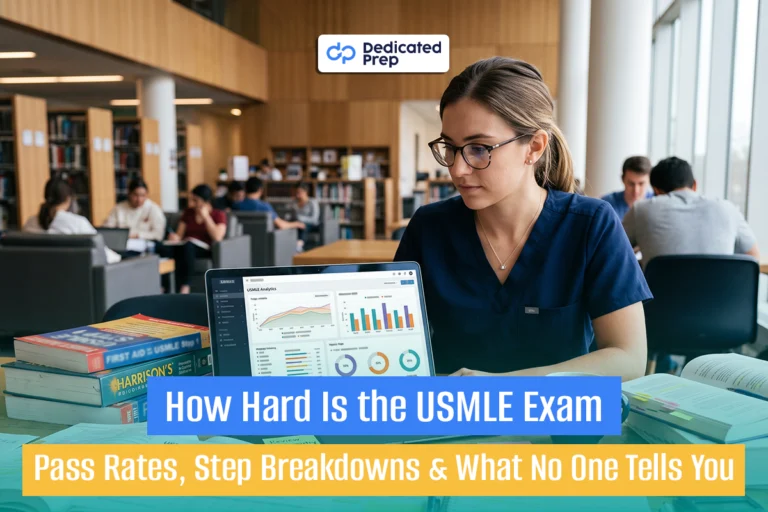

Nine out of ten US medical students pass Step 1 on their first attempt. Step 2 CK has an even higher first-time pass rate among US graduates. Step 3 is passed by most applicants who sit for it during residency. So why does it feel like the most terrifying exam in medicine?
Because the stakes are enormous. A single fail on your transcript can close doors to competitive specialties before you even apply. For international applicants, one bad attempt can derail years of planning. The difficulty is not just the content but what failure means.
You are here because you want a straight answer. Not a motivational speech, not a vague “it depends on the student.” You want to know exactly how hard each step is, what the pass rates actually look like, how the USMLE compares to other licensing exams, and what separates the people who pass comfortably from the ones who struggle.
That is exactly what this post covers: all the answers to your question about how hard the USMLE Step exam is.
Quick Summary: How Hard Is the USMLE Practice Test
- Step 1: 8-hour exam, 280 questions, pass/fail since 2022. First-time USMLE pass rate for US MD students: 91%. For international applicants: 72%
- Step 2 CK: 9-hour exam, 318 questions, scored numerically. A competitive score is 240 to 260. Higher first-time pass rate than Step 1 among US graduates
- Step 3: Two-day exam, 496 questions plus clinical case simulations. The passing score is 200. Most applicants pass during the first year of residency
- Approximately 60% correct answers needed to pass any step, not perfection
- Vs. MCAT: USMLE tests pure knowledge volume; MCAT tests reasoning. Most students find MCAT prep more stressful, USMLE prep more exhausting
- Vs. PLAB: USMLE is significantly harder in depth, duration, and stakes
- Vs. COMLEX: COMLEX is longer and less predictable; USMLE is deeper and more precise
- Biggest mistake: Treating pass/fail Step 1 as less important than it used to be. A fail still follows you everywhere
How Hard Is Step 1 USMLE Exam: The Real Numbers
Before 2022, Step 1 scores were the primary filter for residency programs used to decide who got an interview. Students were grinding 14 to 16 hours a day for months, chasing numbers rather than understanding. Burnout was rampant. The switch to pass/fail was supposed to reduce that pressure.
It did not fully work. Pass rates actually dropped after the change.
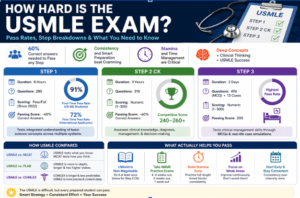
What is the pass rate for the USMLE Step 1
Before the pass/fail transition, first-time US MD pass rates ran between 94% and 96% from 2017 to 2021. After 2022, the rate dropped to 91% and has stayed there. For US DO students, first-time pass rates fell from 94% in 2021 to 86% by 2023. For international applicants, the drop was sharpest from 82% in 2021 to 72% in 2023.
Part of this reflects the increased passing threshold. But a 2025 peer-reviewed analysis published in PMC also found that students were completing fewer practice questions after the pass/fail announcement, treating Step 1 as a lower priority and arriving underprepared as a result.
– Step 1: ~91% (US MD), ~72% (IMGs)
– Step 2: CK: Higher than Step 1 for US students
– Step 3: Highest pass rate among all steps
Why is the USMLE so hard for the Step 1 exam
It is an 8-hour exam with 280 questions across seven 60-minute blocks. You get 40 questions per block. The clock stops for nothing. The content spans anatomy, physiology, pharmacology, microbiology, biochemistry, pathology, and behavioral science, and the questions do not test them in isolation. They require you to connect mechanisms across systems. Knowing that a drug is a beta-blocker is not enough. You need to know what happens when that beta-blocker interacts with a specific receptor in a patient who already has renal failure.
That integration is what separates Step 1 from a standard memorization exam. You need to answer approximately 60% of the questions correctly to pass. That sounds manageable. But 60% of deeply integrated clinical reasoning questions, under time pressure, after six hours of testing, is a different challenge than 60% of isolated recall questions.
PRO TIP
The single most predictive indicator of Step 1 performance is your UWorld percentage on timed, randomized practice sets not your performance on tutor mode or subject-specific blocks. Run timed, random sets from week three of your dedicated prep period and check your percentage weekly.
How Hard Is USMLE Step 2 CK, and Why It Matters More Now
With Step 1 pass/fail, program directors lost their primary numerical filter. Step 2 CK stepped into that gap. A score between 240 and 260 is competitive for most specialties. A score above 256 is what you need for first-choice programs in competitive fields. Below 230, your application faces friction regardless of how strong everything else looks.
Step 2 CK is a 9-hour exam with 318 multiple-choice questions. Every question is a clinical vignette. There are no basic science questions; there are patients presenting with symptoms, abnormal labs, or acute situations requiring a diagnosis, a next step, or a management decision.
This is harder than Step 1 in a different way. Step 1 punishes gaps in your knowledge base. Step 2 CK punishes slow or imprecise clinical thinking. The questions assume you know the medicine. They test whether you can apply it in seconds, under pressure, with four plausible answers in front of you.
The first-time pass rate for US MD students on Step 2 CK is higher than Step 1. But passing and performing competitively are completely different targets. Most applicants who struggle with Step 2 CK are not failing; they are scoring in the 220s when they needed 250.
Before you sit Step 2 CK, make sure your ERAS application strategy is locked in. Dedicated Prep’s complete ERAS Application Guide walks through how your Step 2 score feeds into your overall application and how to position it effectively.
| Step | Duration | Questions | Scoring | Competitive Target |
| Step 1 | 8 hours | 280 | Pass/Fail | Pass on first attempt |
| Step 2 CK | 9 hours | 318 | Numeric (1–300) | 240–260+ |
| Step 3 | 2 days | 496 + cases | Numeric (1–300) | 220+ |
KEY TAKEAWAY
Step 2 CK is now the exam that makes or breaks your residency application. Treat it with the same seriousness you would have given Step 1 before 2022. The students who still coast through it are the ones who end up reapplying.
How Hard Is USMLE Step 3: The One Everyone Underestimates
Step 3 is a two-day exam. Day 1 has 232 multiple-choice questions across six blocks. Day 2 has 180 questions plus 13 clinical case simulations. The passing score is 200. Most applicants sit for it during their first year of residency, already exhausted, and give it two to three weeks of preparation.
That is usually enough to pass. But for international applicants, passing Step 3 before applying for residency is a strategic move worth considering. Some programs use H-1B visa sponsorship as a condition, and Step 3 eligibility affects visa pathways.
IMPORTANT
Do not let Step 3’s reputation as “the easy one” become your study plan. The clinical case simulations on Day 2 are a different format entirely, managing a patient through a real-time scenario with timed decisions. Students who walk in without practicing these specifically often find Day 2 a jarring surprise.
Is the USMLE Harder Than the MCAT, PLAB, and COMLEX
These are four genuinely different exams testing different things. Comparing difficulty depends entirely on where your strengths lie.
USMLE vs. MCAT: The MCAT tests reasoning and critical thinking applied to scientific passages. You can prepare for it by getting sharper. The USMLE tests the volume of what you know, how deeply, and how fast you can retrieve it. Most students who scored above 515 on the MCAT find USMLE prep more exhausting because it requires significantly more raw memorization. The correlation between MCAT and USMLE Step 1 scores is approximately 0.60, indicating they are related but not the same skill set.
USMLE vs. PLAB: Is USMLE harder than PLAB? PLAB is a similar licensing exam in the UK for international graduates. It is a two-part test versus three steps of the USMLE and has less total examination time and is generally thought to be less challenging in both content and stakes. By most objective standards, USMLE is more challenging, longer, more comprehensive, and more serious in case of failure.
USMLE vs. COMLEX: This is the most similar one. Level 1 of the COMLEX has 352 questions in nine hours compared to Step 1 with 280 questions in eight hours. COMLEX features a lower predictability of question style and incorporates osteopathic principles material. The questions in the USMLE are more accurately stated, involve more in-depth multi-step reasoning, and are, on the whole, more content-precise. The majority of students in DO taking both indicate that the USMLE preparation is more challenging and time-consuming.
The truth: USMLE is more challenging than PLAB, is about as demanding as COMLEX in general demand but not in the same style, and measures another skillset than the MCAT.
How to Pass the USMLE Exam: What Actually Works
Passing is not about studying harder. It is about studying the right things the right way.
Three things determine your outcome more than anything else: the quality of your question bank practice, your stamina on test day, and how honestly you diagnosed your weak areas in the weeks before your exam.
- UWorld is non-negotiable: complete it at least once for every step, ideally twice for Step 2 CK. Your percentage on timed random blocks is your best predictor of exam performance
- NBME practice exam: use this as your calibration tool: Four to six weeks out, two weeks out, one week out. Do not have them back-to-back in the last week
- Dedicated prep time: six to eight weeks of minimum study time (US students), eight to twelve weeks for international applicants with logistics management responsibilities as well.
- Stamina is an ability: train complete timed blocks at the beginning of your training time, not just in the last week. Most of the mistakes occur during the last two hours of an eight-hour test.
- Weak areas need to be identified, not avoided. Most students spend 80% of their time on subjects they already know. The exam will test your weakest subject just as hard as your strongest
If you want structured, personalized guidance through this process, Dedicated Prep’s USMLE tutoring pairs you with a 250+ scoring mentor who builds your study plan around your specific gaps, not a generic schedule.
Final Verdict: How Hard Is USMLE explained
The USMLE is genuinely difficult, but it is passable for every prepared student. Step 1 requires integrated thinking across six subjects under eight hours of pressure. Step 2: CK now carries more weight for residency than any other single document in your application. Step 3 is the most forgiving step, but only for students who prepare for the case simulations specifically.
The students who struggle are not the ones who lack ability. They are the ones who underestimate Step 2, over-focus on Step 1, or avoid their weak areas until the last two weeks of prep.
Start early, study honestly, and treat every step as the career-defining exam it actually is. When you are ready for expert support, Dedicated Prep is built for exactly this one-on-one tutoring from 250+ scorers who have been through every step and know how to get you through yours.
FAQs
1. What was the pass rate of the USMLE Step 1 in 2024?
In 2024, the pass rate of US MD students was about 91, their first-time. In the case of international applicants, the rate was about 72% lower than before 2022, when the scoring was switched to pass/fail.
2. Is the USMLE harder than the MCAT?
They put it to the test. The USMLE requires a greater amount of raw knowledge and memorization; the MCAT exams are a test of scientific thought. The preparation for the USMLE is more tiresome to most students, but MCAT performance is more influenced by inherent reasoning skills.
3. Is COMLEX harder than USMLE?
COMLEX is longer and less predictable in question style. USMLE is more precise and requires deeper multi-step reasoning. Most DO students who take both report that USMLE preparation takes more time and demands more content precision.
4. How hard is it to get the USMLE Step 3, as compared to the Step 1 and 2?
The first-time pass rate in Step 3 is the best amongst the three. However, the Day 2 clinical case simulations are a special format that requires applicants to have specific practice in this format. Do not underestimate yourself because most of the people pass.
5. Is the USMLE hard to pass for foreign applicants?
The international applicants are subject to the same content as US students, but are not usually subjected to integrated clinical rotations within the US healthcare system, are not exposed to as many peers in their studies, and have other logistical difficulties. The difference in the first-time pass rate, 91% of the US MDs and 72% of IMGs, is more about access to preparation and clinical exposure than pure talent.