
A solid USMLE preparation plan includes books that provide a high-yield review of all the content; they make or break it during the initial foundation-building step of your prep, long before test day. The majority of students spend weeks purchasing the incorrect set of texts, repeating content they already understand, or purchasing the wrong ones because of peer pressure. So choosing the right books for review and concept-building is extremely important to save your time and resources during your USMLE prep.
This blog explains exactly what USMLE books to use and why for Step 1, Step 2 CK, and Step 3, and provides you with a reading list to follow for the long term.
What Are USMLE Books & Why They Matter the Most
The major books that you need are First Aid and Pathoma. You can then eventually build up according to your individual needs with the Kaplan USMLE series. These books cover years of medical school knowledge and concepts in a concise and easy-to-follow format for you to review.
The right USMLE books can also set the pace for US medical students and IMGs for a dedicated period of USMLE prep. Step 1 has become pass/fail and is still the source of knowledge for Step 2 CK, which is graded numerically and is factored into residency applications.
How USMLE Book-Based Prep Works
The best USMLE books are used in conjunction with one another. They are part of a four-step system:
- Core review book: builds the framework of high-yield facts (e.g., First Aid, Pathoma)
- Question bank: tests applied reasoning and exposes weak areas (e.g., UWorld)
- Video or lecture content: fills conceptual gaps the book alone can’t explain
- Active recall tool: locks in retention through spaced repetition (e.g., Anki)
The sequence of using resources always matters. Most successful test takers read or skim the main book to create a mental map, then move to working with the question bank, reading only what is missing from the mental map and referring to the book for that as a tool to review.
This layered approach is even more important on Step 2 CK and Step 3, where there is no “gold standard” text, but rather the book is used in addition to the Qbank.
Why the Right Book List Matters for USMLE Candidates
For USMLE candidates in the USA, it’s not just about the score. The following are all the consequences of the wrong reading list:
- Wasted dedicated time: dedicated periods are typically 4–8 weeks; the wrong books eat into practice-question time
- Score ceiling: outdated editions miss recent content updates and drug/guideline changes
- Residency impact: Step 2 CK scores are a major screening tool for US residency programs
- Financial cost: full book sets can run $150–$400, and buying twice is a real risk with outdated editions
The first time you get the list right, you will save your study schedule and your money.
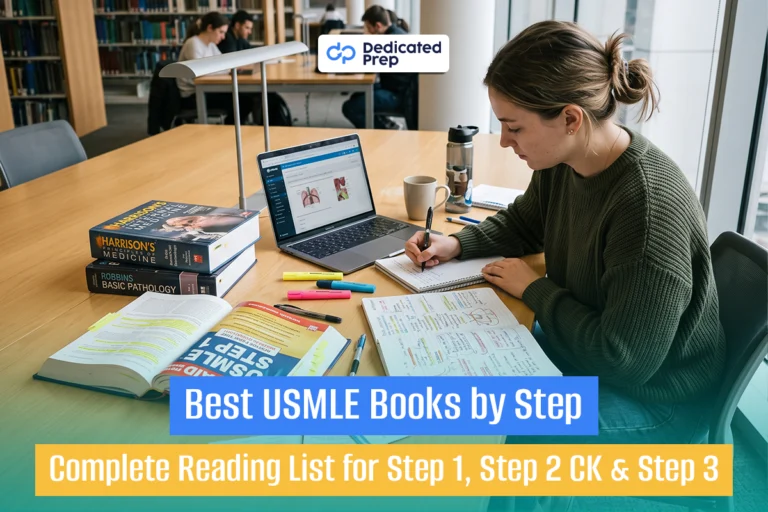
Best USMLE Books by Step
USMLE Step 1 Books:
Step 1: First Aid for the USMLE Step 1 (2026 Edition)
It is the 36th edition that most other Step 1 resources are based on. Features more than 1,000 color clinical images and 1,300+ high-yield facts and mnemonics, broken down by basic principles and organ system. It’s useful because it’s not supposed to be used to learn concepts from scratch; rather, it’s a high-yield index you annotate while working through Qbanks and video content.
Step 1: Pathoma
A short textbook of pathology with the accompanying video lectures. It works because pathology is one of the most lucrative subjects on Step 1, and Pathoma does a better job of explaining the disease mechanisms than First Aid does in bullet point format.
Step 1: Kaplan USMLE Step 1 Lecture Notes
A series of books covering each of the basic sciences in detail. It’s great for students who require a stronger conceptual base before they can dive into high-yield review, particularly physiology and pharmacology.
USMLE Step 2 CK books:
Step 2 CK: Step-Up to Medicine
It’s comprehensive and detailed, so it’s great for an in-depth internal medicine foundation, but it can be heavy-duty for a short period of dedicated time. It works because Internal medicine is the biggest content block on Step 2 CK.
Step 2 CK: Master the Boards USMLE Step 2 CK
This resource is concise, mobile, and question-focused, and it’s very similar to UWorld’s “if you see this, think this” approach. It is suitable for use as a resource in the late-dedicated period when basic knowledge has already been acquired.
Step 2 CK: First Aid for the USMLE Step 2 CK
It has more mnemonic devices than any other Step 2 CK book, and it contains a Rapid Review section which is helpful for last-minute studying, but is best used in conjunction with a question bank.
USMLE Step 3 books:
Step 3: Master the Boards USMLE Step 3
In the 8th edition (2026), the emphasis is on the best initial diagnostic test, most accurate test, and most likely diagnosis reasoning, and includes updates in pharmacology and practical tips for the CCS (Computer-based Case Simulations) section of the exam. This is because Step 3 tests independent patient management, and this format closely reflects the decision-tree type of question.
Step 3: Kaplan USMLE Step 3 Clinical Management Review Set
This two-book set provides case-based review with over 250 in-depth cases covering all disciplines tested on Step 3, with basic science correlates and population health content. It is suitable for applicants who like to engage in a case walk-through before practising CCS.
USMLE Book Comparison at a Glance
| Item | Purpose | Why It Matters |
| First Aid for USMLE Step 1 | High-yield content index across all basic sciences | Nearly every other Step 1 resource is built to align with it |
| Pathoma | Pathology mechanisms with matching videos | Covers one of the highest-yield subjects on Step 1 |
| Kaplan Step 1 Lecture Notes | In-depth subject-by-subject review | Fills conceptual gaps First Aid doesn’t explain |
| Step-Up to Medicine | Deep internal medicine review | IM makes up the largest share of Step 2 CK content |
| Master the Boards Step 2 CK | Concise, exam-style clinical review | Matches UWorld’s reasoning format for faster recall |
| First Aid for Step 2 CK | Mnemonic-heavy clinical summary | Strong supplement for last-minute Rapid Review |
| Master the Boards Step 3 | Diagnostic and management-focused review | Mirrors CCS-style independent decision-making |
| Kaplan Step 3 Case Review Set | Case-based, multi-disciplinary review | Bridges theory and CCS practice with 250+ cases |
What to Look For in USMLE Books: Quick Checklist
✔ Current Edition Year: Medical guidelines, drug names, and exam blueprints change yearly. An outdated edition can teach management steps that no longer match current standards.
✔ Alignment With Your Question Bank: Books that mirror your Qbank’s reasoning style (e.g., “if you see this, think this”) reinforce retention faster than books written in a purely textbook format.
✔ Appropriate Depth for Your Stage: Comprehensive texts like Step-Up to Medicine suit early clerkship learning; concise texts like Master the Boards suit dedicated review. Using the wrong one at the wrong stage wastes time.
✔ Visual and Mnemonic Support: Colour images, tables, and mnemonics measurably speed up recall for high-volume subjects like pathology and pharmacology.
✔ Coverage of Your Weak Subjects: No single book covers every subject equally well. Cross-check a book’s table of contents against your personal weak areas before committing to it as a primary resource.
Expert Tip
Recent Step 1 pass rates have dropped compared to prior years, which means the margin for outdated or mismatched study material is smaller than it used to be; current editions and Qbank-aligned review books matter more now than in previous exam cycles.
USMLE Book Costs: Complete Overview
| Resource Type | Price Range | Notes |
| Single core review book (paperback) | $50 – $75 | Prices vary by edition and format |
| Multi-volume lecture note sets | $150 – $230 | Often sold as a complete bundle |
| Qbank subscription (per step) | $200 – $400 | Typically the largest single expense |
| Digital/e-book editions | $30 – $60 | Usually cheaper than print |
Prices vary by retailer, edition, and bundle inclusions. No book or Qbank guarantees a specific score.
Conclusion
Choosing the right USMLE books for each Step comes down to matching the resource to the exam’s format: high-yield recall for Step 1, applied clinical reasoning for Step 2 CK, and independent management decisions for Step 3. Pairing the right core book with a compatible question bank consistently produces stronger, more efficient study sessions than any single resource alone.
For students who want a structured, personalised approach to building their reading list and dedicated study schedule, Dedicated Prep helps map the right book-and-Qbank combination to your individual timeline and target score.
FAQs
Is First Aid enough to pass USMLE Step 1?
No single book is fully sufficient on its own. First Aid works best as a high-yield reference used alongside a question bank like UWorld and a video resource such as Pathoma or Boards & Beyond.
What is the best book for Step 2 CK?
There isn’t a single dominant text for Step 2 CK the way First Aid dominates Step 1. Step-Up to Medicine and Master the Boards are both widely used, often alongside First Aid for Step 2 CK as a supplement.
Do I need to buy the newest edition every year?
Yes, for core review books. Guidelines, drug protocols, and exam content blueprints are updated regularly, and outdated editions can teach management approaches that no longer match current standards.
How many USMLE prep books should I use per Step?
Most successful candidates use one core review book, one question bank, and one supplemental resource (video or case-based text) per Step, rather than collecting multiple overlapping titles.
Can I use Step 1 books like First Aid for Step 2 CK prep?
Yes, selectively. Topics like biostatistics, public health, immunology, pharmacology, and physiology frequently reappear on Step 2 CK, so reviewing relevant sections of Step 1 material alongside related Qbank questions can reinforce retention.