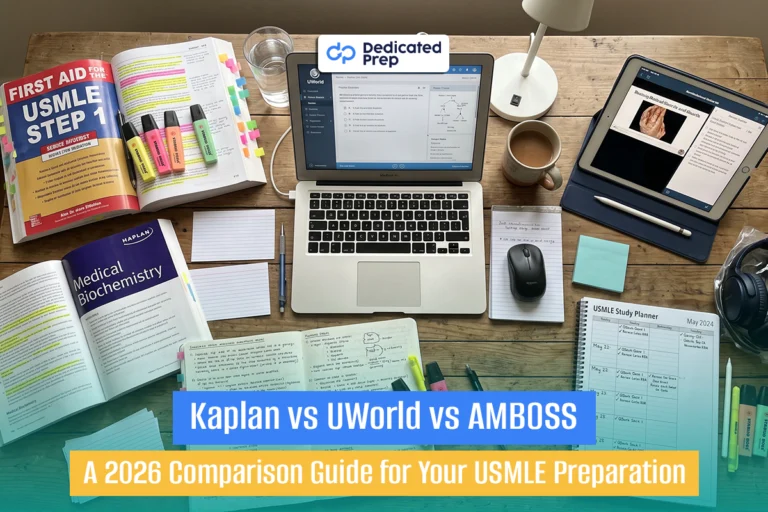
Most students do not fail Step 1 or Step 2 CK because they lack knowledge. They fail because they built their entire study plan around the wrong question bank. Kaplan, UWorld, and AMBOSS are the three big names in USMLE prep, but choosing one is a daunting task and can get extremely overwhelming as a medical student.
So to make that choice a less daunting one, we have compiled this guide for you and have broken down what each of these 3 platforms actually offers in 2026, how Kaplan vs UWorld vs AMBOSS pricing compares, where question quality differs, and which combination gives you the strongest path to a passing or competitive score.
What Kaplan, UWorld, and AMBOSS Actually Offer
Kaplan USMLE prep is built around structure. The course pairs a large question bank with live and on-demand video lectures, a set of seven print textbooks, a diagnostic exam, and an AI tutor that explains concepts on demand. Students who want a guided, classroom-style experience with built-in accountability would choose Kaplan because of its structure.
UWorld is widely considered the gold standard USMLE qbank. It offers roughly 3,600 plus Step 1 questions and 4,250 plus Step 2 CK questions, all written to mirror the format, tone, and difficulty of the real exam. UWorld also includes two self-assessments, UWSA1 and UWSA2, that are well known among students for predicting actual Step 1 scores within five to ten points.
AMBOSS, so if you are someone who retains more by reading text and going back to reviewing notes while practicing, then AMBOSS should be the choice for you. Every answer explanation links directly to a library article, so a single missed question can turn into a full concept review without leaving the platform. AMBOSS also rates each question from one to five by difficulty using a one to five hammer scale, which helps students filter content by how exam-realistic or advanced it is.
Kaplan vs UWorld Pricing and AMBOSS Cost in 2026
Here is how the three platforms compare on price and what each tier actually includes.
| Platform | Typical Price Range (2026) | What It Covers |
|---|---|---|
| Kaplan | $1,999 to $2,999 (On Demand Step 1); $4,000+ for Live Online packages | Qbank, video lectures, 7 print textbooks, diagnostic exam, AI tutor, live classes on higher tiers |
| UWorld | Around $189 for a 30-day entry tier; roughly $560 to $600 for a full year | 3,600+ Step 1 questions, 4,250+ Step 2 CK questions, UWSA1 and UWSA2 self-assessments, ReadyDecks flashcards |
| AMBOSS | About $428 to $448 per year for full Qbank and Library; library-only membership runs $8.25 to $14.99 per month | Integrated medical library, hammer difficulty ratings, Score Predictor, Anki integration |
On a pure cost basis, AMBOSS and UWorld sit closer together, while Kaplan’s live and on-demand packages cost significantly more because they include instructor-led teaching and physical study materials rather than just a question bank.
Question Quality: Which Bank Feels Most Like the Real Exam
If realism is your priority, then UWorld is a must in USMLE prep; it is THE GOLD STANDARD of your entire prep. Kaplan questions are respected but inconsistent. Some students find them sharper preparation for tricky exam logic, while others describe them as more pedantic or confusing than actual USMLE items. AMBOSS questions sit somewhere in between. They are slightly less representative of true exam phrasing, but the instant library access makes them excellent for learning the underlying concept rather than just memorizing the answer.
Extra Study Tools and Features Worth Knowing About
Kaplan’s biggest advantage outside the qbank is live instruction. The Live Online package includes well over 200 hours of expert led teaching for Step 1 alone, plus a money back guarantee on its live courses if you do not pass. UWorld’s strongest extras are its self-assessments and ReadyDecks flashcards, both of which integrate tightly with qbank performance data. AMBOSS leans on its Score Predictor, Anki integration, and Chrome extension, which together make it one of the more connected platforms for students who study across multiple tools at once.
Pros and Cons of Kaplan, UWorld, and AMBOSS
Kaplan
Kaplan works well for students who want structure and live accountability, and the included textbooks are genuinely useful for visual learners. The tradeoff is cost. Kaplan is consistently the most expensive of the three options, and its question bank receives more mixed reviews than UWorld’s.
UWorld
UWorld is hard to beat on realism and predictive self-assessments, which makes it the default choice for most dedicated study periods. Its main limitation is that it functions purely as a question bank. Students who need deeper concept explanations often have to supplement it with another resource.
AMBOSS
AMBOSS offers strong value for the price and is particularly useful during preclinical years because of its library integration. The downside is that its questions are slightly less representative of actual exam phrasing, so students relying on AMBOSS alone sometimes feel less prepared for the specific style of USMLE vignettes.
Which One Should You Choose
If you want live teaching, full textbook coverage, and built in structure, Kaplan is the strongest fit even at a higher price. You cannot skip UWorld, so it definitely is a default choice; you can then definitely make a choice between AMBOSS and Kaplan. If you want a budget friendly option that builds deep conceptual understanding alongside your coursework, AMBOSS is the better starting point, particularly during preclinical years or clerkships.
How to Combine Kaplan, UWorld, and Ahigh-scoringe Best Results
Most high scoring students do not rely on a single platform. A common and effective approach is to use AMBOSS or Kaplan during preclinical years to build foundational knowledge, then switch primarily to UWorld during your dedicated study period when realism and timing practice matter most. Track your progress with NBME self-assessments every two to four weeks so you know whether your qbank choice is translating into real score gains. A clear USMLE study plan that maps qbank usage against your remaining weeks keeps this process from becoming overwhelming. At Dedicated Prep, we typically build this kind of resource sequencing directly into a student’s personalized USMLE tutoring plan, adjusting the qbank mix based on NBME performance rather than guesswork.
Conclusion
There is no single winner in the Kaplan vs UWorld vs AMBOSS debate. Kaplan suits students who want live instruction and full course structure. UWorld remains the most realistic and predictive qbank for dedicated study. AMBOSS offers strong value and deep concept building, especially earlier in your preparation. The right choice, or combination, depends on your budget, learning style, and where you are in your USMLE timeline. Whichever path you choose, pairing your qbank with a structured NBME strategy guide and consistent self-assessment tracking will matter more than the brand name on your subscription.
Frequently Asked Questions
Is UWorld or AMBOSS better for USMLE Step 1?
UWorld offers more exam-realistic questions and stronger self-assessments, while AMBOSS offers better value and deeper concept explanations through its integrated library. Most students preparing for Step 1 choose UWorld as their primary bank and use AMBOSS as a supplement.
Is Kaplan worth the higher price for USMLE prep?
Kaplan is worth it mainly for students who need live instruction, structured pacing, and physical textbooks, since its question bank alone does not outperform UWorld or AMBOSS. Self-directed, Qbank-focused students usually get better value from UWorld or AMBOSS.
How much does AMBOSS cost compared to UWorld in 2026?
AMBOSS runs about $428 to $448 per year for full Qbank and Library access, while UWorld costs roughly $560 to $600 for a comparable full-year subscription. AMBOSS is generally the more affordable option of the two.
Which qbank is best for USMLE Step 2 CK in 2026?
UWorld is the most widely used and most predictive qbank for Step 2 CK because of its larger clinical question volume and realistic vignettes. AMBOSS works well as a secondary resource for management-heavy and ethics-focused questions.
Should I buy more than one USMLE qbank?
Many high-scoring students use two qbanks, typically AMBOSS or Kaplan for early content review and UWorld for dedicated, exam-style practice. Buying multiple banks only helps if you complete and review each one thoroughly rather than rushing through them.