
Preparing for the United States Medical Licensing Examination (USMLE) is one of the most crucial milestones in your medical career. Whether you are just starting your USMLE prep journey or entering the final weeks of dedicated study, test-taking, and prep strategies can go a long way to ensure success on test day.
In this guide, we break down everything you must know about USMLE exam preparation, including schedules, resources, strategies, and common pitfalls, so you can study smarter, stay confident, and perform your best on test day.
What Is USMLE Preparation and Why Does It Matter
USMLE preparation is more than memorizing facts; it’s a strategic process that helps you understand complex medical concepts, apply them in clinical scenarios, and develop the stamina and test-taking skills needed to perform well under timed exam conditions. Proper usmle prep isn’t just about hours studied; it’s about how you study, assess yourself, and adjust your strategy over time.
To set yourself up for success, you need:
- Clarity on exam expectations and content
- A structured study roadmap tailored to your learning style
- Frequent performance checks to guide improvement
- Confidence for test day
In today’s competitive environment, diligent prep can make a real difference in your scores and residency competitiveness, especially for Step 2 CK and Step 3.
USMLE Exam Structure: Step 1, Step 2 CK & Step 3 Explained
Understanding the anatomy of each USMLE Step is critical before planning your study.
Step 1
- USMLE Step 1 is simple. It is a single-day, computer-based exam focused on basic medical sciences and their application to health and disease.
Step 2 CK
- Focuses on clinical knowledge, patient management, and clinical reasoning. Like Step 1, it is taken in one day with multiple blocks of questions.
Step 3
- Taken after passing Step 1 and Step 2 CK, Step 3 measures clinical decision-making and patient management skills, including a Computer-based Case Simulation (CCS) section.
Knowing the exam formats and how skills are evaluated lets you plan your usmle prep classes schedule and study techniques more effectively.
How Long Does USMLE Prep Take: Quick Overview of Timelines
There’s no one-size-fits-all timeline, but based on common practice and expert recommendations, here are effective windows you can plan for usmle exam preparation:
| USMLE Step | Estimated Prep Duration | Focus |
| Step 1 | 4–6 months | Mastering basic science and integrated problem-solving |
| Step 2 CK | 3–6 months | Clinical reasoning, diagnosis, and management |
| Step 3 | 2–3 months | Clinical application and CCS case simulations |
Some students begin prepping early in medical school, but dedicated prep typically begins 4–6 months before exam dates to balance depth and retention without burnout.
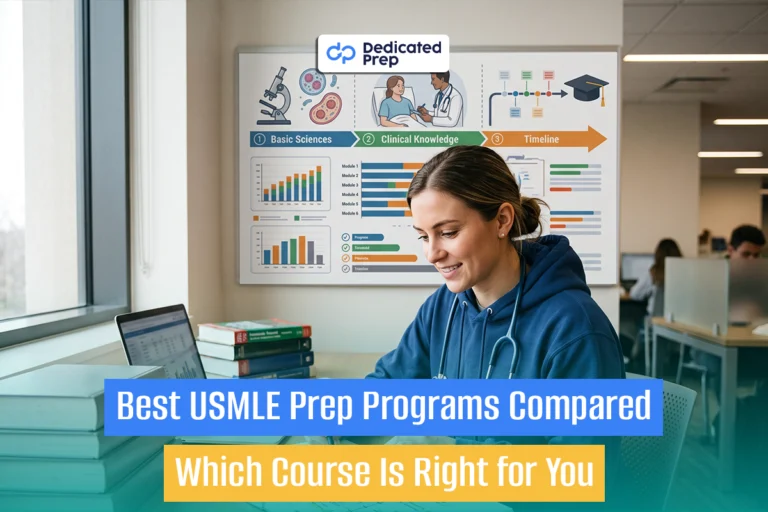
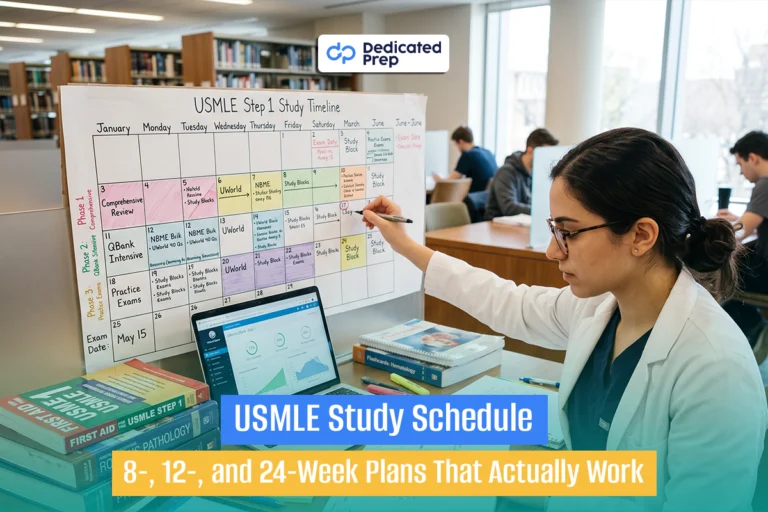
Building a Winning USMLE Prep Schedule: Phased Planning
A phased approach helps balance content review and practice application while tracking progress.
Phase 1 — Conceptual Foundation
This is where you build core knowledge. Break down topics by system and use trusted books and prep resources to create a strong base. Early grinding lays the foundation for high performance later.
Phase 2 — Practice & Integration
Integrate question practice into your schedule early, especially timed question banks that mimic the real format. This helps transition knowledge into applied skills.
Phase 3 — Assessment & Refinement
In the final months/weeks, shift focus to full-length practice tests, identify weak areas, and polish the exam strategy. Use NBME or self-assessments to gauge readiness, assess trends, and strengthen weak spots.
Creating a weekly cycle that includes content review, question practice, review of incorrect questions, and rest days ensures momentum without burnout. Also, you can read our complete guide on USMLE Exam Strategies here.
Core USMLE Prep Resources: Books, QBanks & Courses That Work
Books
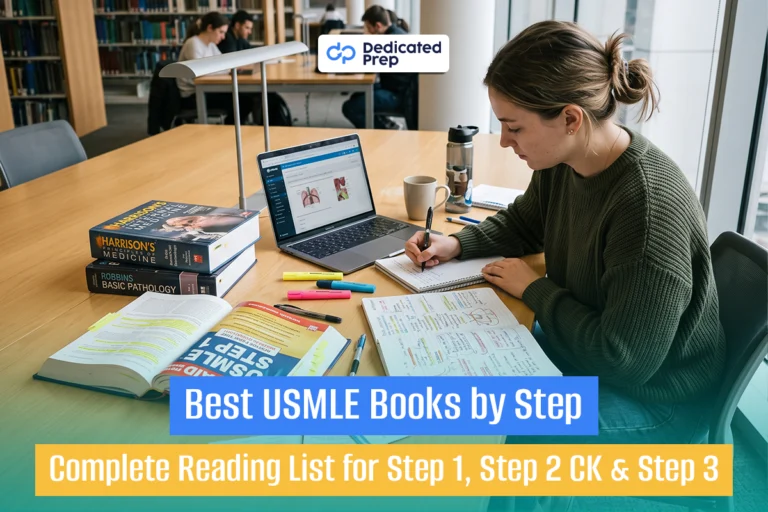
- First Aid for USMLE Step 1– foundational review (especially for sciences).
- Step-Up to USMLE Step 2 CK– concise clinical review.
- Internal Medicine Correlations for Step 3– helps master clinical management.
Question Banks
- UWorld -widely regarded as the most realistic and high-yield Qbank for all steps.
- NBME Self-Assessments -essential for benchmarking your progress.
- AMBOSS – strong supplemental Qbank and analytics.
Courses
Tailored coaching, accountability, and strategy refinement. Structured prep courses and mentorship programs may be helpful, including international medical graduates (IMGs) and busy candidates.
Important: Do not waste your resources on too many tools at once. Master a few high-yield tools to water them down instead. Prepare for your exam and see the format here.
How to Prepare for USMLE: Practice Question and Evaluation Plan According to NBMEs and UWSAs.
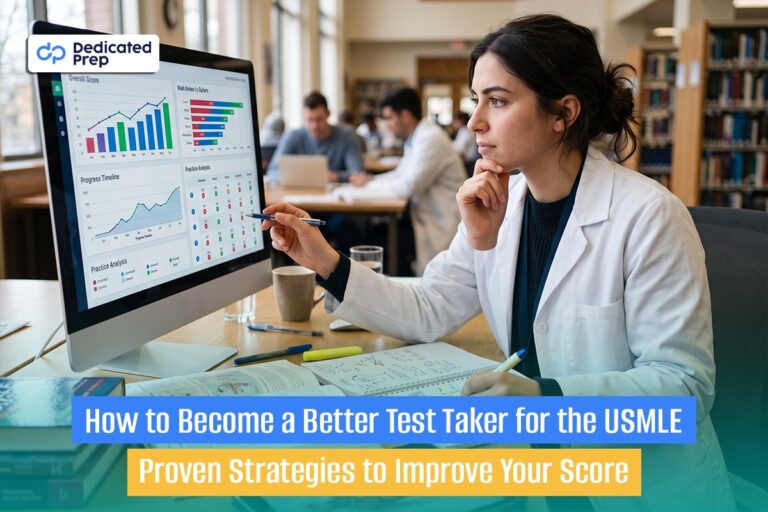
The main component of a successful USMLE preparation plan is assessment, particularly standardized practice exams. They not only provide you with a snapshot of your score, but, when used correctly, they direct your study plan, expose areas of weakness, develop your exam-taking skills and stamina, and help you track your progress over time.
Baseline Practice Test — Know Where You Stand Early
Before you dive deep into studying, take a baseline NBME or UWSA to understand your starting point. This early assessment:
- Identifies knowledge gaps you haven’t recognized yet
- Helps you prioritize content areas from day one
- Gives you a realistic, objective measure to start your prep
Even a low initial score isn’t a setback; it’s data you can act on.
Start baseline practice about 2–4 weeks before your dedicated study period so you can customize your plan around the areas you need to strengthen.
2. Regular Self-Assessments — Track, Adjust, Improve
Throughout your preparation, don’t just collect questions; analyze your performance data consistently. Take NBME self-assessments and UWorld Self-Assessments (UWSAs) on a recurring schedule:
- NBME practice exams every 2–4 weeks or as your study timeline allows
- UWSAs mid-prep and toward the end for confidence and exam feel
- Free 120 up to a week before the exam to boost confidence and review content
Why this matters:
- They measure progress objectively rather than just by gut feeling
- They reveal trending weaknesses you can correct before exam day
- They give you predictive insight into likely performance
Each time you get your scores back, don’t just glance at the number; review them in detail:
- Which systems are consistently low? (e.g., endocrine, biostatistics)
- Are you making the same type of mistakes?
- Do you need more time on clinical reasoning vs. recall?
Tracking scores by topic over time helps you adapt your study focus intelligently, not randomly.
3. Final Simulations — Build Stamina & Test-Day Confidence
As the exam approaches, especially in the last 4–8 weeks, it’s critical to simulate real test conditions:
- Take full-length practice exams in one sitting
- Time yourself exactly as you will be tested
- Include scheduled breaks just like the actual USMLE format
- Use NBME forms and UWSA blocks to mirror fatigue, pacing, and pressure
These full simulations train your mental endurance and pacing, so the real exam feels familiar and manageable rather than exhausting and unfamiliar.
A common practice schedule might look like:
- Early prep: smaller blocks and one baseline assessment
- Mid prep: larger mixed blocks and another self-assessment
- Final weeks: regular NBME/UWSA exams spaced to allow review and refinement
This approach ensures you train like you’ll perform rather than just prepare theoretically. Keeping a realistic schedule and resisting the urge to cram last minute makes a measurable difference. Click here for more info about USMLE preparation.
4. Why Balance Both NBME and UWSA
NBMEs are generally considered more predictive of actual USMLE outcomes because they’re created by the same organization that writes the exam. UWSAs, while also valuable, are best used to:
- Gauge pacing and block fatigue
- Provide additional practice in real-looking exam formats
- Boost confidence and experience with multi-block days
Using both strategically, not randomly, creates a comprehensive assessment strategy that informs your study plan instead of just measuring it.
5. Strategy Tips You Can Start Today
- Don’t wait to take practice tests until you feel “ready.” Early assessment reveals where you need to put in the work.
- Review every incorrect question deeply. Mistakes are your best teachers.
- Track your assessment history, look for trends, not daily fluctuations.
- Avoid doing a practice test the day before your exam. Use that time for light review and rest.
If you want personalized guidance, expert feedback on weak areas, custom study plans, and accountability that accelerates your prep, explore Dedicated Prep’s USMLE tutoring services, where mentors help you turn your preparation into measurable score improvement.
Wellness, Motivation, and Study-Life Balance is the Key to USMLE Prep
USMLE preparation is demanding, but your well-being isn’t separate from your success. Here are a few tips to help you maintain wellness so you can study better, think more clearly, and perform better on your exam day:
- Periodic Breaks during the Day: Taking short breaks in between your study time is important to maintain focus and concentration. Brief periods of rest (e.g., 10-15 minutes every 50-60 minutes) can be used to refresh your concentration and stop fatigue, as well as maintain your brain’s ability to process information.
- Socializing during Non-studying: Isolation during prep makes things more stressful and burns people out. Hanging out with your friends or family will give you the mental room to relax, help you rejuvenate emotionally, and also help you become stronger when you are in the process of studying hard.
- Sleep & Nutrition Influence Cognitive Performance: Sleep and diet are not peripheral items; they define the quality of the encoding, consolidation, and recollection of the studied material. Always get enough rest and eat well; your memory and judgment on the day of the exam will rely on it as much as a question bank.
Practical USMLE Prep Checklist Before Your Exam Date
As you enter the final stretch of your USMLE preparation, use this checklist to make sure you are ready, confident, and focused rather than scrambling at the last minute. Each item here targets a key area proven to reduce stress and improve performance.
- Have a clear timeline and check completed topics: Confirm that every system or subject area on your study plan has been reviewed, and nothing critical is left unwatched or unchecked.
- Completed several full NBME simulations: Regular, timed full-length practice tests help build stamina and accuracy, and give you a realistic sense of readiness.
- Final pass through key resources and flashcards: Go through your high-yield resources (e.g., First Aid, UWorld highlights, flashcards) one last time to refresh core concepts.
- Practiced timed blocks and Prometric-style tests: Train your pacing and endurance by doing back-to-back blocks under simulated test-day conditions.
- Reviewed error logs and weak areas: Go back to your wrong questions and weak topics, not to re-read everything, but to fix specific misunderstandings and reinforce correct logic.
- Prepare your test-day essentials: Have your ID, scheduling permit, snacks, water, and travel plan ready so nothing distracts you on the morning of the exam.
- Check logistics (test center, timing, travel): Verify your Prometric center location, travel time, parking, and check-in protocols early to avoid day-of surprises.
- Establish a sleep & nutrition routine: In the final week, focus on consistent sleep and balanced meals rather than cramming your brain performs best when well-rested and fueled.
- Final mindset check (confidence ritual): Stop comparing yourself to others, trust your preparation, and go into the exam with a positive, calm mindset.
Why this USMLE study prep checklist matters:
It shifts your focus from content anxiety to performance readiness, which is exactly what separates average prep from peak performance. Running through this list in the last 7–10 days creates a sense of control, builds confidence, and minimizes unnecessary stress when it matters most.
Partner with Dedicated Prep Services
Preparing for the USMLE prep test is a marathon, not a sprint. With the right plan, tools, and strategy are all you need. A well-organized USMLE preparation system that matches your learning style will unquestionably allow you to reach your objectives.
Ready to take your USMLE step prep to the next level? With Dedicated Prep, you don’t have to do it alone.
FAQs
- How long does it take to prepare for USMLE Step 1?
Most students devote 4–6 months to USMLE Step 1 prep, focusing first on foundational sciences and then extensive question practice. Also seek affordable usmle prep options too. - Do I need a USMLE prep course, or can I self-study?
USMLE test preparation works for both self-study suits disciplined learners, while structured courses provide guidance, accountability, and strategy helpful if you struggle with self-motivation. - What are the best books for USMLE preparation?
Best USMLE prep resources books include First Aid for USMLE Step 1, Step-Up to USMLE Step 2 CK, and relevant clinical review guides for Step 3. - How often should I take NBME practice tests?
Use NBME tests as progress checks every 4–6 weeks during prep and in the last 4–8 weeks before your USMLE board prep exam to help refine readiness. - How should I prepare for my USMLE interview?
For USMLE interview preparation, focus on practicing clinical scenarios, polishing your communication, and being ready to explain your study approach and goals with confidence. Treat interview prep like part of your overall USMLE preparation time by scheduling regular mock Q&A sessions and feedback.