
If your USMLE question bank average isn’t improving despite weeks (or months) of grinding, the problem isn’t your knowledge; it’s how you’re using the Q-bank. USMLE prep can be. overwhelming, but mastering practice questions is one of the single most effective strategies for scoring higher and gaining confidence. A USMLE question bank isn’t just a random collection of questions; it’s a comprehensive learning engine that teaches you exam reasoning, reinforces high-yield content, and builds real test-day skills. In this guide, we will walk you through everything you need to know about using question banks for Step 1, Step 2 CK, and Step 3, including which ones are most effective, how to use them strategically, and how they fit into a complete USMLE prep plan. This isn’t just a list; it’s a strategy guide for using QBanks to improve performance, not just practice questions.
What Is a USMLE Question Bank
A USMLE question bank (or QBank) is a digital repository of thousands of exam-style multiple-choice questions written to mirror the style, difficulty, and reasoning required by the USMLE. These questions are usually accompanied by:
✔ Detailed explanations for both correct and incorrect answer choices
✔ Tools to tag, flag, and track performance by topic
✔ Analytics showing trends over time (weak areas, pacing, topics)
✔ Study modes (timed vs. tutor vs. mixed/random)
These features make a question bank more than just a practice tool; they turn it into a learning and diagnostic system.
Why Question Banks Are So Valuable
Most students never get past passive review (reading books or videos), but USMLE is not a recall test; it’s an application exam. USMLE question banks help you learn how to think like the exam writers, not just memorize facts, and this makes all the difference on exam day.
Why USMLE Question Banks Matter More Than You Think
While many students know that QBanks are important, few understand exactly how they improve performance. Here’s how they work on a deeper level:
1. They Build Clinical Reasoning
The USMLE question bank requires you to synthesize information from history, physical exam findings, labs, and differential diagnosis. By repeatedly working QBanks, your brain starts to process patterns like a clinician, not just a memorizer.
For example:
A Step 2 CK QBank question might describe a patient with chest pain, then require you to interpret EKG changes, troponin levels, and clinical history to decide the next step in management. This goes far beyond recalling a fact, its application under pressure.
2. They Show You Why You Missed a Question
Simply getting a question wrong isn’t helpful unless you understand the reason behind the error. Most high-yield QBanks break down:
- The concept tested
- Why the wrong choices are tempting
- How to avoid that mistake next time
This reflective learning is far more powerful than just doing more questions without review.
3. They Improve Timing and Stamina
USMLE is a long, multi-block exam. Timing is critical. QBanks in timed mode help you develop pacing skills so that questions don’t feel rushed and fatigue doesn’t impair your reasoning late in the exam.
For expert study plans, performance feedback, and one-on-one support that accelerate your progress, explore USMLE tutoring services from Dedicated Prep today.
Best USMLE Question Banks by Step: Recommended Ones
USMLE Step 1 Question Bank
✔ UWorld Step 1 — The gold standard, known for clinical style and high-yield logic. Many high scorers credit the UWorld question bank USMLE with improving their performance the most.
✔ USMLE-Rx Question Bank — Built around First Aid, which makes it great for connecting content to practice questions.
✔ Kaplan QBank — Robust foundational questions that help build early confidence, especially if you are just starting prep.
✔ AMBOSS — A newer bank with an integrated knowledge library, useful for drilling explanations and a deeper understanding.
Comparison Table: Top Question Banks by Step
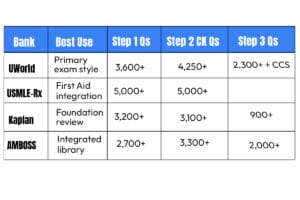
Numbers are approximate and subject to change; check official platforms before purchase.
USMLE Step 2 Question Bank
✔ UWorld Step 2 CK — Widely used for its challenging clinical reasoning and comprehensive coverage.
✔ AMBOSS — Strong supplemental bank with excellent concept links.
✔ TrueLearn/BoardVitals — Valuable additional practice, especially where gaps are identified.
Step 2 CK questions tend to emphasize clinical decision-making and patient management, so QBanks here should challenge not just content recall but best next step logic.
USMLE Step 3 Question Bank
✔ UWorld Step 3 — Includes Computer-based Case Simulations (CCS), crucial for Day 2.
✔ BoardVitals — Good supplemental practice for broader exposure.
Step 3 QA is distinctive because it integrates patient management over time and places greater weight on CCS scenarios rather than basic recall.
How to Use a Question Bank the Right Way: A Quick Check
1. Start with Tutor Mode
In early prep, use tutor mode so you can pause, read explanations, and understand the reasoning behind each answer. This builds foundational understanding.
2. Transition to Mixed Sets
Once you have covered most content areas, mix questions from different systems so you practice multi-system reasoning similar to real test conditions.
3. Move to Timed Mode for Final Prep
About 6–8 weeks before your exam, switch mainly to timed, mixed blocks. This builds pacing, stamina, and test-day confidence.
4. Review Every Wrong Question
Your wrong answers are learning gold. Create an error log where you record:
- Concepts missed
- Reason for the error (recall vs. reasoning)
- How to fix the pattern
This transforms errors into systematic improvement, not random repetition.
How Many Questions Should You Do: A Practical and Data-Driven Approach
There isn’t a single “magic number” of USMLE question bank questions that guarantees a high score; quantity is only part of the story. What matters most is how you review them, how closely they mirror real exam thinking, and how your performance trends over time. That said, experienced tutors and successful test takers use rough volume ranges to structure their prep strategy:
Step 1 — Build Foundation, Recognition & Application
For Step 1, many successful students use 1-2 question banks (e.g., UWorld, AMBOSS, Kaplan) and aim for roughly 2,200–3,500 total practice questions. Doing this USMLE 1 question bank ensures:
✔ You have exposed yourself to key concept patterns and question logic
✔ You have seen enough variety to avoid gaps in thinking
✔ Your performance trends upward in realistic mixed/timed blocks
Most students find that completing one large, high-quality bank like UWorld once (2,000+ questions) with deep review is already strong preparation, and some repeat high-yield sections or weak-topic blocks instead of doing every bank twice.
What that looks like in practice:
- Finish UWorld Step 1 (roughly 2,000–2,400 questions) with a thorough explanation review
- Do targeted supplemental questions from another bank (AMBOSS/Kaplan) ~500–1,000 questions (optional)
- Track your NBME score trends. If you are consistently above the passing threshold with a buffer, you have enough coverage.
This approach emphasizes depth over sheer volume.
Step 2 CK — More Questions for Clinical Reasoning
The USMLE Step 2 CK question bank tends to require more questions than Step 1 because clinical reasoning and management questions are broader and more nuanced. Realistic targets many students use include 2,400–3,500+ questions across:
✔ UWorld Step 2 CK
✔ A supplemental bank (AMBOSS or similar)
✔ Some practice from NBME or UWSA style self-assessments
In most scenarios, doing all of UWorld for Step 2 CK plus a few hundred additional questions gives you strong coverage and experience in typical clinical question logic.
Performance-based guidance:
If you have completed most of UWorld and are scoring consistently well on random/timed blocks and practice assessments, that’s a sign you have done enough high-yield practice questions, even if you haven’t hit some arbitrary number.
Step 3 — Quality and CCS Practice Matters Most
Step 3 includes both traditional MCQs and Computer-based Case Simulations (CCS). Research and prep guidance suggest that a typical, well-prepared candidate benefits from:
✔ 1,500–2,000 high-quality Step 3–style questions
✔ 40–60+ CCS cases to build simulation experience
Many residents, especially those with strong Step 2 CK backgrounds, do around 1,500–2,000 MCQs plus ample CCS practice and perform comfortably on exam day. For those aiming to maximize their score or performance margin, going beyond that to ~2,000–2,500 questions and additional CCS cases provides a stronger
How to Pick the Best USMLE Question Bank for You: Quick Overview
Choosing the right USMLE question bank isn’t just about picking the one with the most questions; it’s about selecting tools that match your study goals, pace, budget, and learning style. Not all banks are equal, and the features they offer directly affect how efficiently you learn and improve your USMLE performance. Here’s how to evaluate your options:
1. Purpose — What Do You Need It For
Before anything else, ask yourself:
- Are you building your basic foundation of knowledge?
- Are you transitioning into application and clinical reasoning?
- Are you practicing under timed, exam-like conditions?
Some question banks are better suited for conceptual learning (like linking questions back to First Aid USMLE question bank core concepts), while others are stronger at high-fidelity clinical reasoning practice.
Foundation vs. Application
If you’re early in prep, choose QBanks that reinforce content connections and explanations, ideally with subject filters and topic breakdowns. If you are further along, pick banks that closely simulate real exam logic and pacing.
Broad Exposure vs. Focused Mastery
Banks like UWorld and USMLE-Rx offer thousands of questions spanning every system, great for broad coverage. Supplemental banks (e.g., AMBOSS) help drill deeper into weak areas or niche topics where you need additional reinforcement.
2. Analytics & Learning Insights — What Happens After You Answer
A good question bank does more than give questions; it tells you where you stand, what you missed, and where to focus next.
Features to prioritize:
Performance dashboards that track progress by topic/system
Error analysis trends (not just percent correct)
Custom reports you can filter by difficulty or content area
Predicted performance trends that help you anticipate readiness
Some platforms offer adaptive analytics (highlighting clusters of weakness and suggesting targeted review), which can make your practice far more efficient than static score lists.
3. Budget & Logistics — What Fits Your Timeline and Wallet
Cost matters, and so does how you pay:
Subscription terms: Some question banks offer monthly access, others only annual plans.
Flexible payment methods: Certain platforms accept PayPal or region-specific payment options.
Pricing vs. value: More expensive doesn’t always mean better, but premier banks often include more questions, deeper analytics, and realistic timed modes.
Tip: If you only need short-term access (e.g., just 3 months), choose a plan that matches your study window to avoid paying for time you aren’t using.
4. Must-Have Features That Make a QBank Worth It
When comparing banks, look for these core strengths:
Exam-like interface — mimics USMLE format (timed blocks, screen tools, flagging, labs, etc.)
Explanation depth — not just the answer, but reasoning and clinical decision logic
Adaptive practice features — spaced retraining, personalized feedback loops
Flexible review options — tutor vs timed mode, topic filters, difficulty settings
Performance benchmarking — how you stack up against peers or national norms
These features turn simple question practice into strategic learning and help build the clinical reasoning skills you need on exam day.
Common Question Bank Mistakes & How to Avoid Them
Here are pitfalls many students fall into and practical fixes:
Doing questions without reviewing the explanations
➡ Always read explanations before moving on.
Switching between too many QBanks
➡ Use one primary, one secondary at most.
Starting timed mode too early
➡ Build foundational knowledge first.
Blindly counting questions as progress
➡ Focus on error patterns and concept mastery instead.
Conclusion: Make Your Question Bank Work for You
A USMLE question bank is one of the most effective tools you have when used the right way. It teaches application, strengthens reasoning, and builds confidence under timed conditions. Whether you are preparing early or drilling in the final weeks, a strategic QBank plan will unlock clearer thinking and higher performance on test day.
Key takeaway: Most top-scoring students rely on a core QBank (like UWorld, AMBOSS, or USMLE Rx question bank), review every explanation thoroughly, track analytics to guide review, and simulate test-day conditions as you get closer to your exam date.
If you want personalized guidance on how to best integrate question banks into your study plan, build a smart daily practice schedule, and get expert feedback on performance trends and weaknesses. Visit our website, Dedicated Prep, today.
USMLE Question Bank FAQs
How many questions are in Kaplan Q bank for USMLE?
Kaplan typically offers around 3,000+ questions across Step-focused USMLE first aid question banks, useful for foundational prep.
Is Kaplan’s question bank like the USMLE?
Kaplan is the best USMLE-style written question bank, solid for early concept review, but many students find UWorld closer to real exam logic and difficulty.
Should I use 2 USMLE question banks?
Yes, one primary (UWorld) and one supplementary (AMBOSS, USMLE-Rx) help cover gaps without overload.
Which USMLE question bank accepts PayPal?
Payment options vary by region and provider; some banks or audio question banks in the USMLE accept PayPal in select regions. Always check the official purchase page.
Why doesn’tthe USMLE create its own question bank?
The official USMLE provides limited free practice exams, such as the “Free 120” for security and exam integrity, while third-party banks provide broader practice coverage.