
In a match cycle filled with thousands of brilliant applicants, what truly makes one name rise above the rest? On paper, many candidates look strikingly similar: strong grades, competitive USMLE scores, impressive letters of recommendation, and meaningful clinical experiences.
Becoming a physician is an incredible achievement, but securing a residency is one of the most important milestones on that journey. In a pool of high achievers, numbers are often not enough to help you stand out since they don’t always reveal who you are, what motivates you, or how you think. That’s exactly where your residency personal statement plays a critical role. It’s your opportunity to step out from behind the numbers and share your story, your motivations, and your aspirations in a way that connects with program directors on a personal level.
A well‑crafted personal statement residency helps reviewers understand not just your qualifications, but the person behind the application, what drew you to medicine, why you chose your specialty, and what you hope to contribute as a future resident.
This complete guide breaks down everything you need to write a powerful residency personal statement, from structure and tone to examples and common mistakes, giving you clarity and direction in one place.
What Is a Residency Personal Statement
Your residency personal statement is a narrative essay, which comes along with your ERAS application, that discusses why you have selected your specialty, what inspired your ambitions, and why you would be an ideal resident to be trained. It is those scores that will be used to complement your CV and test scores with depth, context, and personality to your application.
The personal statement is one of the very few that possess a personal touch on the program directors; they read hundreds of applications in every cycle, and the personal statement offers them an idea of what sets you apart from the rest of the applicants. It is an excellent chance to form contact and demonstrate real interest.
How Long Should a Residency Personal Statement Be
While ERAS allows up to 28,000 characters, that doesn’t mean you should use all of it. In practice:
- A strong medicine residency personal statement is usually ~1 page
- Around 650–800 words is ideal for clarity and readability.
Most reviewers won’t read beyond the first page if your narrative isn’t clear and engaging, so brevity with impact matters more than maximum length.
How to Write a Personal Statement for Medical Residency: A Quick Overview
A clear structure helps your story flow smoothly and keeps the reader engaged. Here’s a simple, effective layout to follow:
1. Introduction: Grab Attention
Start with a meaningful moment: a patient encounter, a formative experience, or a turning point that reflects your motivation. This hook sets the tone and makes the reader want to know more. It is important to make sure the hook is not generic and actually says something about you as a person.
Example Opening Concept:
“The first time I held a stethoscope in a rural clinic, I realized medicine was more than science; it was a connection.”
Your introduction should:
- Be short and engaging
- Set up why you chose this specialty
2. Why This Specialty
Here’s where you explain how your experiences led you to this field. Avoid generic phrases like “I have always wanted to help people.” Instead, tie specific events to your decision. Explain why this specific specialty appeals to you as an individual.
You might draw from:
- Clinical rotations
- Patient stories
- Mentorship moments
- Research that guided your interest
This section should answer:
- What made you choose this field?
- What personal experiences influenced you?
3. Why You Are Qualified
After showing why you chose the specialty, explain what makes you a strong candidate.
Focus on:
- Clinical exposure
- Research or leadership roles
- Key patient care moments
- Personal growth and resilience
Here, tie those experiences to skills needed in your chosen specialty, not just a list of accomplishments. Program directors want to see context and reflection.
4. Where You are Headed
Conclude by looking forward:
- What are your goals as a resident?
- What kind of training environment motivates you?
- How do you see yourself contributing?
This closing paragraph should be hopeful, forward‑looking, and reaffirm your commitment to the specialty.
A strong conclusion loops back to your introduction and leaves a memorable impression. Explore Dedicated Prep’s Residency Personal Statement Services and take your application to the next level.
Advanced Tips for Writing a Standout Residency Personal Statement
Your residency personal statement is not merely a box to check; it is one of the only spots in your ERAS application that you can display your personality, recount your personal experience, and show your future preparedness to undergo residency training. If done well, it can cause a program director to pick you over a similar applicant.
1. Be Authentically You
Program directors want to see a representation of you as a person in your personal statement. Authenticity is shown by writing in your own voice and basing your statement on lived experience rather than attempting to get a dramatic story pushed through the air.
- Don’t use such clichés as I have always wanted to be a doctor since childhood.
- Instead, be real and bring forward the sincere moments that formed your way.
- You should be ready to defend whatever you write in the interviewer which they will later question you on the same.
2. Develop a Rational Flow of Action
A very good personal statement has a well-defined narrative of where you have been, where you are, and where you are going, each part of which is backed up by actual examples. A logical flow will help in making your essay easier to read and easier to remember for the selection committees.
The structure used is a time-tested one that consists of:
- Hook or opening anecdote: A very small incident that attracts the reader.
- Development section: You should explain why you decided to pursue this specialty and what kind of experience influenced it.
- Reflection: What have you learned about those experiences?
- Vision: What are your goals of residency, and how will you be useful?
3. Relate your past to your future
Program directors would want to know how your experiences equipped you for your specialty. Rather than simply enumerating rotations and accomplishments, be sure to explain how every mentioned experience enhanced your dedication, developed your abilities, and informed your objectives for the future.
4. Response to Red Flags Reflectively
In case there are gaps in your application, exam postponements, or disappointments, you do not have to cover them. AMA suggested counsel recommends that you just comment on them in a short and positive manner, what you learned, and how you have grown. This is mature and strong, and these are the attributes that residency programs appreciate.
- Do not blame anyone or make excuses.
- Be able to demonstrate how the struggle made you stronger.
5. Make the Reader Interested and Attentive
It is important to stick to a powerful theme that runs through your personal statement. Do not take irrelevant detours, and do not repeat the CV that you have already provided in other sections of your ERAS application. To effectively use your personal statement, mention engaging real-life experiences that contribute meaningfully and provide insight into your personality.
- Use solid examples rather than abstract adjectives.
- Keep it short, 1-1.5 pages, even though on ERAS you can use as many as 28,000 characters; depth is more important than length.
6. Revise with Feedback
Just proofreading is not sufficient. Having your drafts reviewed by trusted mentors, advisors, or clinicians can help uncover the blind spots and make the draft clearer, more strategic, and more professional.
Why this is important: A well-written personal statement has to be professional and clear so as to show the reasons why you are fit, but also assess your writing skills, your sense of professionalism, and insight, which are vital to a successful residency candidate. Making your story individual, grounded in experience, showing growth, and capacity to observe will be better than a boilerplate statement in terms of attractiveness to the application.
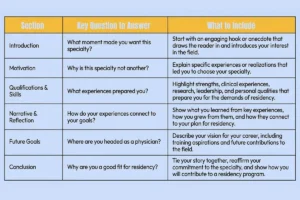
Residency Personal Statement Checklist: Write with Intent and Impact
Each element in this checklist helps ensure your essay answers the key questions program directors are looking for and makes you a compelling candidate:
Residency Personal Statement Don’ts to Avoid: Program Director Insights
Many guides will explain what a residency personal statement should include, but alongside telling your story, it’s about what you include and what you absolutely avoid. Here’s a practical list based on input from experienced PDs and national guidance:
- Don’t Just Summarize Your CV: PDs read your CV and transcripts; repeating that in your personal statement adds no new value. Instead, interpret what those experiences meant to you.
- Don’t Go Overboard or Write Too Long: Stay within one page (650–800 words). Writing in creative formats (like bullet points or experimental structures) can distract rather than impress. Keep it clear, professional, and concise.
- Don’t Write a Generic Essay That Could Belong to Anyone: If your paragraph could be cut and pasted into someone else’s personal statement, it’s not personal enough. Make your narrative unique to you.
- Don’t Personalize for the Wrong Reasons: Adding a specific program name or vague praise without substantive reasons can backfire. If you mention specific programs, make sure you explain why their resources, culture, or focus fit your goals, not just the name.
- Don’t Focus Too Much on Specialty Details or Lifestyle Perks: Program directors already know what their specialty entails. Instead of describing what the field is, focus on why you belong in it and how your experience aligns with its demands.
Why These Are Important
Program directors consistently say they are looking for a residency personal statement that:
- Shows commitment to the specialty
- Reveals unique personal qualities
- Tells a meaningful narrative
- Reflects professional maturity and self‑awareness
Personal statements for residency programs that meet these criteria help them feel confident that they are inviting someone they want on their team, not just someone with scores and accolades.
Residency Personal Statement Examples: Concepts That Worked
Your residency personal statement should be uniquely yours, but there are patterns in successful essays that often appear across specialties. These elements help program directors connect with you personally and professionally, and they appear again and again in winning statements.
Core Elements Seen in Effective Personal Statements
Regardless of specialty, standout personal statement examples for medical residency tend to follow a narrative arc that includes:
✔ A Moment of Impact at the Start: Open with a compelling experience, a patient interaction, an eye‑opening rotation, or a moment of self‑discovery that explains why this specialty matters to you. This sets a memorable tone.
✔ Linking Motivation to Real Experience: Rather than saying “I like this field,” effective writers tie their interest to specific experiences, such as clinical, research, volunteer work, or personal challenges that shaped their decision.
✔ Reflective Growth: Beyond the what and when, great statements explore why and what you learned from your experiences, showing maturity and insight that resonates with program directors.
✔ Forward‑Looking Conclusion: End with a clear, confidence‑building statement about your goals in residency and medicine beyond reinforcing your fit and commitment.
Medical Resident Statement: Specialty‑Specific Examples and Tips
Different specialties seek residents of different qualities, which makes it important to tailor your personal statement accordingly. Here’s how some common residency tracks shape their personal statement for residency programs:
Internal Medicine
Statements of internal medicine should include experiences that involve deep interaction with the patient, critical thinking, and long-term thinking. Effective candidates give accounts on how intricate cases or diagnosis dilemmas strengthen their interest in internal medicine and enable them to value continuity of care and clinical problem-solving. This shows why you are fit for this complex and intellectual field.
✔ Example Inspiration: Talk about a rotation experience when you had a significant involvement in supporting a patient over time, where you demonstrated clinical reasoning as well as empathy.
Surgery
Decisive action, teamwork, and the ability to withstand pressure arecommon characteristics in the surgical personal statements. There are numerous powerful descriptions of the experiences whereby the clinical accuracy, quick thinking, and cooperation in the OR cemented the aspirations of the applicant that s/he wanted to pursue a surgical specialty.
✔ Example Inspiration: Think of a short vignette involving being in the OR that helped you realize your interest in surgery and demonstrated your eagerness to work with intensity.
Family Medicine
Family medicine cherishes the personal rapport, interest in community, and continuity of care across diverse populations. Successful personal statements in this track discuss how relationships with patients in early years, community service, or outpatient experiences developed a passion to provide comprehensive, patient-focused care.
✔ Example Inspiration: Despite all the above, consider a patient or community experience that made you see the holistic effect of primary care.
Pediatrics
In pediatrics, emphasizing the ease of dealing with child and family dynamics, child health advocacy, and pediatric patient care experiences can be quite effective. It is important to depict your compassion for children and how you can speak to both families and care teams.
✔ Example Inspiration: The valuable rotation experience that demonstrated to you the happiness and difficulty of working with children.
Other Tracks (OB/GYN, Psychiatry, etc.)
In specialties such as psychiatry, OB/GYN, etc., prioritize specialty-related experience, such as patient communication in mental health, women’s health advocacy, or even family planning exposure, and match your motivations with the values of the specialty.
✔ Example Inspiration: In the case of OB/GYN, discuss a clinical experience that impacted you regarding women and their health or reproductive issues.
Read our complete ERAS application guide to navigate every step of the residency application process with confidence, from timelines and key components to tips that help your personal statement and supporting materials stand out and maximize your chance of matching
How These Examples Help You Write
Rather than copying anyone’s statement (which is harmful and unethical), use these examples to understand how successful narratives are constructed. Program directors use personal statements to not only measure qualifications but also discern fit, personality, and vision for future practice. By using these examples, you can contextualise your experiences to portray you as a good fit for your chosen speciality.
Here’s what this merged section gives your readers:
- General guidance on narrative structure and qualities of strong statements
- Realistic context on what specialties are valued
- Actionable inspiration without plagiarizing examples
Final Thoughts
Your personal statement for residency isn’t just an essay; it’s your chance to speak directly to program directors, share your unique journey, and show them why you belong in their specialty. Be sincere, be specific, and be thoughtful.
Start early, draft carefully, revise often, and don’t hesitate to seek feedback. With intention and clarity, your family medicine residency personal statement can be one of your strongest application strengths.
Ready to Elevate Your Personal Statement?
If you want expert help person‑to‑person, Dedicated Prep offers tailored personal statement reviews, one‑on‑one mentorship, and strategic coaching designed to make your residency application stand out. From brainstorming to final edit, we’re here to help you match with confidence.
FAQs
- What is a medical residency personal statement?
It’s a narrative essay included in your ERAS application that explains why you chose your specialty and what makes you a great fit, going beyond grades and scores. - What is the ideal word count for a residency personal statement?
Aim for about 650–800 words or roughly one page, clear and focused, as for sample residency personal statements. - Should I address weaknesses in my personal statement?
If there are significant gaps or concerns, a brief, reflective explanation can be appropriate, but don’t focus solely on weaknesses. - Should I tailor my statement for each program?
Generally, one strong statement per specialty is enough, but minor tailoring for programs you’re especially passionate about can be beneficial.
5. What should I avoid in my personal statement?
Avoid clichés, purely factual CV restatements, and overly long narratives. Keep it authentic and professionally written.