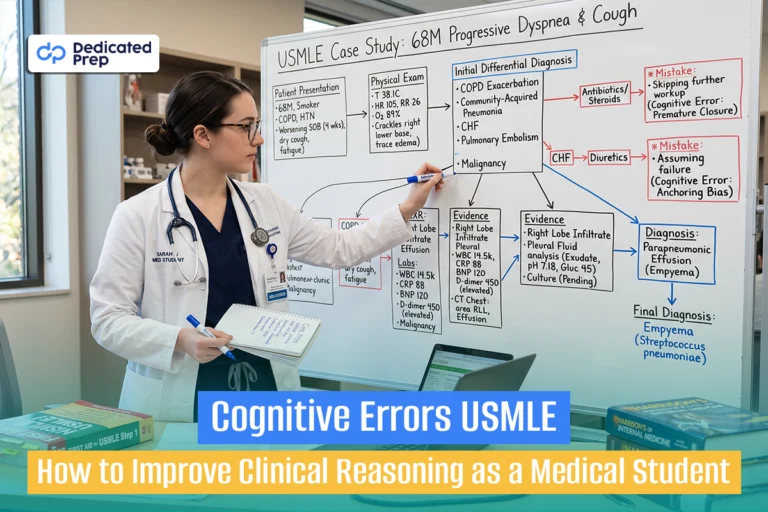

Around 795,000 Americans die or become permanently disabled every year because of diagnostic errors. Most of these mistakes do not happen because doctors do not know something. They happen because of how doctors think.
You will face the same reasoning traps on every Step exam you take. The USMLE does not just test what you know. It tests whether you are thinking breaks down under pressure, with distractors, or when a vignette is deliberately designed to look like something it is not.
Medical students who score well on Step 1 and Step 2 CK are not necessarily the ones who memorized the most. They are the ones who recognized when their brain was being tricked and course-corrected before clicking the wrong answer.
This guide explains the most common cognitive errors USMLE questions exploit, what they actually look like mid-question block, and the specific habits that sharpen clinical reasoning over time.
Quick Summary: Cognitive Errors on the USMLE
- What are they: Systematic thinking shortcuts (heuristics) that cause predictable reasoning mistakes
- Most common types: Anchoring, premature closure, availability bias, confirmation bias, representativeness bias
- Why they matter: Cognitive factors contribute to the majority of diagnostic errors in clinical practice
- How to fix them: Structured reading habits, deliberate metacognition, and consistent post-question review
- Where tested: Step 1 knowledge application, Step 2 CK multistep vignettes, Step 3 CCS case management
What Are Cognitive Errors in Medicine
A cognitive error is a predictable failure in reasoning. It happens when your brain uses a mental shortcut, called a heuristic, that usually works but occasionally leads you in the wrong direction.
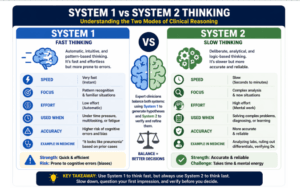
Clinicians and students operate in two reasoning modes. System 1 is fast and pattern-based. It is why you can read “young woman, butterfly rash, joint pain” and think lupus before you finish the sentence. System 2 is slower and more deliberate. It is what you use when you work through a differential step by step.
Most cognitive errors happen when System 1 fires confidently and System 2 never gets a chance to check the work. On the USMLE, that gap is exactly what question writers exploit.
Most cognitive errors happen when System 1 fires confidently and System 2 never gets a chance to check the work. On the USMLE, that gap is exactly what question writers exploit. The Agency for Healthcare Research and Quality provides further context on cognitive biases and clinical reasoning in diagnostic safety, including the role of intuitive and analytical thinking in medical decision-making.
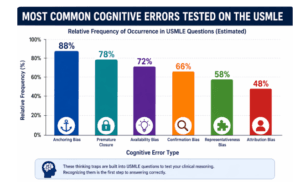
The 6 Most Common Types of Cognitive Errors in the USMLE Questions Test
These are the biases that appear most frequently across Step 1, Step 2 CK, and Step 3. The list of cognitive errors is unique, as each one has a distinct fingerprint in how questions are written.
| Cognitive Error | What It Looks Like on USMLE | How to Catch It |
| Anchoring Bias | You lock onto the first detail (e.g., age, chief complaint) and stop processing what comes after | After forming an impression, ask: What one fact would change my answer? |
| Premature Closure | You pick an answer before reading all the answer choices or the full stem | Read every option before committing. The last choice often corrects the first instinct. |
| Availability Bias | You are overweight: a diagnosis you studied recently or saw on a previous question block | Ask yourself: Am I picking this because it fits the stem, or because it is fresh in my memory? |
| Confirmation Bias | You only notice clues that support your working diagnosis and skip the contradicting ones | Actively look for one disconfirming detail before you finalize your answer. |
| Representativeness Bias | You expect the disease to look like its textbook version and miss atypical presentations | Remind yourself that USMLE writers hide diagnoses behind atypical clues on purpose. |
| Attribution Bias | The patient’s background (homeless, substance use) shapes your differential before the data does | Strip the demographics from your first read. Treat the numbers and findings first. |
1. Anchoring Bias
Anchoring happens when the first detail in a stem becomes the dominant lens for everything that follows. USMLE writers know this and often open vignettes with a charged piece of information, an age, a dramatic symptom, or a past medical history, designed to pull your attention before you have read the full picture.
A 60-year-old man with a history of alcoholic pancreatitis presents with epigastric pain. Students anchored on that history often miss the rest of the stem, which reveals normal lipase, no alcohol use in years, and an ulcer on imaging. The anchor felt so right that the disconfirming data did not land.
2. Premature Closure
Premature closure is locking onto a diagnosis before you have all the information. On Step 2 CK, this most often means picking the first answer that fits the opening lines of the vignette without reading through to the lab values, imaging, or follow-up details that would change the answer.
The USMLE-specific version of this is clicking an answer option before reading all five. Option A looks right, so you stop. Option D is the actual correct answer, and it was right there.
Step 3 penalizes premature closure the hardest. In CCS, treating a presumed diagnosis in a hemodynamically unstable patient before addressing ABCs directly causes point loss.
3. Availability Bias
Availability bias means overweighting diagnoses that are easy to recall. If you just did a two-hour Anki session on pulmonary embolism, you will see PE in vignettes where it does not belong. If you read about a rare condition the night before, you are more likely to select it on exam day, even when the presentation does not support it.
This bias also explains why students overestimate pre-test probability in low-risk patients. The diagnosis is “available” mentally, so it feels more likely than base rates justify.
4. Confirmation Bias
Once you form a working diagnosis, confirmation bias filters your attention. You notice every clue that supports your hypothesis and minimize the ones that do not fit. On the USMLE, that means students often misread lab values, interpret ambiguous findings as confirmatory, and skip the one sentence in the stem that contradicts their answer.
The fix is deliberately looking for the one piece of data that would make your diagnosis wrong before you commit.
Not sure how your clinical reasoning holds up under timed conditions? DedicatedPrep’s USMLE coaching program includes structured question review that specifically targets reasoning errors, not just content gaps.
5. Representativeness Bias
You expect iron-deficiency anemia to present with microcytosis. You expect a PE to present with pleuritic chest pain and a swollen leg. USMLE writers know exactly what the “classic” case looks like, and they deliberately hide the correct diagnosis behind atypical features.
Representativeness bias is why students miss normocytic anemia caused by concurrent B12 deficiency plus iron deficiency, or why they miss PE in a patient with no risk factors and only mild dyspnea. The disease does not look like the textbook picture, so the brain skips it.
6. Attribution Bias
Attribution bias is when a patient’s background shapes your differential before the clinical data does. A classic USMLE trap is a patient described as homeless and smelling of alcohol who presents unconscious. Many students immediately focus on intoxication and miss hypoglycemia, a subdural hematoma, or sepsis.
Strip the demographics from your first read. Let the vitals, labs, and timeline lead before the social history influences your reasoning.
| PRO TIP: After forming your initial diagnosis on any vignette, ask one question before selecting your answer: What single piece of data in this stem does not fit? If you cannot answer that, you have not read carefully enough. |
Why Cognitive Errors Hit Harder on the USMLE Than in Clinical Practice
In a real clinical encounter, you have time, you can ask follow-up questions, and you can order more tests. On the USMLE, you have 90 seconds per question and one shot at the stem. That time pressure forces System 1 reasoning even when the question is designed to punish it.
- Step 1 exploits pattern recognition errors. The vignette gives you a “classic” presentation but with one detail swapped, and students who process the category rather than the specific data pick the wrong answer.
- Step 2 CK exploits premature closure and confirmation bias. Multistep vignettes give you an opening that looks like one disease and a punchline that is something else entirely. You have to read the whole stem every time.
- Step 3 exploits anchoring and premature closure simultaneously. The CCS cases reward students who stabilize before diagnosing, not the ones who jump to a treatment plan on insufficient data.
| WARNING: One of the most common USMLE failure patterns is not a content gap at all. Students who score in the 220s on practice exams and fail Step 2 CK often have strong knowledge but lose 15 to 20 questions to predictable cognitive traps they never trained themselves to recognize. |
How to Improve Clinical Reasoning as a Medical Student to Gain Maximum Results
Clinical reasoning is a trainable skill. The students who improve fastest are not the ones who do the most questions. They are the ones who review their wrong answers and ask why their thinking broke down instead of just memorizing the right fact.
Build a Structured Reading Habit for Every Vignette
Read the last sentence first. The question being asked tells you what kind of reasoning the stem requires. Then read the stem in order, pulling out three categories of data: objective anchors (vitals, labs, timeline), clues that support a leading diagnosis, and clues that do not fit.
If the “does not fit” bucket is empty, you have likely missed something or anchored too early. High-scoring students routinely find one discordant detail before clicking their answer.
Use the Two-Diagnosis Rule
Before selecting any answer on Step 2 CK, articulate at least two plausible diagnoses. This single habit disrupts both premature closure and availability bias. If you can only generate one diagnosis, that is a signal that your reasoning is too narrow for the question.
Do Deliberate Post-Question Review
Most students review what the right answer was. The students who improve their reasoning review why they chose the wrong one. After every incorrect answer, name the cognitive error that caused it. Was it anchoring? Premature closure? Availability bias?
Over time, this builds metacognitive awareness, which is the ability to notice when your thinking is going wrong in real time. That skill is what separates students who score above 250 from those who plateau in the 230s despite equivalent content knowledge.
For a step-by-step breakdown of how to build this into your study schedule, read Dedicated Prep’s complete USMLE preparation guide.
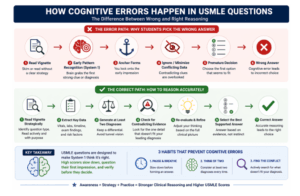
| KEY TAKEAWAY: Cognitive errors are not a sign that you did not study enough. They are a sign that you have not yet trained your reasoning process. Content knowledge and clinical reasoning are separate skills. Both need deliberate practice. |
Cognitive Errors in CBT and How They Overlap with Clinical Reasoning
If you have studied cognitive behavioral therapy for your psychiatry shelf or Step 1, you already know cognitive distortions and thinking errors. Such words as catastrophizing, all-or-nothing thinking, and overgeneralization are borrowed from the CBT literature on the impact of maladaptive thought patterns on behavior.
The use of cognitive errors in clinical reasoning uses the same framework but applies it in diagnostic decision-making. The bias in CBT, confirmation bias, or the inclination to find evidence to confirm a pre-existing belief and disregard evidence to the contrary, is directly applied to the process of a physician anchoring on a diagnosis and sifting through data to eliminate contradictory evidence.
You do not even have to learn a cross-reference between the two systems in the case of the USMLE. The important thing is to realize that both domains explain the same underlying issue: human reasoning is known to have predictable failure modes, and that knowledge of the failure modes minimizes the error.
Final Thoughts: cognitive errors USMLE explained
Cognitive errors on the USMLE are predictable, trainable, and fixable. They are not a knowledge problem. They are a reasoning problem, and once you treat them that way, the path to improving your score becomes much clearer.
Start with the six biases in this guide. Anchoring, premature closure, availability, confirmation, representativeness, and attribution. Get to know what each of them is like in a question stem. Develop the practice of conscious reading and two-diagnosis thinking. Discuss incorrect responses as to why you thought that, rather than what the correct response was. Even those students who score more than 250 on a regular basis do not have access to better resources. There are improved metacognitive habits. Those are habits that can be learned.
Ready to build a structured, reasoning-focused study plan? Dedicated Prep works with medical students across all three Step exams to close the gap between content knowledge and clinical reasoning.
FAQs about cognitive errors USMLE
- What are some cognitive errors in decision-making for the USMLE?
Cognitive USMLE errors are foreseeable reasoning errors that are a result of mental shortcuts. On the USMLE, they appear to anchor to initial information, believing in a diagnosis before reading through to the stem, or choosing a diagnosis familiar to them that does not really match the clinical presentation.
- What is the most frequent step 2 CK cognitive error?
The most frequent mistake made in diagnostic medicine is premature closure, and it is highly tested on Step 2 CK. Students will make a diagnosis prior to reading all the answer options or all the stem information, and the correct answer will be in the information that they did not read.
- What is the difference between the cognitive and knowledge gaps?
A knowledge gap refers to having no idea about a fact. A testing error, USMLE refers to you being possessed of the knowledge, but your line of thought misled you to the incorrect answer. They need various solutions: gaps in knowledge should be filled with the help of studying; cognitive errors should be addressed with the help of purposeful reasoning.
- And what are the cognitive errors as compared to cognitive distortions in CBT?
They have the same ideas but in new contexts. CBT cognitive distortions elucidate the maladaptive thinking patterns in daily living. Clinical cognitive errors are certain errors in logic in terms of making decisions in diagnosis. They both entail confirmation bias and anchoring, whereas clinical versions influence the weighting of diagnostic information by physicians and students, respectively.
- What is the time period in which clinical reasoning can be improved?
The vast majority of students can observe a significant change in four to six weeks of conscious analysis of post-question reviews based on searching patterns, not on the right answers. The most important variable is consistency, not volume. Meditating on twenty-five questions is a hundred times more likely to beat a hundred without any metacognitive reflection.