
Medical school admissions are brutal in a specific way. You can do everything right, solid GPA, competitive MCAT, hundreds of clinical hours, and still get rejected because your personal statement reads like it was written by a committee.
Admissions committees at top programs read 500 to 2,000 statements per cycle. Most land in the same pile. Not the reject pile. The forgettable pile leads to the same outcome.
The most common medical school personal statement mistake is writing about what you have accomplished and how, which makes you sound like the hundreds of other applicants with similar activities: research, clinical work, service, and community outreach.
The ones that earn interviews do something different. They answer one question that most applicants never ask themselves before writing: what could I have written?
This guide breaks down what makes a personal statement for medical school forgettable, what admissions committees are genuinely looking for underneath the formal prompt, and how to write something that makes a program director remember your name.
Quick Summary: Medical School Personal Statement in 2026
- Character limit – 5,300 characters, including spaces for AMCAS and AACOMAS. 5,000 for TMDSAS
- Word count – approximately 800 to 900 words, depending on writing style
- Prompt – “Use the space provided to explain why you want to go to medical school.”
- Biggest mistake – listing accomplishments instead of telling a specific, reflective story
- USMLE connection – your Step 2 CK score gets you the interview. Your personal statement determines whether you keep it
What Is the Medical School Personal Statement Character Limit and Word Count
The available space for the AMCAS medical school personal statement is 5,300 characters, including spaces, or approximately one page. You will receive an error message if you exceed the available space. There is no spellchecker in the AMCAS application, and no changes are permitted after submission.
The Official Limits Every Applicant Must Know Before Writing a Single Word
| Application System | Character Limit | Approximate Word Count | Schools |
| AMCAS (MD programs) | 5,300 characters | 800 to 900 words | 140 plus MD schools |
| AACOMAS (DO programs) | 5,300 characters | 800 to 900 words | All DO schools |
| TMDSAS (Texas programs) | 5,000 characters | 750 to 850 words | Texas medical schools |
IMPORTANT: AMCAS has no spellchecker and allows no edits after submission. Draft your medical school personal statement in Word or Google Docs, run spell check, then paste the final version into the application portal.
What Are Medical Schools Looking for in a Personal Statement
Admissions committees use the personal statement to learn what cannot be captured by numbers: your mindset, values, and personality. They want to know your motivation for medicine, evidence of your values such as compassion, resilience, and curiosity, and above all, self-awareness. Self-awareness is the most important quality the medical personal statement must demonstrate.
The three things every competitive medical school personal statement demonstrates:
1. A specific answer to “why medicine” – not a generic one
Every applicant wants to help people. Every applicant likes science. Your personal statement would not stand out if you fill it with generic statements such as “I want to be a physician because I want to help people.” Everyone knows that. The question is why you specifically, through your specific experiences, your specific turning points, your specific understanding of what medicine actually requires.
2. Show, do not tell
The number one personal statement mistake is telling admissions committees you are compassionate or driven without demonstrating it through specific examples. Admissions committees will not take your word for it. They want evidence. Saying “I learned to be compassionate through volunteering” is telling. Describing the specific moment, the specific patient, and what specifically changed in your thinking is showing.
3. Reflection, not resume
Students who make the decisions regarding an event first and then attempt to cram qualities into it tend to have a hard time. When students select the qualities they wish to express and then select the experience that best illustrates those attributes, they will always produce a stronger personal statement. This is not a list of what you did in your personal statement. It is a testimony of what those experiences have taught you and how they have made you what you will be as a future physician.
| PRACTICAL TIP: Before you write a single sentence, find out what two or three attributes you most desire the admissions committee to attach to you. All the paragraphs of your medical school personal statement must be related to one of those qualities or more. In the absence of this anchor, what you are saying is the resume written down in paragraphs. |
What Makes a Medical School Personal Statement Forgettable
Reading a hundred medical school personal statements back-to-back reveals a pattern. Not bad writing; most applicants write perfectly well. The pattern is sameness. The same openings. The same turning points. The same closing declarations about becoming a compassionate physician.
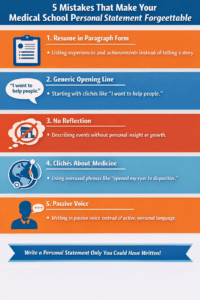
Here are the five specific patterns that make admissions committees mentally move on before finishing the page.
Pattern 1 – The Resume in Paragraph Form
One of the worst personal statement mistakes is repeating information that admissions committee members have already seen in other components of your application. There are thousands of medical school applicants; if your attempt to stand out involves listing where you volunteered and who you shadowed, you are robbing yourself of a legitimate opportunity.
The AMCAS application already has a Work and Activities section. Do not rewrite it in essay form.
Pattern 2 – The Generic Opening Line
Almost every applicant has the rationale in some form of I want to become a doctor because I love to help people. Though excellent, it is too general. There are so many careers that assist individuals. The question is, what is different about medicine to you, specifically, in your particular setting, according to your specific point of view?
o Forgettable opening: Since I was a child, I wanted to be a doctor.
o Memorable opening: Start mid-scene. Drop the reader into a specific moment. Let them feel the context before you name it.
Pattern 3 – Listing Without Reflecting
When your personal statement fails to go beyond mere generalizations, the reader will not get to know you and why you were the one who desires to become a doctor. Your statement has to be particular to what happened, reflective of more thoughtful consideration, and personally disclosing of what you are not, a resume of efforts.
Also, you can read our blog. The complete residency personal statement guide walks you through every step from theme selection to final edit.
Pattern 4 – Clichés About Medicine
Do not explain to physicians what medicine is. Do not describe how inspiring your doctor-parent was without showing what specifically that observation taught you that you could not have learned any other way. Do not write that your mission trip “opened your eyes to healthcare disparities” without showing what specifically changed in your behavior and commitments as a result.
Pattern 5 – Passive Voice Throughout
Passive voice is a weakness of your personal statement. I was faced with many obstacles is not as powerful as I worked 40 hours a week to help build a free clinic in my neighborhood. The second version does not show what happened to me, but tells you what you did.
KEY TAKEAWAY: The least memorable medical school personal statements are the ones that anyone could have written. Only you could have written the most memorable, as they include very particular moments, individuals, and considerations that belong to no other applicant.
How to Write a Personal Statement for Medical School That Actually Gets Interviews
Here is a four-step framework that produces a competitive sample personal statement for medical school students.
- Step 1 – Choose Qualities Before Experiences: Identify two to three qualities you want the admissions committee to associate with you before choosing a single story to tell. Resilience. Curiosity. Communication. Cultural humility. Then identify the experiences in your application that most powerfully demonstrate those qualities.
- Step 2 – Build One Unifying Theme: Your theme is your anchor. It could be resilience, curiosity, empathy, or growth, whatever has driven your path to medicine. Every paragraph should tie back to this theme in some way. Without a theme, your personal statement reads like a list. With one, it becomes a story.
- Step 3 – Open Mid-Scene: Your first sentence determines whether the admissions reader keeps reading. Do not open with a definition of medicine. Do not open with a childhood memory of playing doctor. Open in a specific moment with a specific sensory detail that draws the reader in immediately.
- Step 4 – Connect Every Experience to Your Future Practice: Admissions committees want to know WHY you want to earn a medical degree and how you will contribute to the medical school community. Every experience you include must connect forward, not just backward. What kind of physician are you becoming? What will you do with this degree that only your specific path has prepared you to do?
PRO TIP: Once you have a draft, read it aloud. If any sentence sounds like it came from a template or a thesaurus, rewrite it in the language you would actually use when talking to a friend. Authenticity is audible. So is its absence.
How Does Your Personal Statement Connect to Your USMLE Performance
Your Step 2 CK Score Opens the Door, while Your Personal Statement Has to Justify Walking Through It
Most pre-med guides treat the personal statement and board exam scores as separate concerns. They are not. Your Step 2 CK score determines which residency programs consider your application. Your personal statement determines whether those programs invite you for an interview.
A 255 on Step 2 CK with a forgettable personal statement loses interviews to a 248 with a statement that makes the program director remember your name.
You can explore a 1-on-1 USMLE Step Exam tutoring service to build the score that gets your personal statement in front of the right programs.
Final Verdict: Medical School Personal Statement in 2026
The medical school personal statement is not a summary of your application. It is the only stage of the whole procedure where the number fails to serve your purpose and where the majority of the applicants use that chance to write what they believe makes them seem impressive, but what is not really so about them.
AMCAS and AACOMAS have a character limit of 5,300 characters accepted personal statement for medical school. That is around 850 words. Make them say something of your own. The admissions committees are not seeking the best applicant. They are seeking the most conscious one, the individual who comprehends why they are deciding on medicine and what they will do with such a decision.
And if your Step 2 CK score is not yet where it needs to be to get your statement in front of the programs you want, book a strategy session with Dedicated Prep and build a preparation plan that closes that gap before your application deadline.
FAQ: Medical School Personal Statement
1. What is the medical school personal statement character limit?
The medical school personal statement character limit is 5,300 characters, including spaces for AMCAS and AACOMAS. TMDSAS Texas programs allow 5,000 characters, approximately 750 to 850 words, depending on writing style.
2. What should be the word count of a personal statement for medical school?
Aim to use 90 to 95% of the available 5,300-character limit for the medical school personal statement word count. A focused personal statement that does not reach the limit is always better than one padded with irrelevant content to fill space.
3. Can you use contractions in a medical school personal statement?
Yes, contractions are acceptable and often preferred because they create a natural, authentic tone. Write the way you actually speak, then edit for precision. Overly formal language makes personal statements feel like a template.
4. What are the important elements to look for in a personal statement?
Admissions committees want self-awareness, a specific answer to “why medicine,” and evidence of growth through reflection, not a list of accomplishments. Every experience should connect to the kind of physician you are becoming. Also, one can use medical school personal statement prompts for help.
5. What are good personal statement examples for medical school?
The best personal statements for medical school open mid-scene with a specific moment, build around one unifying theme, and demonstrate qualities through action rather than declaration. Avoid openings about childhood dreams of medicine and generic statements about helping people.