
USMLE tutoring reviews are student testimonials and ratings that evaluate tutoring services based on teaching quality, score improvement, and overall experience. However, most reviews focus on satisfaction rather than measurable outcomes like NBME score improvement.A 2024 report from the NBME showed first-time Step 1 pass rates for international medical graduates sitting below 60%. For students retaking the exam, the stakes and the pressure to find the right help are even higher. Most of them land on review sites, read a few glowing testimonials, and pick a tutoring service based on little more than star ratings.
That approach has a real cost. Tutoring for the USMLE can run anywhere from $100 to $400 per hour. Choosing wrong wastes money you don’t have and time you can’t get back. But the bigger problem is that most online reviews don’t give you what you actually need to make a good decision.
This post breaks down what USMLE tutoring reviews actually mean, what they consistently leave out, and exactly what to look for depending on which step you’re preparing for. You’ll also get a list of the right questions to ask before you book a single session.
| Quick Summary: | ||||||||||
|
Why Most USMLE Tutoring Reviews Leave You More Confused Than Confident
Reading reviews for a USMLE tutor feels like reading Yelp reviews for a surgeon. Everyone sounds amazing, pass rates are always 97%, and the testimonials read like they were written by the same person. That’s because most of them were curated, filtered, and placed there to convert visitors, not to inform them.
The problem isn’t that tutoring services are dishonest. It’s those reviews, by nature, that capture a specific kind of student, usually someone who came in motivated, followed the plan, and passed. The students who didn’t aren’t writing testimonials.
What USMLE Tutoring Reviews Don’t Tell You
- Tutor vs Student Effort: The reviews rarely separate tutor quality from student effort. A student who studied 10 hours a day and had a decent tutor will write a rave review. A student who needed serious rebuilding and got an average tutor will write a mediocre one. You can’t tell which situation yours resembles.
- Step-Specific Differences: They rarely specify which step was involved. Step 1, Step 2 CK, and Step 3 require completely different types of support. A glowing Step 3 review tells you almost nothing about whether that service is good for a student struggling with basic sciences on Step 1.
- Retake vs First Attempt Bias: No review platform asks the reviewer to disclose whether they took the exam once or multiple times. A student who passed on their first attempt after 6 weeks of tutoring is a very different data point from someone who passed on their third attempt after 6 months.
What Verified Reviews Actually Confirm
Verified reviews on platforms like Trustpilot or Google do confirm one real thing: the student had a real interaction with the service. That rules out fabricated testimonials. But even verified reviews measure satisfaction, not outcome quality.
Satisfaction is about how the session felt. Outcome quality is about whether your NBME scores improved by the amount you needed in the time you had. Those are two completely different things, and only the second one matters when your residency application is on the line.
The Metric That Actually Predicts Outcome: NBME Delta
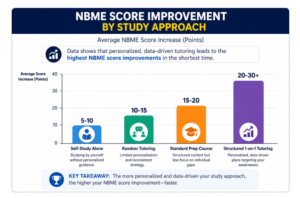
The single most useful data point a tutoring service can give you is the average NBME score improvement across all enrolled students, not just success stories. Services like DedicatedPrep report a 97% student success rate and a history of students going from failing NBMEs to 240-plus scores. That’s a specific, falsifiable claim, not a cherry-picked testimonial.
Before you book anywhere, ask: What is your average NBME score improvement across all students in the last 12 months? If they can’t answer that, the reviews on their site are decoration.
If you want to see how a genuinely personalised study plan is built before committing hours and money, explore Dedicated Prep’s USMLE tutoring approach and compare it against what you’re reading elsewhere.
Step-Specific Tutoring: Why One Review Can’t Cover All Three Exams
Step 1, Step 2 CK, and Step 3 are not harder or easier versions of the same exam. They test fundamentally different things, and the type of tutor you need for each one is genuinely different. This is the single biggest gap in every USMLE tutoring review you’ll find online.
USMLE Step 1 Tutoring: Content Architecture Over Memorisation
Step 1 is now pass/fail for most students sitting it from a US MD programme, but for IMGs, the pressure is different. Residency programme directors still use Step 2 CK scores as a filter, and a strong Step 1 performance builds the conceptual architecture that Step 2 sits on top of.
What you need from a USMLE Step 1 tutor isn’t someone who makes flashcards. You need someone who can show you how pathophysiology, pharmacology, and microbiology connect into a single clinical picture. The best Step 1 tutors teach you to think in organ systems, not isolated facts.
A review that says “my tutor was patient and explained things clearly” tells you nothing about whether they can do this. Ask instead: Did your score on timed UWorld blocks improve? Did your NBME performance predict your actual exam score?
PRO TIP: For Step 1, ask any tutor candidate to walk you through a UWorld question you got wrong. How they explain the reasoning, not just the answer, tells you more than 50 reviews.
USMLE Step 2 Tutoring: Clinical Reasoning and Vignette Strategy
Step 2 CK still gives you a numeric score, which is now the primary academic filter for residency. The minimum passing score on the USMLE has risen from 209 to 214 in recent years, but for competitive specialties, you want to be north of 240.
The tutoring skill that matters most here is clinical reasoning coaching. You’re not primarily dealing with a content gap; you’re dealing with a question interpretation gap. Most students who struggle with Step 2 know what hyponatraemia is. They misread the vignette or missed the management priority.
Good Step 2 tutors review your wrong answers and identify whether you’re failing due to knowledge, reasoning, or test-taking strategy. Those three causes require three different interventions, and a tutor who only reviews content with you is solving the wrong problem.
USMLE Step 3 Tutoring: Management Decisions and the CCS Component
Step 3 is two days long and includes the Computer-based Case Simulations (CCS), where you manage patients in real time through a simulated interface. Most exam prep resources underserve this section entirely.
If you are a resident sitting Step 3 while working full hours, your need is different again. You need a USMLE Step 3 tutor who understands time compression, who can work with you on 45-minute sessions, and who has recent CCS experience. That combination is rare, and most reviews for Step 3 tutoring don’t address it.
Before choosing a Step 3 tutor, ask specifically: Have you helped students pass the CCS component after they struggled with it? Ask for at least two references from Step 3 students.
The IMG Lens: What International Medical Graduates Should Read Differently
If you are an IMG reading tutoring reviews written by US MD students, you are reading about a different exam experience. The content is the same. The context is not.
US MD students typically sit for Step 1 during a dedicated study period of 6 to 10 weeks with full institutional support. IMGs often prepare across months or years, frequently while working, frequently without peer support, and frequently with a much longer gap between completing medical school and taking the exam.
That gap matters. A tutor who helped a US MD student add 20 points to a Step 1 NBME in 8 weeks has demonstrated a very different skill from a tutor who helped an IMG rebuild basic science foundations after a 4-year gap from medical school and then hit a competitive score.
What to Look for in Reviews If You Are an IMG
Look for reviews that specifically mention the IMG experience: preparation across a long gap, rebuilding foundations, navigating ECFMG requirements alongside study, and managing isolation during prep. These details tell you the tutor has worked with someone in your actual situation.
Dedicated Prep’s tutors include IMGs who have taken and scored highly on all three steps. That specific background matters because they understand the psychological pressure of the IMG journey in a way that a tutor who graduated from a US school and passed the first time simply cannot replicate by reading about it.
You should also ask whether the service has helped IMGs who are applying in the current Match cycle, not just students who passed the exam. Passing and matching are two different things, and the best services bridge both.
KEY TAKEAWAY: IMGs should filter reviews by three data points: long gap year experience, ECFMG support, and whether the tutor has helped students who went on to match into competitive programs.
For a deeper look at the IMG prep journey, the ECFMG certification pathway outlined by the NBME is the official source for understanding what documentation and steps you need before applying to residency programs.
Green Flags Vs Red Flags: How to Read Any USMLE Tutoring Review
Not all reviews are created equal. Once you know what you’re looking for, you can pull signal from noise in about two minutes.
| What You See in the Review | What It Actually Means | Signal |
| “My tutor was patient and kind” | Good rapport. Tells you nothing about score outcomes. | Weak |
| “I went from 198 to 241 on Step 2 CK” | Specific numeric outcome. High-value data point. | Strong |
| “They created a personalised study plan” | Standard claim. All services say this. Ask for specifics. | Neutral |
| “My tutor noticed I kept missing pharmacology” | Evidence of genuine diagnostic work. The tutor was paying attention. | Strong |
| “I passed on my first attempt” | Good outcome, but context-free. Was this a first-time sitter or a retake student? | Neutral |
| “I failed twice before and passed with them” | High-value review. Retake success is harder to achieve. | Very Strong |
| “Sessions were flexible and easy to schedule” | Logistics review. Helpful but secondary to academic outcome. | Weak |
| “My NBME scores improved 35 points in 6 weeks” | Specific, time-bounded improvement. Most reliable kind of review. | Very Strong |
Red Flags to Filter Out Immediately
Be sceptical of any service where every review is 5 stars and every testimonial mentions a pass on the first attempt. Real student outcomes include borderline passes, retakes, and students who needed to change tutors. A platform with zero negative reviews is either filtering them or fabricating them.
Watch out for reviews that describe the tutor using language that sounds identical across multiple posts: phrases like “went above and beyond” or “truly personalised” appearing word-for-word across multiple reviews are a sign of coached testimonials.
And if a service can’t give you references, that’s the clearest red flag of all. As Elite Medical Prep correctly points out in its own vetting guide, any company that can’t put you in contact with a former student because of “privacy policies” is a company you should walk away from.
- WARNING: Never commit to more than a trial session without seeing NBME score improvement data and speaking to at least one former student in a similar situation to yours.
For the official standard on what tutoring oversight and medical education accountability look like, the USMLE program overview gives you the baseline expectations against which any prep service should be measured.
5 Questions to Ask Any USMLE Tutor Before You Pay
The best USMLE tutor reviews tell you what past students experienced. These five questions tell you what you’ll experience. Ask them in your free trial or consultation session and pay close attention to how the answers come.
- What is your average NBME score improvement for students at my step? A tutor who has worked consistently with Step 2 students should know their typical delta. “It depends on the student” is not a data-based answer. Push for a range.
- Can I speak to a former student who had a similar starting point to mine? Not just a success story from their homepage. A student who came in at your score level, your step, and your timeline.
- How do you identify whether my problem is content, reasoning, or test strategy? This question separates tutors who teach from tutors who coach. The answer should involve reviewing your actual wrong answers, not just asking about your feelings.
- What happens if we’re not making progress after 4 sessions? Good tutoring services have a plan for this. They adjust the approach, they escalate the intensity, or they offer a tutor switch. Services without an answer to this question are selling hours, not outcomes.
- Have you worked with students who have had a gap year or are retaking this step? Especially critical for IMGs. The study strategy for a retake student is different from that of a first-time sitter, and a tutor who doesn’t understand that distinction will apply the wrong approach.
For context on what a genuinely strong mentorship model looks like in practice, read about how Dedicated Prep helps students to achieve 250+ scores who have sat the same exams under the same conditions.
When USMLE Tutoring Won’t Actually Help You
This is the section no tutoring company writes. But it matters, because if you’re in one of these situations, the most helpful thing anyone can tell you is: get the other thing sorted first.
Tutoring does not fix burnout. If you’re 14 months into a Step 1 prep and you’ve read First Aid three times and your NBME scores are still not moving, the problem is often not a knowledge gap. It’s cognitive exhaustion. A tutor adding more sessions will accelerate the burnout, not the score.
Tutoring also doesn’t fix a resource problem. If you haven’t completed a UWorld pass, if you’re jumping between six different question banks, or if you’re doing passive video-watching instead of active question practice, a tutor can point this out, but they can’t make up for the hours you haven’t put in.
And tutoring won’t close a gap that requires a different kind of support. If you’re dealing with significant test anxiety that makes your timed blocks non-representative of your actual knowledge, a clinical psychologist who works with medical students will help you more than an additional content session will.
The most honest USMLE tutoring services tell you when tutoring isn’t the right intervention. That honesty is itself a green flag when you’re evaluating who to work with.
Final Verdict: Dedicated prep should be your first choice
Start with your diagnostic data, not with reviews. Pull your last two NBME scores, identify whether your errors cluster in content gaps, reasoning errors, or timing issues, and write that down. That single document is worth more than an hour of reading testimonials.
Then look for a USMLE private tutor that can speak to your specific situation: your step, your gap year or retake history if relevant, and your timeline to exam day. Ask the five questions above. Request a free trial. Speak to a former student.
Dedicated Prep is built specifically for the best USMLE tutoring online for medical students around the globe. Every student is paired with a 250-plus scoring mentor who has passed the same exam you’re preparing for, and every study plan is built from your actual NBME data, not a generic template. You can explore our high-scoring approach and start your USMLE prep today.
FAQs about USMLE Tutoring Reviews
How much does USMLE online tutoring typically cost?
One-on-one USMLE tutoring ranges from roughly $100 to $400 per hour, depending on the tutor’s credentials and the service model. Package pricing is usually more cost-effective than per-session billing if you need 20 or more hours of support.
Is online USMLE tutoring as effective as in-person tutoring?
Yes, for the vast majority of students. All NBME practice and UWorld question review happen on a screen anyway, so online delivery matches the format of the actual study work. What matters is session consistency and tutor quality, not location.
How do I know if a USMLE tutor is right for me before committing?
Ask for a free trial session and come with a specific wrong answer from a recent practice block. Evaluate how the tutor diagnoses your error and whether their explanation shifts your understanding, not just gives you the answer.
Can tutoring help me if I’ve already failed a step exam?
Yes, but the approach needs to change. Retake students typically need a diagnostic reset, not just more content review. The best USMLE tutors for retake students will start by identifying what failed in your previous strategy before adding new material.
What is the difference between a USMLE tutor and a USMLE prep course?
A prep course delivers structured content to a group on a fixed schedule. A tutor works from your personal diagnostic data and adjusts every session to your specific gaps. Courses are efficient for building foundations. Tutoring is more effective for targeted score improvement.