
As an IMG, you are not just preparing for an exam. You are rebuilding clinical reasoning in a specific framework, the USMLE decision logic, that may differ significantly from how you were trained. Generic prep plans do not account for that gap.
A failed Step 2 CK attempt does not simply delay your exam date. It follows you permanently on your ECFMG record, appears on every residency application you submit, and in a match cycle with fixed ERAS deadlines, a failed first attempt can cost you an entire application year. For IMGs applying to competitive programs, even one failed attempt shifts your application from borderline-competitive to functionally disqualified at many programs. The retake window, alone, restudy period, rescheduling, and the 3-month eligibility reset typically burn 4 to 6 months you cannot get back.
According to the NBME 2024 performance data, the average matched non-U.S. IMG scored 245 on the Step 2 CK, a score that most 4-week study guides were never designed to help you achieve. This 12-week USMLE Step 2 study plan is built specifically for IMG realities. It gives you the exact weekly structure, daily hour breakdown, resource priorities, score benchmarks, and decision rules you need to pass on your first attempt with a number that actually gets you interviews.
What Every IMG Must Understand Before Opening UWorld
Most Step 2 CK guides skip the context and jump straight to the schedule. That is a mistake because if you do not understand the exam landscape you are entering, you will optimize for the wrong goal.
The Passing Score Just Changed: And Passing Is Not the Goal
Effective July 1, 2025, the NBME raised the minimum passing score for Step 2 CK from 214 to 218. That change matters less than this one: since Step 1 became pass/fail in 2022, program directors now use Step 2 CK as the primary numerical differentiator between applicants. According to the NRMP Program Director Survey 2024, 83% of program directors consider Step 2 CK scores when screening IMG applicants, and approximately 30% of programs use a hard cutoff score for interview invitations.
Passing is not your goal. A competitive score is your goal. Those are two very different preparation strategies.
Why IMGs Need 12 Weeks When U.S. Students Use 6
This is not about intelligence or work ethic. It is about what each type of student brings to the exam.
U.S. MD students finishing clerkships have spent 2 years reinforcing the exact clinical decision framework, the “next best step” logic, the management sequence hierarchy, the way the exam presents a clinical scenario and expects a specific type of reasoning. They are refining a framework they already have.
Most IMGs are building that framework from scratch alongside their content review. The 12-week plan exists to give you enough time to do both properly.
The Most Common IMG Error Pattern and How to Fix It
The single most consistent pattern in IMG Step 2 CK performance is this: you recognize the diagnosis but choose the wrong next step. You know it is a pulmonary embolism. You get the CT pulmonary angiography question right. But then the management follow-up question is about anticoagulation sequencing, duration, and the next action when a patient deteriorates.
That is not a content problem. That is a clinical reasoning framework problem. The fix is not reading more. The fix is to treat every UWorld explanation as a decision algorithm: not just what the right answer is, but why this was the next step rather than the other one that also seemed correct.
The tutors at Dedicated Prep’s expert USMLE coaching programme work specifically with the Flexible USMLE Step 2 1-month study plan and USMLE Step 2 60-day study plan for IMGs on rebuilding this decision framework, turning medical knowledge you already have into the specific reasoning patterns the USMLE rewards.
The 12-Week IMG USMLE Step 2 Study Plan: Full Schedule
| Phase | Weeks | Primary Focus | Daily Hours |
| Foundation | 1 – 3 | Baseline diagnostic and systems review and UWorld habit | 8 hrs |
| Core Build | 4 – 8 | Full UWorld first pass on parallel topic review by the system | 10 hrs |
| Intensive | 9 – 10 | UWorld wrong questions reset and NBME to weak area targeting | 10–12 hrs |
| Peak & Polish | 11 – 12 | UWSA simulations are the final consolidation of mandatory rest | 8–10 hrs |
Phase 1- Foundation (Weeks 1 to 3)
Week 1: Diagnose Before You Treat
Take NBME 10 on Day 1. No preparation. No review beforehand. This is your diagnostic, not a performance test. Treat it like drawing labs before starting treatment. Record every wrong answer by the system. This list becomes your personal weak-topic priority map for the next 11 weeks.
Begin UWorld on Day 2 in tutor mode, 40 questions per day, starting with Internal Medicine. Read every explanation regardless of whether you answered correctly. Do not chase speed in Week 1, chase understanding.
Key resources required for the USMLE Step 2 CK study plan
Tier 1 — Mandatory
- UWorld
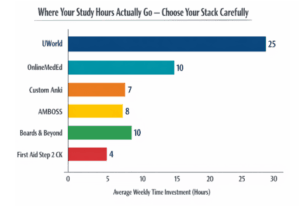
- NBME 10–13
- UWSA 1 & 2
Tier 2 — Recommended
- OnlineMedEd
- Personal Anki
Tier 3 — Optional
- AMBOSS OR Boards & Beyond
Tier 4 — Avoid
- Pre-made Anki
- Random YouTube lectures
Week 2: Cardiology and Pulmonology
These two systems alone account for approximately 20% of Step 2 CK content. Watch OnlineMedEd videos for each topic before doing UWorld questions in that area. Increase to 60 questions per day. Start building your personal Anki deck, one card per concept that surprised you, not one card per fact you knew.
Pre-made Anki decks test other people’s weak points. The cards you make from your own UWorld mistakes test your own. A personal deck of 400 cards built from your errors is worth more than a downloaded deck of 4,000 cards built from someone else’s.
Week 3: GI, Nephrology, and Endocrinology
Increase to 80 questions per day. These three systems together represent another 20–25% of exam content. Take NBME 11 on the final day of Week 3. You should see a 5-10-point improvement over your Day 1 baseline. If improvement is less than 5 points, your review pace is too fast; you are reading explanations without processing them. Slow down.
Step 2 CK preparation works best when it is part of a long-term strategy rather than an isolated study period. See our complete USMLE Step study plan covering Step 1, Step 2 CK, and Step 3 for the full timeline and resource stack.
Phase 2 – Core Build (Weeks 4 to 8)
This is the engine of your USMLE Step 2 study plan. Five weeks. Full days. This is where your score is built.
Best study plan for USMLE Step 2 CK, daily for Weeks 4 through 8
| Time | Duration | Task |
| 7:00 – 8:30 AM | 90 min | 40 UWorld questions, timed, test mode |
| 8:30 – 10:30 AM | 2 hrs | Review all 40 questions in full detail |
| 10:30 – 12:00 PM | 90 min | Topic review: OnlineMedEd or Boards & Beyond |
| 12:00 – 1:00 PM | 1 hr | Break and lunch: leave the desk completely |
| 1:00 – 2:30 PM | 90 min | 40 UWorld questions, timed, test mode |
| 2:30 – 4:30 PM | 2 hrs | Review all 40 questions in full detail |
| 4:30 – 5:30 PM | 1 hr | Anki review existing cards only, no new additions |
| 7:30 – 8:30 PM | 1 hr | New Anki cards from today’s UWorld review |
System Coverage by Week
- Week 4– OB/GYN: high yield, frequently tested, very learnable in one week
- Week 5– Paediatrics: focus on developmental milestones, vaccines, and acute presentations
- Week 6– Surgery and Orthopaedics: trauma algorithm, pre-op and post-op management
- Week 7– Psychiatry and Neurology: DSM criteria precision, stroke localisation, headache types
- Week 8– Dermatology, Ophthalmology, ENT: brief but present on every exam, do not skip
Take an NBME after a 4-week study plan, USMLE Step 2 CK at the end of Week 5 and again at the end of Week 7. Record your wrong answers by system and adjust the following week’s topic review toward your worst-performing areas.
What to Do When Your NBME Score Plateaus
Score plateaus between a 5-week study plan for the USMLE Step 2 and 7 are common, and they mean one specific thing: you have covered the content, but your clinical reasoning application is lagging. The fix is to switch from reading UWorld explanations to actively teaching them after each explanation. Close it and explain the reasoning chain out loud in your own words. If you cannot explain it, you have not learned it.
Phase 3 – Intensive (Weeks 9 and 10)
You are no longer learning. You are performing. Reset UWorld to show only your previously incorrect questions. Do not redo questions you got right the first time; your wrong questions are where your score is hiding.
Targeting Your Weakest System with Surgical Precision
Pull your NBME error logs from Weeks 1 through 8. If any system shows a consistent wrong-answer rate above 40%, that system gets three dedicated days in Week 9: UWorld wrong questions, topic review video, and new Anki cards built from every missed concept.
Do not spread yourself across every weak area. Pick the one that is costing you the most points and go deep.
The UWSA 1 Decision Rule
Take UWSA 1 at the end of Week 9. This score is the clearest real-time predictor of your actual exam performance.
- 245 or above: You are on track. Proceed to Phase 4.
- 235 to 244: You are close. Continue with Phase 4, but extend it by one week.
- Below 235: Do not proceed to a scheduled exam date. Add a Week 10B intensive week targeting your two weakest systems, and retake UWSA 1 before committing to an exam date.
Phase 4 – Peak and Polish (Weeks 11 and 12)
Week 11: Simulation Week
Take NBME 13 on Monday. Take UWSA 2 on Thursday. These are currently the most predictive assessments of your actual exam score. Review every wrong answer. Do not study new material. Rest completely on Friday, Saturday, and Sunday. Your brain consolidates information during rest, not during additional reading.
The Most Ignored Step 2 CK Advice: Rest Is Part of the Plan
In our experience working with IMG students, the week before the exam is where the most preparation damage happens, not because students stop studying, but because they cannot stop. Anxiety drives 12-hour cramming sessions that produce fatigue and cognitive overload, not learning. The students who score highest on exam day are the ones who arrived rested, not the ones who studied hardest the night before.
Week 12: The Final Week
Monday and Tuesday: review your personal weak-topic list, only not new material, only the specific concepts that have appeared on multiple wrong answers throughout your prep.
Wednesday: take the NBME Free 120 questions as your final simulation. Score it. Note any pattern in wrong answers.
Thursday: logistics only. Confirm your testing centre location, travel time, what to bring, and what to eat. No studying.
Friday: done with step 2 of the USMLE study plan and all set for exam day.
Final Verdict: Your Exam Date Is a Decision, Not a Calendar Entry
The 12-week USMLE Step 2 study plan above is your structure. But the most important decision you will make in this entire preparation is whether to sit the exam on your scheduled date or reschedule it.
This plan is built for IMGs who cannot afford a failed first attempt. The rule is simple: if your UWSA 2 score in Week 11 is below 240, reschedule. Two extra weeks of targeted preparation are a better investment than a failed attempt that follows your application for the rest of your career.
If your UWSA 2 is at 245 or above, you are ready. Go to your exam with confidence that you have done the work.
For IMGs who want expert guidance on the clinical reasoning patterns that are holding their score below target, the specialist USMLE tutors at Dedicated Prep offer one-on-one sessions designed to identify and fix those patterns. One week of targeted expert feedback often moves scores by 10 to 15 points faster than an additional week of solo UWorld.
Your score is built up over the 12 weeks before the exam. Your match is built on that score. Start the plan, follow the benchmarks, and do not sit until you are ready.
FAQs
1. How many hours a day should I realistically study as an IMG with no structured programme?
USMLE Step 2 CK study plan for IMGs starts with 8 hours per day for the first three weeks to build the habit without burning out early. Increase to 10 hours per day from Week 4 onward. Quality matters more than hours. 8 focused hours with complete UWorld review beats 12 hours of passive video watching every single time.
2. Is 12 weeks actually enough for the USMLE STEP 2 CK study plan?
For most USMLE Step 2 CK study plan IMGs typically takes 2 to 4 years post-graduation; 12 weeks is enough to reach 240–250 if the schedule above is followed consistently. If you are more than 5 years post-graduation, or your clinical training was shorter than average, consider extending the Foundation Phase by 2 weeks to 14 to 16 weeks.
3. Is UWorld enough, or do I actually need the AMBOSS USMLE Step 2 CS study plan?
A 1-month USMLE Step 2 study plan alone is sufficient for the vast majority of IMGs to pass with a competitive score. Finish UWorld and review every explanation before considering AMBOSS. The most expensive mistake in Step 2 CK preparation is spreading time across two question banks shallowly instead of mastering one deeply.
4. What score do I actually need as a non-US IMG to match in Internal Medicine?
According to NRMP 2024 match data, the average Step 2 CK score for matched non-U.S. IMGs in Internal Medicine was 248. Family Medicine and Psychiatry typically accept lower scores. For competitive specialities like Neurology, Radiology, or academic Internal Medicine programmes, aim for 255 or above to be genuinely competitive.
5. My UWSA 2 is at 237, and my exam is in 10 days. Should I push it back?
Yes, reschedule. A 237 on UWSA 2 puts your predicted real exam score in the low-to-mid 230s, which is below the competitive threshold for most IMG applicants. Ten more days of cramming will not significantly improve that score. Reschedule for 3 to 4 weeks out, spend two weeks on your weakest two systems with targeted UWorld reset work, and retake UWSA 2 before confirming your new exam date.