According to NRMP 2025 data, 58.0% of non-U.S. citizen IMGs matched to PGY-1 positions, compared with 93.5% of U.S. MD seniors.
That is the approximate match rate for non-US IMGs in the 2024 NRMP Main Residency Match, compared to 94% for US MD seniors. The gap is not a myth, and it is not closing fast. It is structurally built into how residency programs filter applications before a program director ever reads your personal statement.
Your USMLE Step scores are the first filter. And for IMGs, those scores need to do more work than they do for US graduates. A 230 that is perfectly competitive for a US student can quietly eliminate an IMG application in the same specialty.
This is not a reason to panic. It is a reason to be strategic. And the most important strategic decision most IMGs make or fail to make is finding the right USMLE tutor online. Not a general tutor. Not someone who works primarily with US medical students. The best USMLE tutor online for IMGs is one who offers IMG-specific diagnostics, Step 2 CK score strategy, clinical reasoning reconstruction, ECFMG timeline planning, and specialty-aware study guidance.
This guide is built entirely around that question: what does the best USMLE tutor online for IMGs actually look like, and how do you find one?
Why IMGs Face a Structurally Different USMLE Challenge
Understanding the landscape you are competing in is not optional it directly determines what kind of tutoring you need and what score you actually need to reach.
The Match Rate Gap No One Talks About Openly
Program directors will rarely say directly that being an IMG is a disadvantage. What the data says, however, is unambiguous. Non-US IMGs consistently match at rates 30 to 40 percentage points below their US MD counterparts across most specialties. In competitive programs, that gap is wider.
The NRMP 2024 Main Residency Match data show that while US MD seniors achieved a 93.7% match rate overall, non-US IMGs matched at approximately 57 to 64%, depending on specialty and year of graduation. For IMGs with graduation gaps of three or more years, those numbers tighten further.
What bridges this gap most reliably? Step 2 CK scores, now that Step 1 has moved to pass/fail. Programs that once filtered on Step 1 are now using Step 2 CK as the primary numeric differentiator for IMG applications.
What NRMP 2024 Data Reveals About IMG Scores and Match Outcomes
The NRMP’s Charting Outcomes reports consistently show that matched IMGs score significantly higher than unmatched IMGs on USMLE steps score differential between matched and unmatched IMG applicants is larger than the equivalent differential for US seniors, meaning score matters more for IMGs, not less.
This means your study strategy cannot be built around the same benchmarks a US student uses. It must be built around IMG-specific competitive thresholds by specialty.
Specialty-by-Specialty IMG Step 2 CK Score Benchmarks
| Specialty | Minimum Competitive | Strong IMG Application | Notes |
| Internal Medicine | 235 | 245+ | Most IMG-friendly; scores still differentiate |
| Family Medicine | 225 | 235+ | Accessible; Step 3 often required early |
| Psychiatry | 235 | 245+ | Growing IMG acceptance; score + research helps |
| Pediatrics | 235 | 245+ | Competitive; CS/observer ship important |
| Surgery (General) | 250 | 258+ | Very competitive; high bar for non-US IMGs |
| Emergency Medicine | 245 | 255+ | Highly competitive; publication record helps |
| Radiology | 250 | 258+ | Research output critical alongside scores |
| Dermatology | 255 | 260+ | Extremely competitive; rare IMG matches |
The Clinical Reasoning Gap Built into Non-US Medical Training
This is the part of the IMG challenge that score data alone does not capture, and the part where the right tutor makes the most difference.
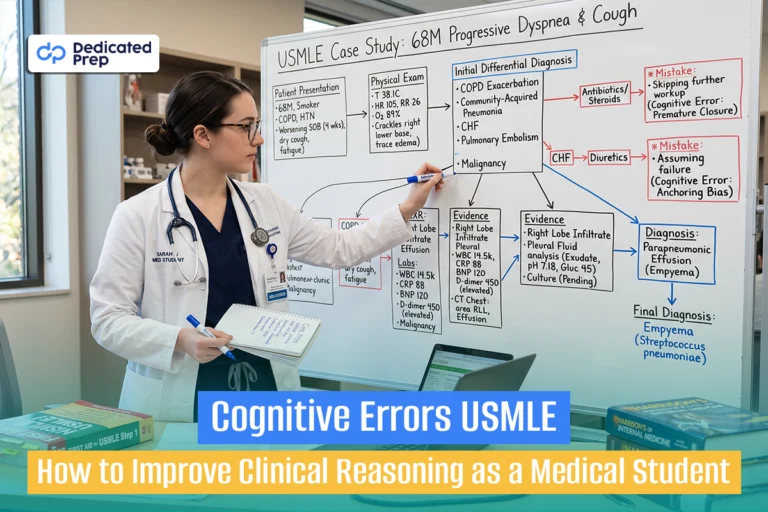
Most international medical curricula are built around theoretical mastery: anatomy, physiology, pathology, and biochemistry taught as disciplines. The USMLE, particularly Step 2 CK, is built around clinical decision-making: a patient present, you manage them. The logic is sequential, American, and deeply embedded in the US healthcare system’s protocols and ethical frameworks.
IMGs who were strong students in their home country often arrive at Step 2 CK sessions confused, not because they lack knowledge, but because they are applying the wrong decision model. They know what is happening to the patient. They do not yet know how an American physician would respond and the USMLE rewards the American response, not the clinically reasonable one from another context.
How the US Healthcare Decision Model Differs
The US medical decision model taught through the USMLE has several features that are genuinely different from other systems:
- Patient autonomy is paramount. In many international systems, a physician’s clinical judgment overrides patient preference in ways the USMLE would mark incorrect.
- Informed consent is a clinical process, not a formality. Questions about what to do before a procedure will test your understanding of consent, not just clinical management.
- The next best step framework is highly specific. ‘Best initial management,’ ‘most appropriate next step,’ and ‘most likely diagnosis’ are not interchangeable; the USMLE distinguishes them with precision.
- End-of-life care, advance directives, and DNR protocols follow specific US legal and ethical frameworks that differ substantially from most other countries.
How USMLE tutor online for IMGs works: step by step Breakdown for Each Exam
A tutor who works with IMGs on Step 1 spends significant time on question interpretation teaching students to extract the basic science concept from the clinical framing rather than content review of concepts the student already knows.
USMLE Step 1 Tutoring for IMGs
Step 1 is pass/fail since 2022, but passing on the first attempt is non-negotiable for IMGs. A failed Step 1 significantly complicates residency applications and requires explanation in every program’s secondary. The strategic goal is a confident first-attempt pass with minimal delay not maximizing a score that no longer exists.
Bridging Basic Science Gaps from Non-US Curricula
Most IMG curricula cover the core sciences tested in Step 1 the gap is usually in how the material is tested, not what is tested. The USMLE uses integrated, clinical-context questions for basic science: a question about enzyme kinetics will present as a patient with a metabolic disorder, not as a stand-alone biochemistry problem.
Most Common Step 1 Weak Areas for IMGs by Training Region
| Training Region | Common Strength Areas | Typical Weak Areas |
| South Asia (India, Pakistan, Bangladesh) | Anatomy, Pathology | Behavioral Science, Biostatistics, Ethics |
| Middle East & North Africa | Biochemistry, Microbiology | Health Systems, Preventive Medicine |
| Sub-Saharan Africa | Clinical Sciences | Pharmacology (US drug naming), Genetics |
| Latin America | Physiology, Surgery basics | Immunology, Behavioral Science |
| Eastern Europe | Anatomy, Physiology | Biostatistics, Patient Communication |
USMLE Step 2 CK Tutoring for IMGs
Step 2 CK is now the most important exam in an IMG’s residency application. It is also the exam where the IMG-specific knowledge gap is most pronounced not in content knowledge, but in clinical reasoning style.
Mastering the Next Best Step Framework
The single most high-yield skill for Step 2 CK is understanding what the question is actually asking. USMLE Step 2 CK uses a precise vocabulary of question stems that each demand a different type of answer:
- ‘Most likely diagnosis’ choose the most probable given the presented evidence, not the most serious.
- ‘Best initial step’ often history, physical exam, or a cheap, safe test before imaging or advanced workup.
- ‘Most appropriate next step’ may be management, not diagnosis, depending on patient stability.
- ‘Most likely cause’ etiology, not management or diagnosis.
- ‘Best treatment’ evidence-based first-line per US guidelines, not what is clinically reasonable globally.
IMGs who conflate these categories lose points consistently. A tutor’s job is to make these distinctions automatic through repetition and immediate feedback.
US vs International Clinical Decisions That IMGs Must Actively Unlearn
- Ordering more tests before treatment in unstable patients the USMLE rewards treating first in emergencies.
- Deferring to family members in end-of-life decisions, US law prioritizes patient autonomy and documented advance directives.
- Using first-line treatments from non-US guidelines, only US guidelines (USPSTF, AHA, ACC, CDC) are correct on the USMLE.
- Aggressive workup before considering cost or patient preference shared decision-making is tested explicitly.
USMLE Step 3 Tutoring for IMGs
Step 3 is often the least-discussed exam in IMG tutoring contexts, but it is taken seriously by programs that require it before offering positions. It introduces a format, Computer-based Case Simulations (CCS) that is genuinely novel for nearly every IMG candidate.
CCS Navigation — The Format Most IMGs Have Never Encountered
CCS cases require you to manage a patient over a simulated time period ordering tests, treatments, consultations, and follow-ups in a realistic sequence. There is no multiple-choice prompt. You type orders and the simulation advances based on your decisions. For IMGs who have trained exclusively in written exam formats, this is disorienting in a way that content review alone cannot fix.
CCS requires dedicated practice with the software itself, combined with tutoring on clinical management sequences. A tutor who has helped IMGs through Step 3 knows which CCS scenarios are highest yield and how to practice the order-entry interface efficiently.
Ambulatory Care Scenarios That Catch IMGs Off Guard on Step 3
- Preventive care and screening intervals, including mammography, colonoscopy, and vaccine schedules per USPSTF
- Chronic disease management in the outpatient setting, diabetes, hypertension, and hyperlipidemia protocols
- Medication reconciliation and follow-up scheduling tested as clinical management, not pharmacology
- Mental health first-line management, antidepressant initiation, follow-up intervals, crisis referral
What to Look for in the Best USMLE Tutor Online for IMGs
Not every experienced USMLE tutor is equipped for the IMG challenge. The qualifications that matter are specific, and the questions you ask before booking a session are just as important as the sessions themselves.
Qualification 1 — IMG-Specific Match Experience
A tutor who has helped US medical students pass Step 1 may be excellent at content delivery but entirely unprepared for the clinical reasoning reconstruction, score strategy, and application sequencing that IMG preparation requires. These are different skills.
Look specifically for tutors who can tell you: which specialties their IMG students matched into, what score improvements they achieved, and how they approach cases where graduation gaps complicate exam validity windows.
Questions to Ask Before Booking a First Session
- How many IMG students have you worked with in the last 12 months?
- What specialties did your IMG students match into, and what were their Step 2 CK score ranges?
- How do you adjust your approach for students with graduation gaps of two or more years?
- How do you incorporate ECFMG sequencing into the study plan you build?
- Can you share specific examples of how you approached clinical reasoning gaps with non-US-trained graduates?
Red Flags That Disqualify a Tutor Immediately
- They give you a study schedule without first asking about your graduation year, prior attempts, or target specialties.
- Their student testimonials come exclusively from US MD or DO graduates.
- They cannot explain the difference between the IMG match strategy and general USMLE preparation.
- They are unfamiliar with ECFMG requirements or cannot discuss exam validity windows.
- They set score targets without referencing specialty-specific IMG benchmarks.
Qualification 2 — Clinical Reasoning Reconstruction Ability
The tutor’s ability to rebuild clinical reasoning from the ground up, not just teach content, is what separates adequate from exceptional for IMG students. This requires patience, a specific teaching methodology, and a firsthand understanding of how the US clinical decision model differs from others.
What a Clinical Reasoning Reconstruction Session Actually Looks Like
In a well-structured clinical reasoning session for an IMG, the tutor does not just explain why the correct answer is correct. They walk through the question the way an American physician would think through the clinical scenario, narrating the differential, the decision points, the protocol-based choices until that thinking pattern becomes the student’s default.
This is active, iterative, and slow by design. It takes longer than content review, and it is more important. An IMG who understands the American clinical reasoning framework can apply it to questions they have never seen before. An IMG who has only memorized content hits a wall at clinical vignettes that they cannot map to prior knowledge.
Qualification 3 — Timeline Flexibility Around Real IMG Constraints
US students have a defined study block. IMGs often do not. You may be preparing while completing observer ships, managing visa renewals, working part-time to support your preparation, or studying across a 7-hour time zone difference. A tutor who builds a plan that assumes eight uninterrupted weeks of full-time study is not building your plan they are building a hypothetical plan for a different student.
ECFMG Sequencing and Score Validity Windows
ECFMG certification requires passing all USMLE Steps and meeting medical school credential requirements. Critically, USMLE Step scores must be achieved with the highest ranking, and there are limits on the number of attempts per Step. For IMGs planning their exam sequence, this is not a bureaucratic footnote; it is a planning constraint that shapes everything. See ECFMG’s official requirements for current documentation.
Why Online USMLE Tutoring Works Well for IMGs
Finding the best USMLE tutor online for IMGs is not a compromise option because in-person tutoring was unavailable. It is structurally the better format. Here is why that is true by design, not by default.
Timezone Accessibility and the Global Expert Problem
The best USMLE tutors for IMGs are not necessarily located in your city, your country, or even your time zone. Online tutoring removes geography as a selection criterion entirely you choose based on expertise, IMG experience, and teaching fit rather than proximity.
This matters more for IMGs than for any other USMLE student group. The pool of tutors who genuinely understand IMG challenges is smaller. Restricting yourself to local options dramatically reduces the probability of finding the right match.
How to Structure Weekly Sessions Across Time Zones
Consistent scheduling is critical for USMLE preparation. Inconsistent tutoring sessions every few weeks rather than weekly or bi-weekly does not build momentum. When structuring sessions across time zones:
- Anchor your session time to your most cognitively alert hours, not your tutor’s preferred slot.
- Build in 15 minutes of post-session consolidation time to capture key insights while they are fresh.
- Record sessions where your tutor allows it clinical reasoning walkthroughs are more valuable the second time through.
- Schedule two weeks in advance so both parties protect the time. Also, analyze exam cost.
Tools That Make Online Tutoring as Effective as In-Person
The technology stack for effective online tutoring is well-established and accessible. The difference between a productive online session and an unproductive one is rarely technology it is structure and preparation.
Screen Sharing, UWorld Integration, and Session Recording
- Screen sharing with annotated UWorld questions in real time is the most effective question deconstruction format available more efficient than reviewing printed questions.
- Digital whiteboards allow tutors to draw pathophysiology pathways, differential trees, and decision frameworks that visual learners retain better than spoken explanation alone.
- Session recordings allow you to revisit clinical reasoning walkthroughs which are the highest-value part of any IMG tutoring session in the days after the session when consolidation happens.
- Shared Google Docs for running weakness logs and study plan adjustments, keep both tutor and student accountable between sessions.
The IMG USMLE Preparation Timeline: Where Tutoring Plugs In
Most generic USMLE timelines are built for US students with defined study blocks. The IMG timeline is longer, more variable, and more complex. Below is a realistic framework, with tutoring integration mapped at each phase.
| Phase | Typical Duration | Tutoring Role | Key Milestones |
| Baseline Diagnostic | Weeks 1–2 | Diagnostic testing, IMG profile assessment, score gap analysis | Realistic score target set; study calendar built |
| Content Review | Months 1–4 | High-yield concept reinforcement; weakness identification | Subject-level mastery confirmed per Step |
| Question Bank Integration | Months 3–6 | UWorld deconstruction; clinical reasoning drills | QBank % > 60% sustained; reasoning framework internalized |
| NBME Practice | 6–8 weeks pre-exam | Score prediction calibration; timed block strategy | NBME within 5–8 points of target score |
| Final Push | 2–3 weeks pre-exam | Weak area consolidation; exam-day strategy | Confidence, pacing, and peak readiness |
Phase 1 — Baseline Diagnostic and IMG Profile Assessment
A proper IMG baseline is not just a diagnostic test score. It is a full profile assessment that accounts for factors no standardized test captures.
What a Proper IMG Diagnostic Covers Beyond Test Scores
- Years since graduation and depth of clinical exposure
- Prior USMLE attempts and score history
- Medical school curriculum style: problem-based vs traditional lecture-based
- English language proficiency and medical terminology fluency
- Target specialties and corresponding score requirements
- Available daily study hours accounting for observerships and work
- ECFMG status and exam registration timeline
Phase 2 — Content Review with Clinical Application Focus
Content review for IMGs is not the same as memorizing First Aid. It is about understanding the American clinical application of each concept, not just what it is, but how it presents, how it is managed, and how the USMLE tests it.
High-Yield Topics IMGs Consistently Underperform On
- Biostatistics and epidemiology are frequently skipped in non-US curricula but heavily tested
- Medical ethics and patient autonomy scenarios: a US-specific framework
- Health maintenance and preventive care protocols, CDC and USPSTF guidelines
- Ambulatory and outpatient management, most IMGs have inpatient-heavy training
- Psychiatric management diagnostic criteria and first-line treatment protocols differ by country
Step 1 vs Step 2 CK Priority Differences for IMGs
Since Step 1 moved to pass/fail in January 2022, the strategic priority for IMGs has shifted significantly. Step 1 must be passed confidently and on the first attempt, but it is Step 2 CK that now carries the numeric weight for IMG applications. An IMG preparing for both should allocate the majority of their score-optimization effort to Step 2 CK, not Step 1.
Phase 3 — NBME Practice Exams and Score Calibration
How to Interpret NBME Scores as an IMG Applicant
NBME self-assessments are the most reliable predictors of actual USMLE performance, but they must be interpreted correctly. For IMGs:
- NBME score and actual exam score are typically within 5–10 points for well-prepared students.
- If your NBME score is below your specialty benchmark, your exam date should be postponed. A failed or low Step 2 CK attempt is significantly more damaging for an IMG than delaying.
- Consistent NBME performance, not a single high score, is the signal that you are ready.
- Your tutor should review your NBME incorrect answers with you, not just the score.
Final Thoughts: Why Choose Dedicated Prep for Your IMG Journey
Every engagement begins with a full IMG diagnostic, not just a practice exam score, but a complete profile assessment covering graduation year, clinical exposure depth, prior attempt history, target specialties, and realistic timeline constraints. From there, Dedicated Prep’s USMLE tutoring builds a study plan that reflects your life, not a hypothetical US student’s study block.
The Diagnostic-First, Specialty-Aware Score Setting Method
Generic USMLE tutoring services set score targets based on what is generally considered high. IMG tutoring done correctly sets score targets based on what your specific specialty, program tier, and application profile actually require and then builds a strategy to reach that specific number, not a generic benchmark.
This distinction matters because the study intensity, session frequency, and time allocation required to move from 235 to 245 on Step 2 CK are different from moving from 245 to 255. And for an IMG targeting internal medicine versus surgery, those two benchmarks are worlds apart in terms of application competitiveness.
What to Expect in Your First Dedicated Prep Session
- Full IMG profile assessment, not a generic intake form
- Honest evaluation of your current score position and realistic target range
- Best USMLE tutor online for IMGs with Specialty-specific match strategy discussion
- Identification of your highest-priority weakness areas
- A draft study timeline built around your actual availability
Ready to build your IMG-specific USMLE strategy? Book a free consultation with Dedicated Prep and start with a plan built for your exact situation, not a generic template.
FAQs
1. What Step 2 CK score does an IMG need to be competitive for internal medicine?
Most competitive internal medicine programs expect IMG applicants to score 240 or above on Step 2 CK, with stronger programs filtering for 245+. Scores below 235 are difficult to overcome with other application components for most IMG profiles. Your tutor should be setting your target based on the specific tier of programs you are applying to, not a blanket benchmark.
2. How long does it realistically take an IMG to prepare for Step 2 CK?
For IMGs with a graduation gap of two or more years, a realistic preparation timeline for Step 2 CK is four to eight months of structured study. This is longer than the 8-12 week block most US students use and accounts for clinical reasoning reconstruction alongside content review.
3. Is online USMLE tutoring as effective as in-person tutoring for IMGs?
For IMGs specifically, online tutoring is often more effective, not just equivalent. Access to the best IMG-experienced tutors globally, scheduling flexibility across time zones, session recording for review, and screen-based UWorld question deconstruction all favor the online format.
4. Should I attempt Step 2 CK before or after completing observerships?
Generally, completing observerships first improves Step 2 CK performance, and clinical exposure reinforces the US healthcare decision model that the exam tests. However, some programs require Step 2 CK scores before considering applications, which may require sequencing exams before observerships are complete.
5. How do I know if a USMLE tutor has genuine IMG experience?
Ask for specifics: how many IMG students have they worked with in the past year, what specialties did those students match into, and what was the average score improvement achieved? A best USMLE tutor online for IMGs with genuine experience answers these questions with specific details, not generalities.