
The USMLE (United States Medical Licensing Examination) is a three-step examination required for medical licensure in the U.S that tests a physician’s knowledge, clinical skills, and abilities in patient management.Steps in USMLE Exam: Standardization of competency of all U.S. and international medical graduates, Safe and effective patient care, and important in the selection for residency.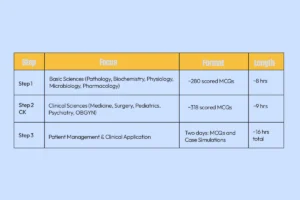 Why is it important: The switch to a pass/fail Step 1 does not simplify the exam. It continues to have a great impact on residency competitiveness and tends to dictate early clinical opportunities. The portions are focused on various levels of knowledge, starting with basic sciences during Step 1 and clinical practice comprehensively in Step 3.
- Step 1: Foundational sciences (biology, chemistry, physiology).
- Step 2 CK: Clinical knowledge for supervised patient care.
- Step 3: Independent patient management and clinical application.
Why the USMLE Exam is More Than Just a Test
So what is the USMLE Exam all about? The Exam name is the USMLE, also known as the United States Medical Licensing Examination, which all doctors have to pass before they can be permitted to practice medicine in the United States, regardless of their place of training. The examination evaluates the understanding of a given medicine, reasoning capability, and the capacity of a physician to offer care to the patient. Passing the test predestines that the doctor meets the criteria for safe and effective care.The exam is a three‑step sequence, and you must pass them all to obtain a medical license in the U.S. Let’s be clear, the USMLE exam questions aren’t just another test you write once and forget. It’s a gateway to:- Residency applications (especially competitive specialties)
- Medical licensing authority approval
- Credibility among peers and patients
- A standardized metric for evaluators worldwide
How Many Steps Are There in the USMLE Exam
There are three official steps in the USMLE exam preparation sequence:USMLE Step 1 — Basic Science & Foundational Knowledge
- Tests foundational medical science (anatomy, physiology, biochemistry, etc.)
- Assessed via computerized multiple-choice USMLE Step 1 exam questions.
- “Exam format: 7 timed blocks, each with 40 qs and lasting one hour.”
- Taken typically after the first 2 years of med school (or equivalent prep).
USMLE Step 2 CK — Clinical Knowledge
- Step 2 CK is about thinking like a doctor, applying knowledge to diagnose and manage patients safely and effectively.
- “Exam format: 8 timed blocks, each with 38 to 40 qs and lasting one hour.”
- Intended to ensure readiness for supervised patient care.
- USMLE Step 2 “NBME” practice exams include 5 blocks x 50 qs covering medicine, surgery, pediatrics, psychiatry, OBGYN, etc.
USMLE Step 3 — Independent Clinical Practice
- The final licensing USMLE Step 3 practice exams
- Focuses on clinical practice and patient management scenarios
- Taken after graduating from medical school and often during residency
USMLE Exam Structure and Content Breakdown
Below is a simple snapshot of what each step tests:Why is it important: The switch to a pass/fail Step 1 does not simplify the exam. It continues to have a great impact on residency competitiveness and tends to dictate early clinical opportunities. The portions are focused on various levels of knowledge, starting with basic sciences during Step 1 and clinical practice comprehensively in Step 3.From USMLE Exam Eligibility and Registration to Fees Updates
Below is the detailed breakdown and step-by-step process for the medical students to look at for better understanding before you are applying for the USMLE in the USA.Eligibility: Who Can Take the USMLE Exam
For U.S. Medical Students
- Must be enrolled in or a graduate of an LCME‑accredited medical school to sit for Step 1 and Step 2 CK.
- Apply through NBME.
For International Medical Graduates (IMGs)
- Must have their medical degree verified through ECFMG or the relevant authority.
- Register through FSMB (as of 2026, all USMLE services are consolidated under one system).
Step 3 Eligibility
- Only after passing Step 1 and Step 2 CK.
How to Register for the USMLE Exam
Registration involves a few key steps:- Verify your eligibility via NBME (U.S. grads) or FSMB (IMGs).
- Submit the application and pay the fees.
- Receive your eligibility period and scheduling permit.
- Book your test date and center via Prometric.
The USMLE Exam Fees 2025‑2026 Updated
Fees for USMLE steps can vary based on where you take the test and your program affiliation:- Step 1 & Step 2 CK: ~$695 each.
- Step 3: ~$955.
Final Tips Before You Register
✔ Read the official Bulletin of Information before applying. ✔ Apply early to ensure your preferred test window. ✔ Talk to peers who have already taken the exam. ✔ Use official sample questions to learn the exam interface.Most importantly, it’s as mental as its academic that you believe in your preparation. After you ace your USMLE, it is time to concentrate on how you can get your residency spot. Our Residency & Match Services will help you with all the details, such as which program to choose, how to prepare for interviews, etc. Get an expert level of knowledge and advice that will increase your likelihood of matching at your first preferred college.How to Prepare for the USMLE Exam: A Quick Roadmap to Follow
Just spending hours is not enough; you must be smart and efficient in your study.. Here’s a study strategy that top performers swear by:Study Materials & Practice Exams
Use High‑Yield Resources. Common recommendations include:- UWorld Question Bank (QBank) is essential for mastering question styles and explanations
- NBME practice materials (official)
- First Aid and Pathom
- Anki flashcards for spaced repetition
Mock & Sample Exams
- Take USMLE Step 1 practice exam sessions early and often
- Use mock exam environments to build stamina
- Analyze incorrect answers to focus on weak areas
Study Plan Essentials
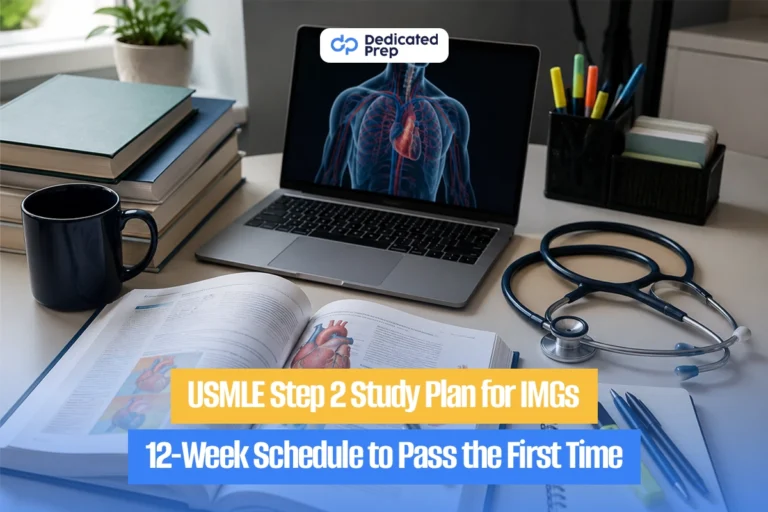
- Start preparation at least 4–6 months before your target exam.
- Use spaced repetition and active recall methods.
- Focus first on high‑yield systems (pathology, physiology, pharmacology).
USMLE Scoring Explained: What You Need to Know
Step 1: Step 1 is a Pass/Fail exam as of 2022. This shift is towards a numerical mark to a pass/fail result. Numerous materials are addressing the previous grading system, whereas the new Pass/Fail format will be aimed at alleviating stress. High Step 2 CK remains an important requirement in residency applications.Step 2 CK and Step 3: These tests will maintain numerical marking on a scale of 1 to 300. Higher scores are commonly used in residency programs to determine the clinical knowledge and preparedness of the candidates. Good scores will be particularly significant in competitive residency placements.This is a downloadable checklist that will help you plan your studies, monitor major milestones, and stay focused when studying to pass the exam.What are the USMLE Exams Duration and Location
You can take USMLE Step 1 and Step 2 CK in any order once eligibility is confirmed. Most students take:- Step 1: After the 2nd year of medical school
- Step 2 CK: During the 3rd or early 4th year
- Step 3: After graduating and completing Step 1 and Step 2 CK
Where Are USMLE Exam Centers Located?
The USMLE tests are administered at Prometric testing centers across the world. The slots of the tests are filled fast, particularly during the months when the test is popular, thus it is better to book early during your eligibility period.This may be anywhere between these cities, like Delhi, Karachi, Dhaka, Nairobi, or Riyadh. The international centers are present regularly, yet Step 3 remains U.S.Common Mistakes USMLE Students Make and How to Avoid Them
When you are training to take the USMLE, you have to know the pitfalls that several aspirants fall into. Such pitfalls might cost you time, unnecessary stress, and decrease your chances of success. The following are the errors that most aspirants commit, and ways through which you can avoid them:Absence of a study plan: The majority of students get into studying without a plan. This results in disjointed efforts and omissions of the important areas. Solution: Have a regular weekly plan, which has specific objectives, e.g., targets on practice exams, and review weak concepts.Delaying practice questions: It seems like you should wait to begin doing practice questions closer to the date of the exam, to begin doing practice questions but this can cause you to be unprepared when it actually comes time to take the exam. Solution: Start training questions early enough so that you can be acquainted with the question format, test time, and identify where you need to improve.Blogging about what you are good at: It is simple to focus on what one is good at, and forgetting about the weak points would cost them some valuable points in the exam. Remedy: Check your practice test results and reconsider incorrect answers, and focus more on areas where you are weak to get better grades.Booking exam dates too soon: It is usually common to book exam dates at the last moment ,and as such, one ends up with poor preparations and no time to revise. Plan and organize at least some months before you get the exam, when you have a chance to study, review, and take practice exams.These are the major pitfalls that you can avoid by mitigating them at an early stage, and thus improve your study process by a large margin and have a high probability of passing the USMLE with confidence.Conclusions: Ace Your USMLE on First Attempt
The USMLE is not as complicated as it might sound because all it takes is getting the right plan and working on it; the achievement is well within your reach. When you have a properly thought-over strategy of studying, when you make the highest priority resources your priorities, and when you avoid traps, you will manage to pass all the stages of the examination process without fear. Always be disciplined, know where you are, and remind yourself that what you are doing is not in vain.Take the First Step Toward Your Success!
There is no need to wait before you begin preparing for the USMLE. Visit our website Dedicated Prep, to get access to expert materials, custom study schedules, and study aids that will help you pass the USMLE without any doubts.It is time to begin your career as a licensed physician in the USA!FAQs
1. How hard is the USMLE exam?
The USMLE practice exam is difficult since one is tested on deep understanding, application, and not memorization. You can be successful with the help of constant studying and appropriate materials.2. How long is the USMLE exam?
- Step 1: ~8 hours
- Step 2 CK: ~9 hours
- Step 3: Two days (combined ~16+ hours)