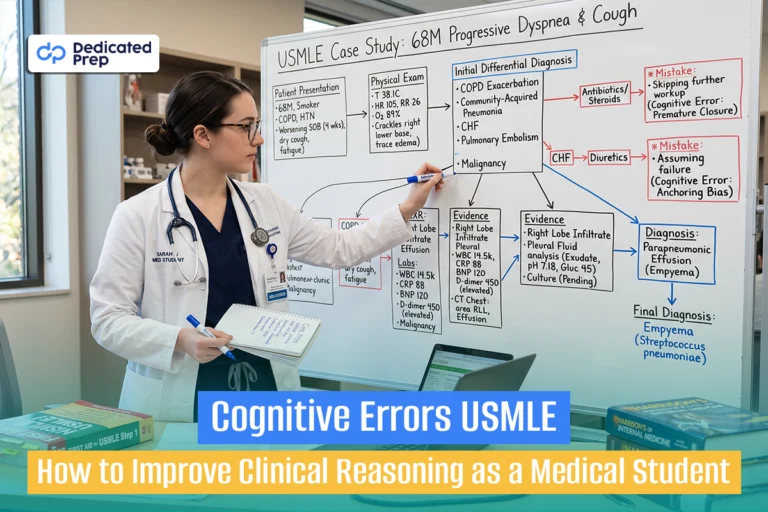

Preparing for the USMLE almost always involves taking multiple NBME practice exams to measure progress and predict readiness. However, many students make the same mistake: they finish an NBME exam, check their score, and move on to the next test without properly analyzing their mistakes.
If you are wondering how to review NBME incorrect questions, the most effective method is not simply reading explanations. Instead, the goal is to identify why you missed the question, rebuild the underlying concept, and retest that concept through spaced recall.
Educational research consistently shows that feedback combined with repeated testing improves retention and reasoning. This means that every incorrect answer becomes an opportunity to strengthen your understanding and prevent the same mistake from appearing again.
In fact, NBME self-assessments are designed not only to predict exam performance but also to provide diagnostic feedback about strengths and weaknesses, helping students target their study more efficiently.
The best way to review NBME incorrect questions is to:
- Classify the mistake (knowledge gap, reasoning error, or misread)
- Rebuild the underlying concept using trusted resources
- Retest the concept with similar practice questions
This feedback loop turns missed questions into long-term learning.
By the end, you will know exactly how to review NBME exams step 2, Step 1, and NBME shelf exams so each test leads to real score improvement.
What Is an NBME Exam and Why Review Matters
The NBME exam refers to self-assessment tests created by the National Board of Medical Examiners to simulate the style and difficulty of the real USMLE.
These NBME practice exams are among the most accurate predictors of your readiness for the real exam because they mirror the same question structure and clinical reasoning format.
Unlike many question banks, however, NBME explanations are intentionally brief. Their goal is to test your ability to apply concepts rather than teach them directly.
That means the real learning happens during the NBME review, not during the test itself. When students review incorrectly or skip reviewing entirely, they often repeat the same mistakes on the next exam.
How to review NBME practice exams with proper question analysis allows you to:
- Identify weak subject areas
- Improve clinical reasoning
- Avoid repeating mistakes
- Strengthen retention through active learning
Simply put, reviewing NBME exams correctly is one of the fastest ways to improve your USMLE score.
What You Can Review on NBME Exams and What You Can’t
One of the most common questions students ask is whether they can review how to review the NBME self-assessment after completing it. The answer is yes.
After completing an NBME self-assessment, you can review:
- all exam questions
- correct answers
- explanations
- performance feedback
This information is available in the MyNBME Examinee Portal through the interactive score report. However, once a section is completed and locked, answers cannot be changed.
Students can also analyze their performance through NBME’s INSIGHTS dashboard, which allows them to view question-level explanations and identify weak subject areas across multiple exams.
Understanding how to use the NBME exam portal is critical because many students mistakenly believe they cannot review their tests.
In reality, you can review:
- all items
- only incorrect items
- questions organized by content area
This flexibility allows you to create a highly targeted NBME review strategy.
Why Reviewing NBME Incorrect Questions Actually Improves Your Score
Many students believe that doing more questions automatically improves their performance.
However, experienced tutors consistently emphasize that most score improvements occur during review, not during the exam itself.
When you answer a question incorrectly, the error typically falls into one of three categories:
- knowledge gap
- reasoning error
- misreading the question
If you simply read the explanation and move on, the underlying reasoning mistake remains uncorrected.
Instead, effective NBME review questions analysis focuses on understanding the thinking process that produced the error.
Experts recommend reviewing incorrect answers carefully because analyzing mistakes helps convert weaknesses into strengths and improves critical reasoning skills needed for the USMLE.
In simple terms:
- Answering questions tests knowledge.
- Reviewing mistakes builds knowledge.
NBME vs Qbank Review: Why the Explanations Feel Different
Students often notice that NBME explanations feel shorter than those from question banks like UWorld. This difference is intentional. NBME exams test knowledge, while question banks teach knowledge. NBME explanations usually provide only the key concept behind the question. They expect students to reinforce that concept using other resources.
Question banks, by contrast, include detailed explanations that walk through the reasoning step by step.
This means the ideal review strategy is:
- NBME → identify the weak concept
- Qbank or textbook → learn the concept thoroughly
NBME vs Question Bank Review: Quick Overview
| Feature | NBME Exams | Qbanks |
| Purpose | Assess readiness | Teach concepts |
| Explanations | Short, concept-focused | Detailed teaching explanations |
| Best use | Diagnose weaknesses | Learn weak topics |
| Review strategy | Identify reasoning errors | Deep content study |
Why this matters:
NBME explanations are intentionally short and focus on validating concepts rather than teaching them in depth. Understanding this difference prevents frustration when reviewing NBME review questions.
Step-by-Step Guide: How to Review NBME Incorrect Questions
Now, let’s break down the exact system high-scoring students use when reviewing NBME practice exams.
Step 1: Identify the Core Concept
Before reading the explanation, determine what the question was testing.
Ask yourself:
“What concept did this question assess?”
Examples include:
- Pathophysiology
- Pharmacology mechanism
- Diagnostic test selection
- Clinical management
This step prevents superficial learning.
Step 2: Understand Why Your Answer Was Wrong
Write down:
- Why did you choose your answer
- What detail did you miss
- What reasoning error occurred
This step is essential because most students remember answers but forget the reasoning mistake.
Step 3: Review the Concept in Depth
Once the error is identified, revisit the topic using trusted resources.
Examples include:
- NBME review books
- First Aid
- Online lectures
- Anki flashcards
The goal is to understand the mechanism behind the concept, not simply memorize the answer.
Step 4: Create a Learning Tool
Transform incorrect questions into study tools.
Examples include:
- Anki cards
- Flashcards
- Concept notes
- Diagrams
Many students also create a spreadsheet tracking NBME review questions by subject.
This helps identify recurring weaknesses.
Step 5: Reinforce with Similar Questions
After reviewing the concept, find similar questions in a question bank.
This step strengthens memory and ensures the concept sticks.
Research shows that repeated testing significantly improves long-term retention and reasoning ability.
Table: Poor vs Effective NBME Review Methods
| Review Method | What Students Do | Why It Fails | Better Strategy |
| Passive Reading | Read the explanation and move on | Weak retention | Analyze why the answer was wrong |
| Memorization | Remember the answer choice | Question won’t repeat | Learn the underlying concept |
| Skipping Review | Focus only on new questions | The same mistakes repeat | Spend hours reviewing the incorrects |
| Random Studying | Study everything equally | Weak areas remain weak | Target specific knowledge gaps |
| No Reinforcement | Never revisit concepts | Learning fades quickly | Use flashcards or similar questions |
The Dedicated Prep Three-Pass Method on How to Review NBME Incorrect
Without a structured workflow, reviewing NBME practice exams can quickly become overwhelming. A simple system used by high-scoring students is the three-pass review method.
Pass 1: Categorize the Mistake
The first step is rapid classification.
Spend about 60–90 seconds per question determining why the error occurred.
Ask yourself:
- Did I lack knowledge?
- Did I misinterpret the clinical vignette?
- Did I misread the question stem?
This quick classification prevents spending too much time on low-yield review.
Pass 2: Rebuild the Concept
Once mistakes are categorized, focus on the highest-yield topics.
Use trusted resources such as:
- NBME review books
- First Aid
- clinical review notes
- question banks
The goal is to understand the transferable concept, not simply memorize the answer.
Pass 3: Retest the Concept
The final step is reinforcement.
Convert the mistake into:
- Anki flashcards
- mini practice questions
- quick recall drills
This feedback loop ensures the concept becomes long-term knowledge rather than temporary recognition. If you want personalized help analyzing your NBME exams and improving your score, explore our USMLE tutoring services.
Mistake Taxonomy Table for Every NBME Review
| Error Type | How It Appears | What to Do Next | Best Tool |
| Knowledge Gap | You didn’t know a mechanism or fact | Study the topic deeply and answer related questions | First Aid and Qbank |
| Reasoning Error | You knew facts, but applied the wrong logic | Write the decision rule you missed | Error log and vignette practice |
| Stem Trap | Missed keywords like “next step.” | Create a reading checklist | Stem checklist |
| Test-Taking Error | Two answers felt correct | Learn elimination strategies | Option comparison notes |
| Fatigue/Pacing | Errors occur late in blocks | Train endurance and pacing | Full exam simulations |
Example: Turning One Incorrect Question Into Learning
Imagine you miss a question about adrenal insufficiency.
- Question scenario: Patient presents with fatigue, hypotension, and hyperpigmentation.
- Why the question was missed: You overlooked the significance of hyperpigmentation.
- Rule extracted: Hypotension and hyperpigmentation → suspect Addison’s disease.
- Retest plan: Complete three adrenal insufficiency questions in your question bank.
This method converts an incorrect question into a transferable diagnostic rule.
Should You Review Correct Questions Too
Many students only review incorrect answers. However, correct-but-guessed questions are just as important. If you guessed correctly but were unsure, that concept is still a weakness.
Experts recommend reviewing:
- incorrect questions
- guessed questions
- unfamiliar topics
This prevents future score fluctuations.
How Long Should NBME Review Take
Proper NBME review takes time. Experts recommend spending several hours reviewing each NBME exam to fully understand mistakes. A typical review schedule may look like this:
| Task | Time |
| Score analysis | 15 minutes |
| Categorize mistakes | 45 minutes |
| Deep concept review | 2 hours |
| Create notes/flashcards | 30 minutes |
Overall, most students spend 3–4 hours reviewing an NBME self-assessment.
A Time-Boxed NBME Review Schedule
Reviewing NBME practice exams should be structured to prevent burnout.
One-Day Review Plan
Morning
- analyze score report
- categorize mistakes
Afternoon
- review key concepts
Evening
- create flashcards or notes
Block-Per-Day Plan
For busy students preparing for NBME shelf exams:
Day 1 → review block 1
Day 2 → review block 2
Day 3 → review block 3
The Two-Hour Rule
If a question requires more than two hours of review, move on and revisit later. This prevents inefficient study sessions.
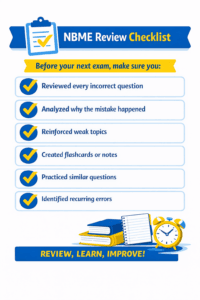
Turning NBME Review into a Weekly Score-Improvement Plan
Instead of analyzing each exam separately, look for patterns across multiple NBME exams.
Ask yourself:
- Which systems consistently appear as weaknesses?
- Are there recurring reasoning mistakes?
- Does fatigue affect later blocks?
A weekly improvement plan might include:
- Rebuilding two weak systems
- Petraining one reasoning pattern
- Improving pacing strategy
This approach transforms NBME practice exams into a continuous learning cycle.
When to Use Anki During NBME Review
Flashcards can be powerful, but they should be used selectively.
Create cards for:
- repeated mistakes
- high-yield rules
- core mechanisms
Using spaced repetition reinforces these concepts long-term. Our guide on how to use Anki for USMLE prep explains how to turn missed questions into long-term memory.
Common Mistakes When Reviewing NBME Exams
Even motivated students sometimes review inefficiently. Here are the most common mistakes.
- Passive reading: Students read explanations without analyzing why they chose the wrong answer.
- Highlighting without thinking: Highlighting notes feels productive, but rarely improves recall.
- Over-reviewing low-yield questions: Spending hours on obscure details wastes time.
- Ignoring patterns: If the same topic appears repeatedly, it signals a larger knowledge gap.
Avoiding these mistakes dramatically improves NBME review efficiency.
Conclusion: Turning NBME Incorrect Into Score Improvements
Learning how to review NBME incorrect questions properly is one of the most powerful ways to improve your USMLE score. Instead of rushing to the next practice test, use each NBME as a diagnostic tool for your thinking process. When you combine structured error analysis, targeted concept review, and reinforcement practice, every incorrect question becomes a step toward mastery.
If you want personalized guidance on NBME review strategies, study planning, and score improvement, explore our expert USMLE preparation resources at Dedicated Prep. Our mentors help students turn practice exams into real score gains.
FAQs
Can you review NBMEs? Are NBMEs accurate?
Yes. The best way to review for NBME self-assessments is to allow students to review questions and explanations after completing the exam through the interactive score report.
Should I review NBME the same day?
Ideally yes. Best NBME to review takes within 24 hours helps reinforce concepts while the questions are still fresh.
Can you retake NBMEs?
Yes, but it’s generally not recommended because remembering questions can artificially increase your score.
What is the hardest NBME form for Step 1?
Difficulty varies, but later forms often feel more challenging due to complex clinical reasoning questions.
Are NBMEs accurate for Step 2?
Yes. NBME Step 2 self-assessments are widely used to estimate readiness and identify weak subject areas before the actual exam.