Finding the right USMLE prep schools or coaching centres feels like choosing between dozens of nearly identical options, all promising high scores and residency matches.
You are a second-year med student staring at Step 1. Your classmates are signing up for different courses. Some swear by live classes. Others are doing self-paced online programs and have no idea which one actually works. And the price tags range from $179 to $3,500.
If you pick wrong, you waste thousands of dollars and months of study time on a course that does not match how you learn. Your Step 1 score suffers. Your residency options narrow.
This post breaks down exactly what USMLE prep classes cost in 2026, when college students should start, which format works for different situations, and whether California has local programs. You will know which class type fits your schedule and budget by the end.
Quick Summary:
- Best time to start: 6 to 12 months before your Step 1 exam date
- Online options: Yes, most major providers offer fully online classes
- Subject-specific classes: Limited; most courses cover all topics in an integrated format
- Cost range: $179 to $3,500, depending on format and provider
- Typical duration: 4 to 12 weeks for structured courses, 4 to 12 months for self-paced courses
- Pass guarantees: Available from Kaplan, PASS Program, BoardVitals, and others
What Are USMLE Prep Classes and Do You Actually Need One
USMLE prep courses are structured classes designed specifically to help you pass Step 1, Step 2 CK, or Step 3. They are not the same as your medical school lectures.
These courses focus exclusively on exam-relevant material. High-yield topics. Test-taking strategies. Practice questions are formatted exactly like the real exam.
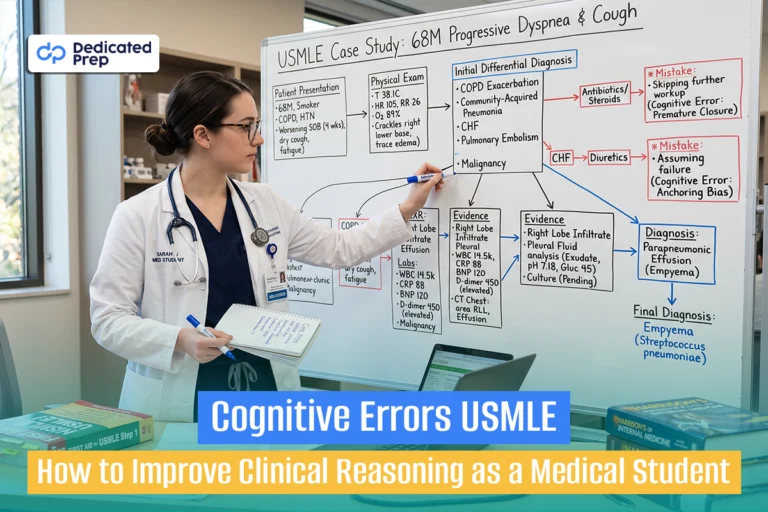
Medical school teaches you medicine. USMLE prep schools teach you how to pass the exams.
The difference matters because the USMLE Step 1 consists of approximately 280 multiple-choice questions, testing students’ ability to apply scientific principles to real-world clinical scenarios. Your pathophysiology lectures cover the science. A good prep class teaches you how to pick the right answer when two options both seem correct.
Most students who rely only on medical school coursework struggle. The exam demands focused and strategic preparation provided by prep courses, especially for medical students balancing heavy academic workloads.
Which USMLE Prep Classes Actually Work for Step 1: Quick Overview
Most USMLE prep classes follow one of three formats.
Live online classes put you in virtual sessions with an instructor and other students. You attend scheduled lectures, ask questions in real time, and work through practice problems together. Kaplan allows you to customize your study plan based on your learning style and schedule, with options for in-person, live online, and on-demand courses
Self-paced online courses give you video lectures, question banks, and study materials you access whenever you want. No fixed schedule. No live sessions. Achievable offers a flat rate of $179 for a full year of access, making it the most budget-friendly option for students who learn well independently.
In-person bootcamps are intensive multi-week programs where you show up daily for lectures and drills. The PASS Program offers an in-person bootcamp option for $3,499.00 at their Houston facility. Online format dominates over 90% of students now choosing self-paced or hybrid courses.
How to Balance USMLE Prep Classes with Medical School Without Falling Behind
Better USMLE prep programs sync their content with what you are learning in medical school right now.
If you are studying cardiology in your third-year clerkship, a good prep course lets you simultaneously review cardiology for Step 2 CK. Integrate your USMLE study prep materials with your medical school curriculum, for instance, if you’re studying cardiology in class, simultaneously review the cardiology section in your USMLE resources
Subject-specific modules help you target weak areas without paying for material you already know. But most providers integrate subjects rather than selling them separately.
PRO TIP
If you are considering the PASS Program, start at least 8 months before your exam. The comprehensive nature of these courses works best when you have time to absorb everything without rushing.
When to Start USMLE Prep Classes: Timeline for College Students
When to start your best USMLE Step 1 prep classes depends entirely on which year you are in and how much time you can dedicate per week.
Medical School Year 1
Do not start formal USMLE prep classes recommended for college students in your first year. Your MS1 coursework builds the foundation you need for Step 1.
Focus on learning the material well the first time. Take good notes. Use high-quality resources like Pathoma or Sketchy for your regular classes.
What you can do: Start using Anki decks alongside your coursework. Download the Anking deck. Add cards as you go through each system.
This passive preparation means you are already reviewing Step 1 material without the pressure of active exam prep.
Medical School Year 2 (Early)
Start formal prep 6 to 8 months before your planned Step 1 date if you are an average student who needs a comprehensive review.
This gives you time to work through an entire USMLE Step 1 prep class while keeping up with MS2 coursework.
Balancing the demands of medical school coursework and preparing for the USMLE Step 1 exam requires careful planning and prioritization. You cannot cram everything in the last 4 weeks.
KEY TAKEAWAY
Starting 6 months out lets you dedicate 15 to 20 hours per week to Step 1 prep classes without completely abandoning your regular classes.
Medical School Year 2 (Dedicated Period)
The 4 to 8 weeks immediately before Step 1 is your dedicated study period. No classes. No clinical duties. Just Step 1 prep.
This is when you do your final content review, take full-length practice exams weekly, and drill your weakest subjects.
Students could spend an hour or two each night after coursework on practice questions and high-yield topics, or dedicate a specific day of the week for Step 1 preparation during the months leading up, then go full-time during the dedicated time.
Most students do 6 to 8 weeks of dedicated prep. High performers might do 4 weeks. Students who struggled with MS1 and MS2 content often need 10 to 12 weeks.
For International Medical Graduates
IMGs typically need 8 to 12 months of focused prep time because you are not simultaneously taking US medical school courses that align with USMLE content.
You are learning and reviewing everything from scratch without the benefit of recent coursework reinforcing the material.
Start your USMLE prep classes earlier than US medical students. Give yourself the time to thoroughly review all systems before entering your dedicated period.
This approach cuts your total study time in half because you are not learning everything twice. One student we worked with at Dedicated Prep USMLE tutoring services used this method and knocked four weeks off his Step 1 preparation timeline.
USMLE prep classes cost: what you really pay in 2026
The course price is only part of the bill. The official exam fees for 2026 are $695 for Step 1, $695 for Step 2 CK, and $995 for Step 3. If you test outside the U.S. or Canada, there is also a regional fee for Step 1 and Step 2 CK.
Then come the extras. NBME self-assessments are part of how many students gauge readiness, and NBME continues to promote its self-assessment products and bundles in 2026.
A realistic Step 1 budget usually looks more like this:
| Budget level | What it usually includes | Approximate total |
| Lean | Achievable or BoardVitals, Step 1 fee, a couple of self-assessments | $1,000 to $1,300 |
| Mid-range | UWorld or Bootcamp, Step 1 fee, several self-assessments, core books | $1,300 to $2,000 |
| Premium | Kaplan or PASS, Step 1 fee, self-assessments, add-on materials, and possible travel | $2,500 to $5,000+ |
Most students underestimate the total cost of prep. Beyond course fees, you also need to factor in the complete USMLE exam fees breakdown, including registration and rescheduling costs.
USMLE Prep Classes Online vs In-Person: Which Format Works
USMLE prep classes online have become the default for most students. The pandemic accelerated this shift, and most providers now prioritize their online offerings.
Online Format Advantages
- You study from anywhere. Your dorm room. The library. A coffee shop between clinical rotations.
- Courses should offer the ability to study at your own pace, with resources accessible at any time, which can be especially beneficial for those balancing work, school, or other commitments
- Online classes cost less than in-person options. No travel. No housing. No time lost commuting to a physical location.
- Most platforms offer mobile apps, letting you do practice questions during downtime between rounds or while waiting for a patient.
- The self-paced nature means you can spend three hours on cardiology if that is your weak area, then blow through pulmonology in 45 minutes if you already know it cold.
Online Format Disadvantages
Nobody is watching to make sure you actually study. Discipline becomes everything.
- You miss the accountability of showing up to a physical classroom. The social aspect disappears. No study group formed organically after the lecture.
- Some students genuinely learn better with in-person instruction. The ability to ask a question and get an immediate verbal response matters more than the convenience of recorded videos.
- Internet connectivity issues can derail your study session. Platform glitches happen. Technical support cannot always fix problems instantly.
In-Person Format Reality
Only a handful of providers still offer true in-person USMLE prep classes in 2026.
- PASS Program hosts classes at their facility in Houston, Texas, and offers a traditional bootcamp-type experience, with the option to stay in company-operated student housing.
- The immersive environment works. You wake up, attend test-taking strategy sessions, sit through content lectures, do practice drills, eat dinner, study more, sleep, repeat for five weeks.
- This format eliminates distractions. You cannot skip a day. You cannot fall behind. The structure forces consistent daily progress.
- But you pay for that structure. Housing costs extra. You cannot work or attend clinical rotations during the bootcamp period. These in-person courses are offered in 5-week increments, costing approximately $3,500 for the full program.
For most students, balancing medical school online makes more sense. For students who have failed Step 1 once or who consistently struggle with self-directed study, in-person bootcamps can be worth the premium.
Are There USMLE Step 1 Prep Courses for Individual Subjects
USMLE Step 1 prep courses rarely sell individual subject modules separately.
Most providers package all content together because the exam itself tests integrated knowledge. A cardiology question on Step 1 might require you to know pharmacology, pathophysiology, and biochemistry simultaneously.
What Providers Actually Offer
Sketchy comes closest to subject-specific prep. Their platform focuses heavily on microbiology and pharmacology through memorable visual stories.
Students often buy Sketchy specifically to strengthen these two subjects while using other resources for the remaining systems.
Pathoma sells subject-specific pathology. The videos break down each organ system’s disease processes in clear, concise lectures.
You can watch just the cardiovascular pathology section without purchasing anything else, though most students buy the full course because pathology spans all systems on Step 1.
Question banks let you filter by subject. BoardVitals, UWorld, and AMBOSS all allow you to create custom quizzes focusing exclusively on renal physiology or endocrinology if those are your weak areas.
This is the closest thing to subject-specific prep most students get. You take the full course but concentrate your time on specific systems that need work.
Why Integrated Courses Work Better
USMLE exam prep for Step 1 does not test subjects in isolation.
A question about heart failure requires you to know cardiac physiology, pharmacology of diuretics and ACE inhibitors, pathophysiology of ventricular remodeling, and potentially biochemistry of ATP generation.
- Studying only cardiovascular content without understanding how it connects to pharmacology and biochemistry leaves you unprepared for the integrated questions that dominate the exam.
- Apply what you learn in your classes to USMLE practice questions to reinforce your knowledge and improve retention across multiple subjects simultaneously.
- The students who score highest treat Step 1 prep as learning medicine holistically, not as memorizing isolated facts about individual organ systems.
If you are weak in one subject, use a question bank to drill that area heavily while still reviewing other subjects through your main prep course.
How to Balance USMLE Prep Classes with Medical School
Balancing USMLE prep classes with regular coursework is the single hardest part of med school for most MS2 students.
You have lectures to attend. Labs to complete. Exams every few weeks. Clinical skills sessions. Maybe research obligations or volunteer commitments.
Then you are supposed to add 15 to 20 hours of Step 1 prep on top of all that. Here are some of the strategies to ponder:
1. The Integration Strategy
The smartest approach is integration, not addition.
Integrate your USMLE study materials with your medical school curriculum, for instance, if you are studying cardiology in class, simultaneously review the cardiology section in your USMLE resources.
When your pathology course covers GI diseases, spend your Step 1 study time that week on GI pathology questions and videos. You learn the material once but apply it twice.
This cuts your total study hours dramatically because you are not treating medical school and Step 1 as completely separate endeavors.
2. Time-Blocking Reality
Implement time-blocking techniques to dedicate specific periods to different activities, for example, allocate mornings for medical school lectures and afternoons for USMLE study sessions.
Early morning works well for Step 1 review. Your brain is fresh. The library is quiet. You knock out 90 minutes of practice questions before your first lecture.
Late evening fits for many students, though retention drops when you are exhausted after a full day of classes.
Weekends become crucial. Most successful students dedicate 4 to 6 hours on both Saturday and Sunday to Step 1 prep during the 6 months leading up to the dedicated study period.
3. What to Cut
You cannot do everything. Something has to give. Social activities shrink. You skip the Thursday night hangouts. You say no to weekend trips. You reduce time spent on hobbies that do not directly contribute to becoming a physician. This is temporary. The 6 to 8 months of Step 1 prep plus a dedicated period, is not forever.
Lower-yield extracurriculars get cut first. If you are doing research solely because you think it looks good, and it is not leading anywhere meaningful, consider pausing during intensive prep months.
Non-essential clinical volunteering can wait. Your primary job as an MS2 is passing Step 1 and your coursework, not padding your residency application.
The only exception: If you are applying to highly competitive specialties, you might need to maintain some research or leadership activities. Balance carefully.
Final Verdict: Choose Your Prep Class Based on Learning Style
USMLE prep classes work when they match how you actually learn, not when they have the fanciest marketing. If you need structure and accountability, pay for Kaplan or the PASS Program. The higher cost buys you a clear daily plan and live instruction that keeps you on track. Or you want to learn well independently and want to save money, Achievable or Med School Bootcamp delivers solid content at a fraction of premium course prices.
This decision affects whether you pass Step 1 comfortably or spend months retaking the exam. Choose the format that fits your schedule, budget, and proven learning style.
Start your USMLE test prep classes with expert guidance from high-scorers at Dedicated Prep. We help med students create personalized study plans that actually work.