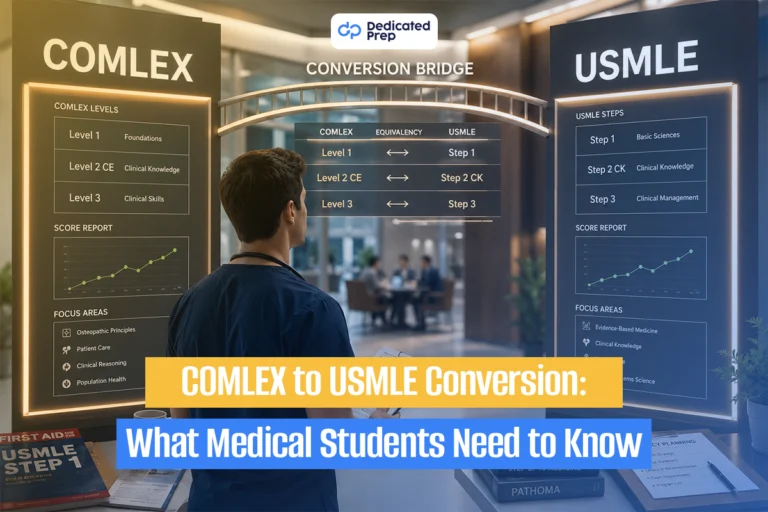

No exact conversion formula exists between COMLEX and USMLE scores because the exams test different student populations with different training. A COMLEX Level 2 score of 600 corresponds to USMLE Step 2 scores of 238 to 241, but your individual score could vary by 50 points from this prediction. The Barnum 2022 study with 2,115 students provides the most reliable conversion table available.
Here is what matters more than the conversion itself. DO students scoring at the 75th percentile on COMLEX need to explain they are performing better than MD students at the 60th percentile on USMLE, even though those scores technically correspond. Program directors do not always understand this percentile gap.
With Level 1 and Step 1 both pass/fail since May 2022, your Level 2 and Step 2 scores are now the only numeric data residency programs see. That makes understanding score conversion critical for application strategy, not just curiosity.
This guide explains exactly how conversion works, which study to trust, when taking both exams makes financial sense, and how to position your scores strategically in residency applications.
Quick Summary: COMLEX to USMLE Conversion
- Most reliable data– Barnum 2022 study analyzed 2,115 DO students from 5 schools using equipercentile matching, not simple formulas
- Key conversion points– COMLEX 560-579 = USMLE 231-235, COMLEX 600-619 = USMLE 238-241, COMLEX 640-659 = USMLE 245-248
- Prediction accuracy– Individual scores vary by approximately 50 points from predicted values, despite a strong overall correlation
- Selection bias issue– DO students who take both exams score 25-40 points higher on COMLEX than those who skip the USMLE
- Pass/fail impact– Level 1 and Step 1 went pass/fail in 2022, making Level 2 and Step 2 your only numeric differentiators
- Current test-taking rates– 60% of DO students take at least one USMLE exam despite having COMLEX scores
- Cost of taking both– $2,000 in exam fees plus 6-8 weeks additional study time per exam
- Who needs USMLE-DO students applying to competitive specialties, programs explicitly requiring USMLE, or scoring above 600 on COMLEX
Why Score Conversion Matters More Than Ever in 2026
Before 2022, both Level 1 and Step 1 gave you numeric scores. Program directors used those numbers to screen applications. Then both exams switched to pass/fail.
Now, Level 2 and Step 2 are your only numeric scores. That shift made these exams significantly more important for residency matching.
Approximately 60% of osteopathic medical students took at least one portion of the USMLE in 2020 despite already having COMLEX scores. That percentage has not decreased. DO students are still taking both exams because program directors remain more comfortable with USMLE scores.
The problem is not that COMLEX scores are rejected. 86% of program directors require COMLEX results from DO students. The problem is how those scores are interpreted.
Is USMLE Actually Harder Than COMLEX
Neither exam is objectively harder. They test overlapping clinical content with different emphasis.
COMLEX includes osteopathic manipulative medicine. USMLE does not. If you excel at OMM, that portion of COMLEX may boost your score. If you struggled with OMM throughout school, it may lower your score.
USMLE questions are often described as more direct with clearer stems. COMLEX questions are described as longer with more extraneous information.
Students who take both exams tend to have better relative performance on COMLEX than on USMLE. A student at the 90th percentile on COMLEX might score at the 67th percentile on USMLE.
This does not mean USMLE is harder. It means the percentile scales measure performance against different populations with different training backgrounds.
The Percentile Gap Problem
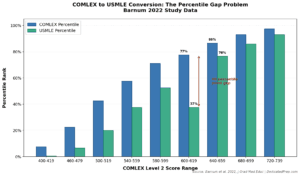
A COMLEX score of 600 places you around the 75th percentile among DO students. The corresponding USMLE score of 238 to 241 places you around the 35th to 40th percentile among all Step 2 test-takers.
To match into anesthesiology, the average COMLEX Level 1 score was approximately 570 (66th percentile), while the average USMLE Step 1 score was 232 (47th percentile) DO students needed nearly 20 percentile points higher scores to match into the same specialty.
That pattern repeats across competitive specialties. Conversion matters because it helps you articulate why your 75th percentile COMLEX score makes you competitive with MD students at lower USMLE percentiles.
Which Conversion Study Should You Trust
Two major studies since 2021 provide conversion data. One is significantly more reliable than the other.
The Barnum 2022 Study: Your Most Reliable Reference
This 2022 study from the National Board of Osteopathic Medical Examiners analyzed 2,115 DO students from 5 osteopathic schools who took both COMLEX Level 2 and USMLE Step 2 between 2015 and 2020.
The study used equipercentile matching. This method finds students performing at the same relative level on both exams and matches their scores. It accounts for the fact that the relationship between COMLEX and USMLE scores curves at high and low ends rather than forming a straight line.
Key findings from this study:
- COMLEX 540-559 corresponded to USMLE 227-231
- COMLEX 600-619 corresponded to USMLE 238-241
- COMLEX 700-719 corresponded to USMLE 253-256
Students took the exams an average of 12 days apart, with 48% taking COMLEX before USMLE.
This is the most reliable conversion data available because of sample size, multiple institutions, and a methodology that captures the curvilinear relationship between scores. You can read the complete Barnum 2022 study published in the Journal of Graduate Medical Education for full methodology and results.
The Smith 2021 Study: Simpler but Less Accurate
The 2021 Smith study from Lake Erie College of Osteopathic Medicine analyzed 340 students between May 2020 and April 2021.
This study used linear regression to create a formula: USMLE Step 2 = 0.13(COMLEX Level 2) + 163.5
For every 1-point increase in COMLEX Level 2, there was a 0.13-point increase in USMLE Step 2, with an R-squared of 0.64.
The formula works reasonably well for COMLEX scores above 540 but breaks down at lower scores. For a COMLEX score of 450, the formula predicts USMLE 222. The Barnum table shows COMLEX 440-459 actually corresponds to USMLE 206-211. The formula overpredicts by more than 10 points in this range.
Bottom Line: Use Barnum for Decisions That Matter
Use the Barnum study for any important decision. It includes 6 times more students across multiple institutions rather than a single school. The equipercentile matching method is the gold standard for test concordance. The data is more generalizable and more accurate across the full score range.
The Smith formula might give you a quick ballpark estimate if your score is above 540. For anything lower or for decisions that actually matter, use the Barnum conversion table.
Need expert guidance on whether to take both exams? Our 1on 1 USMLE tutoring services help DO students create cost-effective study strategies tailored to their residency goals.
2026 Complete COMLEX to USMLE Conversion Table
This table combines Barnum study data with 2024-2025 percentile information to show how scores translate.
| COMLEX Level 2 | USMLE Step 2 | COMLEX Percentile | USMLE Percentile | What This Means |
| 400-419 | 197-201 | 5-10 | <1 | Passing COMLEX, failing USMLE range |
| 460-479 | 211-215 | 20-25 | 5-8 | Both passing, well below average |
| 500-519 | 219-223 | 40-45 | 18-22 | Below means on both exams |
| 540-559 | 227-231 | 55-60 | 35-40 | Average COMLEX, below average USMLE |
| 580-599 | 235-238 | 70-72 | 50-55 | Above-average COMLEX, average USMLE |
| 600-619 | 238-241 | 75-80 | 35-40 | Strong COMLEX, below average USMLE |
| 640-659 | 245-248 | 85-88 | 75-78 | Very strong on both exams |
| 680-699 | 251-253 | 92-94 | 85-87 | Excellent on both exams |
| 720-739 | 256-259 | 97-98 | 92-94 | Top-tier performance |
The percentile gap is most visible between COMLEX 580-619. You are outperforming 70-80% of DO students, but the corresponding USMLE scores place you around the 35th-55th percentile among all test-takers.
This is not because the USMLE is harder. It reflects the fact that DO and MD students are different populations with different training emphases, measured by different exams.
PRO TIP
When discussing your scores with program directors or in personal statements, always include percentile context. Say you scored at the 75th percentile on COMLEX rather than just stating the numeric score.
What Correlation Really Means for Medical Students
A strong association exists between COMLEX and USMLE scores that allows prediction of performance, but the association is not the same as precise prediction.
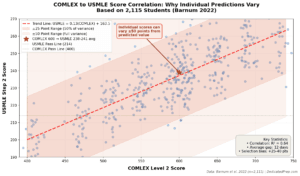 Students who score well on COMLEX tend to score well on USMLE. That is correlation. It does not mean you can plug a COMLEX score into a formula and get an exact USMLE prediction.
For students scoring at mean COMLEX scores of 560 for Level 1 and 600 for Level 2, observed USMLE scores varied across approximately 50 points.
A 50-point range on the USMLE is massive. It is the difference between matching and not matching in many specialties. It means a COMLEX score of 600 could correspond to USMLE scores anywhere from 213 to 263 for individual students, even though the average correspondence is 238-241.
Why Individual Predictions Vary So Much
Selection bias is the biggest factor. DO students who take both exams score 25 points higher on Level 1 or 40 points higher on Level 2 compared to students who only take COMLEX.
Students confident about their COMLEX performance are more likely to take the USMLE. Students who struggled skip it. That means all conversion data comes from a higher-performing subset of DO students, not a random sample of all DO students.
The second factor is content differences. COMLEX tests osteopathic manipulative medicine and emphasizes osteopathic principles. USMLE does not. If OMM is your strength, your COMLEX score may overpredict USMLE performance. If you struggled with OMM, the reverse may occur.
Test-taking stamina, question style preferences, and timing between exams also contribute to individual variance.
KEY TAKEAWAY:
Conversion data shows general correspondence between score ranges. It cannot predict your individual USMLE score from your COMLEX score with precision.
When You Should Take Both Exams: COMLEX to USMLE Conversion Overview
Taking both costs approximately $2,000 plus 6 to 8 weeks of study time. That is a significant investment during an already intense period of medical school.
Most DO students still take both. That does not mean you should. Also read our guide on USMLE VS COMPLEX.
Clear Reasons to Take Both COMLEX and USMLE
Take the USMLE in addition to the COMLEX if:
- Your COMLEX score is strong: If you scored 600 or above on Level 2, the corresponding USMLE score helps program directors understand you are performing at a high level. You are in the top quartile of DO students. The USMLE score confirms a format they trust.
- You are applying to competitive specialties: Dermatology, orthopedic surgery, plastic surgery, neurosurgery, and interventional radiology programs often have strong preferences for USMLE scores. Having both removes barriers.
- Programs you want require USMLE: Check residency program websites. Some still list USMLE as required or strongly preferred despite the single accreditation system. If your top choices require it, take it.
- You need geographic flexibility: Certain regions and hospital systems are more familiar with USMLE than COMLEX. If you have geographic constraints for family reasons, USMLE expands options.
- You failed COMLEX on your first attempt: Passing USMLE provides an additional data point showing competency on a different licensing exam. It does not erase the COMLEX failure but adds context.
Clear Reasons to Skip USMLE
Skip USMLE if:
- Your COMLEX score is below expectations: Students who take both exams score 25-40 points higher on COMLEX than students who skip USMLE. If you struggled on Level 2, adding a mediocre USMLE score does not help your application. Focus on strengthening other components.
- You are applying to primary care: Family medicine, internal medicine, pediatrics, and psychiatry programs are comfortable evaluating COMLEX scores. You do not need the USMLE unless targeting top academic programs in these specialties.
- You are already a strong applicant: If you have high clinical grades, excellent letters, research, and COMLEX scores above 580, USMLE is optional. Your application is already competitive.
- Time and money matter significantly: Medical school is expensive. If $2,000 and 6 weeks of study time represent a real hardship, prioritize one exam and strengthen other application components.
How Program Directors Actually Use Your Scores for COMLEX to USMLE Conversion
Program directors receive hundreds or thousands of applications. They need screening filters. COMLEX Level 2 percentiles rank as the fourth most important selection factor, behind specialty-specific letters, Level 1 pass status, and clinical grades.
When programs set numeric minimums, misunderstanding the percentile gap can hurt DO applicants. University of Colorado Internal Medicine requires a minimum COMLEX score of 600. That is one of the very few programs publishing explicit minimums.
A COMLEX score of 600 is around the 75th percentile. The equivalent USMLE range of 238-241 is around the 35th-40th percentile. If a program director sets that cutoff, thinking it corresponds to the 50th percentile USMLE performance, they are inadvertently filtering out qualified DO students.
Having both scores removes this ambiguity. Program directors see exactly where you rank on the scale they know best.
Looking for strategic guidance on positioning your board scores in residency applications? Read our complete guide to medical school application strategy for insights on presenting scores in context.
What Specific COMLEX Scores Mean in USMLE Terms: Quick Review
If You Scored 600 on COMLEX
A COMLEX Level 2 score of 600 is strong. You are in the top 25% of DO students.
According to the Barnum study, COMLEX 600-619 corresponds to USMLE 238-241.
That USMLE range is around the 35th to 40th percentile. You are scoring better relative to DO students than the USMLE number suggests relative to MD students.
If program directors understand this, your 600 COMLEX is valued appropriately. If they do not, they may view the corresponding USMLE score as below average.
This is why some DO students with high COMLEX scores still take the USMLE. They want the actual USMLE score on record to provide percentile context that works in their favor.
If You Scored 222 on the USMLE
Working backward from USMLE to COMLEX is harder.
Using the Smith formula backward: COMLEX = (USMLE – 163.5) / 0.13
For USMLE 222: COMLEX = (222 – 163.5) / 0.13 = 450
But the Barnum table shows COMLEX 440-459 corresponds to USMLE 206-211, not 222. The formula does not work in this range.
A USMLE score of 222 falls between the published conversion ranges. At this score level, the exams are measuring different populations with different strengths. Conversion becomes less meaningful.
How to Use the Smith Formula Correctly
The Smith formula is: COMLEX to USMLE conversion Step 2 = 0.13(COMLEX Level 2) + 163.5
For a COMLEX score of 580: USMLE = 0.13(580) + 163.5 = 239
That roughly matches the Barnum table range of 235-238 for COMLEX 580-599. Above 540, the formula and table align reasonably well.
Below 540, the formula fails. For COMLEX 450: USMLE = 0.13(450) + 163.5 = 222
But the Barnum table shows COMLEX 440-459 corresponds to USMLE 206-211. The formula over-predicts by more than 10 points.
Use the formula only for quick estimates when your score is above 540. For anything that matters, use the Barnum table.
Electronic COMPLEX conversion to USMLE tools and Excel functions exist to make the Barnum table easier to use for screening applications, but most program directors are not using these tools yet.
You cannot Hide Scores If You Take Both Exams
If you take both exams, both scores appear in ERAS. They automatically pull scores from NBOME and NBME when you link your accounts. You cannot hide a score if you took the exam.
Some students take the COMLEX first, evaluate their score, and then decide whether to take the USMLE. This works if your COMLEX score is high enough that you do not need USMLE.
It backfires if your COMLEX score disappoints, you take the USMLE hoping for better results, and your USMLE score is also low. Now programs see two mediocre scores instead of one.
The safest strategy: Prepare thoroughly for whichever exam you prioritize. Only add the second exam if your first score is strong enough that a comparable second score would strengthen rather than weaken your application.
IMPORTANT:
You cannot selectively report scores. Taking an exam means program directors see that score regardless of how it compares to your other scores.
Final Verdict: Complex to USMLE conversion simplified
The COMPLEX to USMLE conversion scores generally correspond across large groups of students. They do not predict individual performance with enough precision for high-stakes decisions.
If you are deciding whether to take both exams, weigh your target specialty, your COMLEX score strength, and whether you can afford the time and cost. For competitive specialties with strong COMLEX scores, USMLE adds value. For primary care with average scores, it may not.
DO students are navigating a system built around USMLE scores. Conversion data helps translate your performance into terms program directors understand, but it has limits.
Prepare thoroughly for whichever exam you prioritize. Know your percentile ranking. Use that information strategically in applications. Ready to maximize your board exam performance with expert guidance? Dedicated Prep provides specialized support for DO students managing dual licensing exam preparation.
FAQs
1. Can residency programs compare COMLEX and USMLE scores directly?
No. COMLEX and USMLE use different scoring systems and examine different candidate groups. Program directors often rely on published conversion studies, such as the Barnum 2022 study, to estimate equivalent performance.
2. Is there an official COMLEX to USMLE conversion calculator?
No. Neither the NBOME nor the NBME provides an official conversion calculator. Published conversion tables offer estimates, but they cannot accurately predict an individual’s USMLE score.
3. Should every osteopathic (DO) student take the USMLE?
Not necessarily. Taking the USMLE is most beneficial for students applying to competitive specialties or residency programs that prefer USMLE scores. Many primary care programs accept COMLEX scores alone.
4. Which study provides the most accurate COMLEX to USMLE conversion?
The Barnum 2022 study is currently considered the most reliable because it analyzed over 2,100 DO students using equipercentile matching, making it more accurate than earlier linear regression models.
5. Does a higher COMLEX score guarantee a higher USMLE score?
No. Although COMLEX and USMLE scores are strongly correlated, individual performance can vary considerably. Conversion tables estimate average score ranges rather than exact score equivalents.