
Caribbean medical schools’ USMLE pass rates often range from 80% to 98% for first-time Step 1 takers at top schools. But that number alone does not tell you whether graduates actually match into U.S. residency programs.
Many Caribbean schools require students to pass internal qualifying exams before they are allowed to sit for Step 1. That means students most likely to fail the USMLE may never be included in the official pass-rate statistics.
The real question prospective students should ask is not just:
“What is the Step 1 pass rate?”
It is:
“How many students who start at this school actually make it through Step 1, Step 2 CK, and into residency?”
The difference between those two numbers determines whether a Caribbean medical school becomes a path to practising medicine in the United States or a six-figure detour.
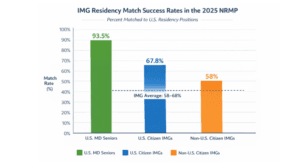
In the 2025 NRMP residency match, U.S. medical school seniors matched at 93.5%, while U.S. citizen IMGs matched at 67.8% and non-U.S. IMGs at about 58%.
This guide breaks down:
- What Caribbean USMLE pass rates really mean
- How do they relate to residency match odds
- Which schools perform best
- And what Step 2 CK score do you actually need to compete as an IMG?
What Caribbean USMLE Pass Rates Really Mean
The Number of Schools Published Is Not the Number You Should Trust. Here is the math that schools do not show you.
Start with 100 students enrolled. Only 70–75 are allowed to sit for Step 1 after internal qualifying exams. Of those, 95% pass, that is 66–71 students. That shiny “95% pass rate” hides a quiet 30–40% attrition before the exam even starts.
The two numbers every prospective Caribbean student must ask for:
- First-attempt pass rate: among students who sat for the exam
- Graduation-to-Step-1 pipeline rate: What percentage of year-one enrollees actually reach the exam
Schools that only publish the first number and dodge the second are telling you something important about the second number.
Red flag: If a school cannot answer “what percentage of your incoming class eventually passes Step 1?” walk away.
How Pass Rates Vary Across Caribbean Schools
USMLE Step 1 pass rates at Caribbean schools vary significantly, ranging from 70% to 90%, depending on the institution, with top-tier schools rivalling US rates while lower-ranked schools lag due to inadequate academic support and lower entry standards.
| School | Step 1 First-Time Pass Rate | Match Rate | Data Period |
| St. George’s University (SGU) | 84% | 95% US placement | 2019–2023 |
| Ross University (RUSM) | 83% | 96% first-time attainment | 2020–2024 |
| American University of the Caribbean (AUC) | 81% | 95% first-time attainment | 2020–2024 |
| Saba University | 98% | 3,000+ practising grads | 2023–2024 |
| Lower-tier schools | As low as 19% | Single digits in some cohorts | Variable |
Why Saba’s 98% looks different:
Saba is smaller, more selective, and has stricter pre-qualifying standards. The 98% is real, but it applies to a much smaller, more filtered group than SGU or Ross. A smaller denominator means it’s easier to protect the number.
How Do Pass Rates Actually Connect to Residency Match Odds
Passing Step 1 Gets You in the room, while Step 2 CK Gets You the Interview. This is the gap every competitor misses.
Step 1 is pass/fail since 2022. Passing it does not make you competitive. It makes you eligible. Residency program directors filter applicants by Step 1 pass status first, but it is Step 2 CK scores that determine who actually gets interview invitations, especially for IMG applicants, where the volume of competition is highest.
Here is what the 2025 NRMP data shows for IMGs:
- US citizen IMGs matched at 67.8% – up 0.8% from 2024
- Non-US citizen IMGs matched at 58% – 41.3% went completely unmatched
- US MD seniors matched at 93.5% – essentially unchanged for 40+ years
That 25–35 point gap between Caribbean graduates and US MD graduates is not a ceiling. It is an average that includes students from schools with 19% pass rates. Top Caribbean students with strong Step 2 CK scores consistently beat that average.
USMLE Pass Rates by Exam (Step 1, Step 2 CK, Step 3)
Understanding where you stand starts with knowing the average USMLE Step 1 pass rate at Caribbean medical schools and then understanding why that average is almost always misleading without context.
Here is what verified data shows across all student types and all Steps:
| Exam | US MD first-time | US DO first-time | IMG first-time | Caribbean Big Four est. |
| Step 1 | 89% | 86% | 72% | 81–98% |
| Step 2 CK | 97% | 95% | ~84% | 83–96% |
| Step 3 | 97% | 95% | ~91% | ~88–93% |
The USMLE Step 3 pass rate for US MD and DO graduates sits at 97%, while the USMLE Step 3 pass rate for IMGs, including Caribbean graduates, runs approximately 91%, a gap that narrows significantly compared to the average USMLE Step 1 pass rate of Caribbean medical schools because by Step 3, the weakest performers have already exited the pipeline.
What Is the USMLE Pass Rate for International Students Across All Three Steps
The USMLE pass rate for international students, meaning IMGs from all countries, including Caribbean medical schools, follows a consistent pattern across every Step:
- Step 1: IMGs pass at approximately 72% on the first attempt vs 89% for US MD graduates
- Step 2 CK: IMGs pass at approximately 84% on the first attempt vs 97% for US MD graduates
- Step 3: IMGs pass at approximately 91% on the first attempt vs 97% for US MD graduates
The gap between IMG and US MD pass rates narrows considerably from Step 1 to Step 3, which reflects the natural filtering effect of the pipeline. By the time an IMG sits for Step 3, they have already cleared Step 1, Step 2 CK, and ECFMG certification, meaning the Step 3 pool is already a self-selected group of the strongest performers.
What this means for you as a Caribbean student:
- Failing Step 1 ends your US residency path immediately
- Passing Step 1 and scoring strongly on Step 2 CK puts you in the top-performing IMG pool
- Step 3 is your final proof of clinical readiness, and most Caribbean students who reach it pass it
What Does the USMLE Pass Rate by Country Show for Caribbean Nations
The USMLE pass rate by country reveals significant variation even within the Caribbean region, confirming that choosing the right school within the Caribbean matters far more than the geographic region itself.
Among Caribbean nations, Grenada, home to St. George’s University, consistently reports among the strongest USMLE outcomes in the region. However, pass rates vary enormously by country across the Caribbean, and the data is heavily influenced by which schools dominate each country’s testing pool, meaning a country with only one strong school will show strong country-level data regardless of how other regional schools perform.
Key pattern by country/territory:
| Country/Territory | Notable School | Step 1 Pass Rate Range |
| Grenada | St. George’s University | ~84% (5-year avg) |
| Saba (Netherlands Antilles) | Saba University | ~98% (1-year) |
| Dominica | Ross University | ~83% (5-year avg) |
| Antigua | American University of the Caribbean | ~81% (5-year avg) |
| Lower-tier Caribbean nations | Multiple unaccredited schools | As low as 19–30% |
The country-level data is only useful if you know which school dominates that country’s testing pool. Always look at the USMLE pass rate by school, not by country, when making your enrollment decision.
Pass Rates at Major Caribbean Schools
The USMLE pass rate by school is the only data point that matters when choosing a Caribbean medical school. Country averages mask enormous within-country variation; a single strong school can inflate an entire nation’s numbers while dozens of weaker schools drag the real pipeline rate down.
The honest USMLE pass rate by school breakdown:
| School | Step 1 Pass Rate | Step 2 CK Pass Rate | Residency Match Rate |
| Saba University | 98% (1-year) | 98% | Strong – 3,000+ practising |
| SGU | 84% (5-year) | ~90% | 95% US placement |
| Ross University | 83% (5-year) | ~89% | 96% first-time attainment |
| AUC | 81% (5-year) | ~88% | 95% first-time attainment |
| Lower-tier schools | 19–50% | Not published | Single digits |
The question nobody asks but everyone should:
When a school publishes a passing rate of USMLE, ask them which year range it covers, whether it includes all enrolled students or only exam-takers, and whether the Step 2 CK and Step 3 pass rate data is available alongside Step 1. A school that freely shares all three numbers is a school confident in its outcomes. A school that only publishes one number is protecting the other two.
What Happened to USMLE Step 2 CS and Why Are Students Still Searching for It
Many Caribbean students still search for the USMLE Step 2 CS pass rate, and this is important to clarify before it confuses their preparation planning.
USMLE Step 2 Clinical Skills was permanently discontinued during the COVID-19 pandemic after being initially suspended in 2020 it has not been administered since, and there are no plans to reinstate it, meaning the clinical skills component of Step 2 no longer exists as a separate examination.
What replaced it:
- Clinical skills are now assessed through your residency application, specifically through clinical rotation evaluations and letters of recommendation from US-based supervisors
- Step 2 CK remains the only active Step 2 examination and is now more important than ever as the primary scored metric for IMG residency applications
- Some programs have increased their emphasis on clinical rotation quality and supervisor letters precisely because Step 2 CS no longer provides a standardised clinical skills signal
If you are a Caribbean student planning your board preparation:
Your exam sequence is Step 1 → Step 2 CK → Step 3. Step 2 CS no longer exists. Focus your clinical preparation energy on securing strong US-based rotation evaluations, which is now the closest equivalent to what Step 2 CS was designed to assess.
Specialities Caribbean Graduates Match Into
Genuinely accessible for Caribbean graduates:
- Internal Medicine- non-US IMGs filled 33.3% of categorical Internal Medicine positions in 2025
- Family Medicine- 805 unfilled positions after Match Day 2025
- Psychiatry- 25.2% more positions added since 2021
- Paediatrics- IMGs filled 20.4% of categorical positions in 2025
- Neurology- growing IMG representation year over year
Possible with exceptional scores and US research:
- Emergency Medicine-rebounding post-COVID, increasing IMG spots
- Anesthesiology- competitive but not closed
Effectively closed to most Caribbean graduates:
- Orthopedic Surgery
- Dermatology
- Plastic Surgery
- Otolaryngology (ENT)
The truth: If you want competitive specialities, “better odds” and “Caribbean medical school” rarely belong in the same sentence; regardless of pass rate, your Step 2 CK score, US clinical performance, and visa status will dominate every other variable.
Caribbean Medical Schools USMLE Pass Rates: The WFME Accreditation Rule
Since 2024, the USMLE passing rate in Caribbean medical schools has Changed Everything, and Most Students Don’t Know It. The WFME rule is the most important thing most Caribbean students have not heard of:
Starting in 2024, ECFMG requires graduates to come from a school accredited by a WFME-recognised agency to be eligible for ECFMG certification, which is required to apply for US residency.
What this means practically:
- No WFME recognition = cannot get ECFMG certification
- No ECFMG certification = cannot apply for US residency
- This applies regardless of your USMLE scores
The Big Four and WFME status:
- SGU– Grenada Medical and Dental Council has WFME Recognition Status (since September 2022)
- AUC– Accredited by ACCM, meets comparable standards
- Ross– Accredited by ACCM
- Saba– Dutch-accredited, meets WFME recognition requirements
Before enrolling anywhere, search your school’s accrediting body on the WFME recognised agency list. This one check prevents a catastrophic mistake.
Step 2 CK Score Targets for Caribbean and IMG Applicants
The Honest USMLE pass rate Caribbean medical schools Score Targets by Speciality and No One Else Publishes This. Competitors give you general advice. Here are the actual score targets Caribbean graduates need based on 2025 match data:
| Specialty | Minimum Competitive Step 2 CK | Realistic Target for Caribbean Grads |
| Internal Medicine | 230+ | 235–245 |
| Family Medicine | 220+ | 225–235 |
| Psychiatry | 225+ | 230–240 |
| Pediatrics | 230+ | 235–245 |
| Emergency Medicine | 240+ | 245–255 |
| Anesthesiology | 245+ | 250+ with research |
The key insight: For Caribbean medical school USMLE pass rate graduates, they need clear Step 1 and Step 2 first-time pass rates above 85–90% as a baseline, but even then, the realistic target is community-based primary care, and strong scores plus solid US clinical evaluations are what make that competitive rather than just possible.
Passing is the entry ticket. The score above passing is what determines your speciality options.
How Caribbean Students Improve Match Odds
Four Moves That Separate Caribbean Graduates Who Match from Those Who Don’t. Caribbean students who match successfully do not do so because of luck; they achieve high USMLE scores, especially Step 2 CK, secure prestigious US-based clinical rotations during M3 and M4, and receive strong letters of recommendation from US-based supervisors.
Move 1: Treat Step 2 CK as your primary competitive weapon
Step 1 is pass/fail. Step 2: CK is scored. A 245+ on Step 2 CK changes how program directors read your entire application, including the Caribbean school on your degree. This is the single highest-leverage action available to you.
Move 2: Secure US clinical rotations, not just any rotations
Letters from US-based attending physicians outweigh overseas letters in every competitive speciality. Non-negotiable for anything beyond family medicine.
Move 3: Apply broader and earlier than feels comfortable
A Caribbean graduate who applied to only one speciality failed to match the first year, not because of poor scores, but because of insufficient application volume. The next year, he applied across multiple specialities to become a practising physician first and was matched.
The optimum number of programs for IMGs is significantly higher than for US MD graduates. Apply broadly. Apply early. Rank everything you would genuinely accept.
Move 4: Stop when your practice scores plateau, then get targeted help
A Step 2 CK score stuck at 230 across three consecutive NBME practice exams is not a motivation problem. It is a preparation system problem. In our experience working with Caribbean students at Dedicated Prep, the students who break that plateau consistently are the ones who get targeted one-on-one preparation focused specifically on the clinical reasoning gaps driving the stuck score, not more of the same self-study that produced it.
Questions to Ask Caribbean Schools: Quick Checklist
Most competitors tell you what to look for generally. Here is exactly what to ask in writing before signing anything:
- What percentage of your entering class from the last 3 years has sat for USMLE Step 1?
- Of those who sat, what is the first-attempt pass rate?
- What is the average time from enrollment to Step 1?
- What percentage of graduates matched into a US residency in the last 3 years?
- Can you provide the full, unedited match list with program names and specialities?
- Is your accrediting body on the WFME-recognised agency list?
- What US hospital systems are your M3/M4 clinical rotations placed in?
If a school dodges, gives vague answers, or only quotes old pre-COVID data, assume the numbers are bad. Strong schools show this pipeline clearly, and weak ones hope prospective students cannot do basic math.
Final Verdict: Caribbean Medical Schools’ USMLE Pass Rates in 2026
The pass rate on a Caribbean school’s website is marketing. The number that determines your residency chances is your Step 2 CK score, and that number is entirely within your control regardless of which school you attend. The top four Caribbean schools produce physicians who match successfully every single year. Not because their published pass rates are impressive, but because their graduates treat Step 2 CK as the primary competitive differentiator in a pool where every other variable starts at a disadvantage.
If you are a Caribbean student preparing for Step 1 or Step 2 CK and want a structured preparation plan built around the specific score you need for your target speciality, book a strategy session with Dedicated Prep and walk away with a concrete plan you can start this week.
FAQ: Caribbean Medical Schools and USMLE Pass Rates
Which country has the highest USMLE passing rate for Caribbean medical schools?
Among Caribbean nations, Grenada, home to SGU, consistently reports the strongest outcomes, with an 84% first-attempt Step 1 pass rate among US/Canadian students from 2019–2023. However, pass rates vary dramatically by school within the same country.
How hard is it to get into Caribbean med school?
Getting in is not the challenge; the Big Four accept students on a rolling basis with lower GPA and MCAT thresholds than US MD programs. Succeeding academically, passing the USMLE on the first attempt, and matching into residency afterwards is where the real difficulty lies.
Is it harder to get residency from a Caribbean med school?
Yes, the data is clear. US citizen IMGs matched at 67.8% in 2025 compared to 93.5% for US MD seniors, a gap that has remained consistent for years. However, this is an average across all Caribbean graduates. Top school graduates with Step 2 CK scores above 240 and strong US clinical evaluations consistently match into internal medicine, family medicine, psychiatry, and paediatrics every year.
What are the top 3 Caribbean med schools for USMLE and residency outcomes?
USMLE pass rates for Caribbean medical schools: SGU with 84% Step 1 pass rate and 95% US residency placement over five years, Saba with a 98% Step 1 first-time pass rate and rigorous pre-qualifying standards, and Ross with an 83% five-year Step 1 pass rate and 96% first-time residency attainment.
What is the acceptance rate for the American University of the Caribbean medical school?
According to Caribbean medical schools’ USMLE pass rate, AUC does not publish its acceptance rate. It accepts students on four intake dates per year: September, January, May, and August, with a 4:1 student-to-faculty ratio, a five-year Step 1 first-time pass rate of USMLE is 81%, and a 2024–2025 first-time residency attainment rate of 95%.
Disclaimer: This article is provided for educational and informational purposes only. USMLE pass rates, residency match outcomes, accreditation status, and ECFMG eligibility requirements may change over time. Prospective students should verify the latest information directly with the USMLE, ECFMG, NRMP, WFME, and individual medical schools before making enrollment or career decisions. Residency placement depends on multiple factors, including academic performance, USMLE scores, clinical evaluations, research experience, letters of recommendation, and visa status.