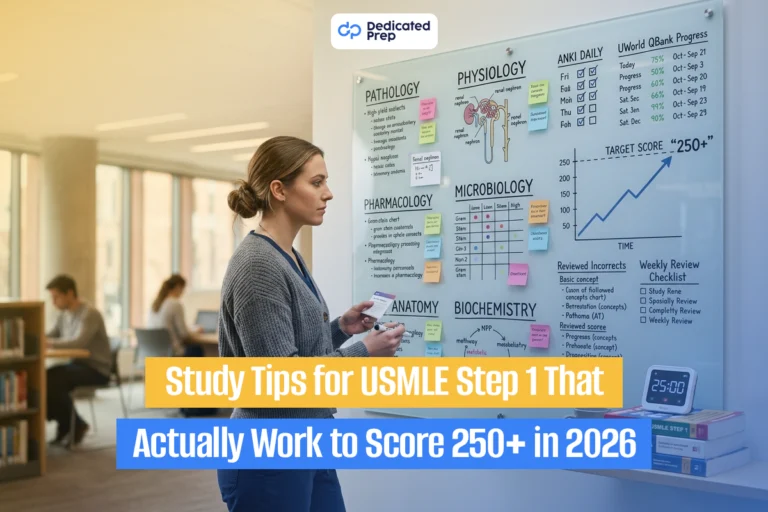
To pass USMLE Step 1 with a score of 250 or higher (or in the new pass/fail era, high performance), a person must switch passive reading to active doing, learn to master the high-yield concepts, and use a small number of resources wisely. According to the best tutors, preparation is a marathon that cannot be done out of cramming.
Just using UWorld and First Aid isn’t enough; Step 1 pass rates have been declining every single year since 2022. First-time pass rates for MD students dropped from 91% in 2022 to 89% in 2024, while DO students held at 86% in both 2023 and 2024. The students who pass on their first attempt aren’t studying harder; they are studying smarter. Here are the key steps to ponder:
- Structured Study Plan: Prepare a practical plan that is both disciplined and flexible, and always have breaks in between to avoid burnout during the preparation for the USMLE Step 1.
- Control of Memorization: It is more important to master the art of thoroughly learning and remembering the information, and applying the information to practical use, as with PACE.
- High-Yield Focus: Focus on the essential subjects such as physiology, pharmacology, and microbiology, and rely on the structured materials and self-care activities to achieve maximum efficiency and well-being.
This guide gives you the exact study tips for USMLE Step 1 that work in 2026, from building your study schedule to choosing the right resources to knowing when you need a tutor.
What Is USMLE Step 1 and Why Passing First Time Matters
USMLE Step 1 is a one-day exam divided into seven 60-minute blocks, administered in a single 8-hour testing session, with a maximum of 280 questions total. Since January 2022, Step 1 is now reported as pass/fail, but it no longer provides a numeric score or percentile rank.
But don’t let “pass/fail” fool you into taking your foot off the gas. Failing Step 1 on your first try doesn’t end your career in medicine, but it might limit your options; some competitive specialties filter out applicants with a failure on their transcript.
Passing on your first attempt is not optional. It’s your baseline.
USMLE Step 1 Pass Rate 2026: What the Numbers Tell You
Here’s the reality check every student needs before they start studying:
| Student Type | 2022 Pass Rate | 2023 Pass Rate | 2024 Pass Rate |
| US MD (first attempt) | 91% | 90% | 89% |
| US DO (first attempt) | 89% | 86% | 86% |
| International MGs | ~75–80% | ~75–80% | ~75–80% |
Pass rates have been falling every year since Step 1 went pass/fail. The reason? Some students took their foot off the gas when the exam went pass/fail, but residency programs still see a failed attempt on your transcript, and that matters.
The minimum passing score remains 196. Your goal isn’t just to reach 196; it’s to build the kind of foundation that sets you up to dominate Step 2 CK, which is now the real residency differentiator.
Which Resources Are Actually Worth Your Time for Tips for USMLE Step 1 Studying
The gold standard resources for USMLE Step 1 preparation are referred to using the acronym UFAPS: UWorld, First Aid, Anki, Pathoma, and Sketchy, and students who master these core resources consistently outperform those who spread themselves across multiple competing materials.
| Resource | Primary Function | When to Start |
| First Aid for USMLE Step 1 | Content anchor and annotation hub | Day one of the dedicated period |
| UWorld Step 1 QBank | Question practice and clinical reasoning | Day one in tutor mode |
| Anki — AnKing deck | Spaced repetition for long-term retention | Week 1 at 200 cards daily |
| Pathoma Chapters 1–3 | Pathology deep dive | Week 1 alongside First Aid |
| Sketchy Micro and Pharm | Memorization through visual storytelling | Weeks 2–4 for high-yield micro |
| NBME Self-Assessments | Objective readiness tracking | Week 1 baseline, then every 2 weeks |
| Boards and Beyond | Video-based physiology review | Supplemental only |
Why Buying More Resources Is the Fastest Way to Score Lower
Students often make the mistake of thinking the more resources they can get, the better but for each new resource you choose, there will be a new learning curve as you familiarize yourself, and at this point in your medical education, your time is extremely limited, so you must be efficient in how you study.
Pick one video resource. Pick one question bank. Use them completely before adding anything else. You can read our complete guide on USMLE Preparation 2026 based on individual baseline strategies and timeline because the right stack for an entire foundation starting from scratch looks very different for a student in the week of a strong steadiness.
What Are the High-Yield Topics Every USMLE Step 1 Study Plan Must Cover
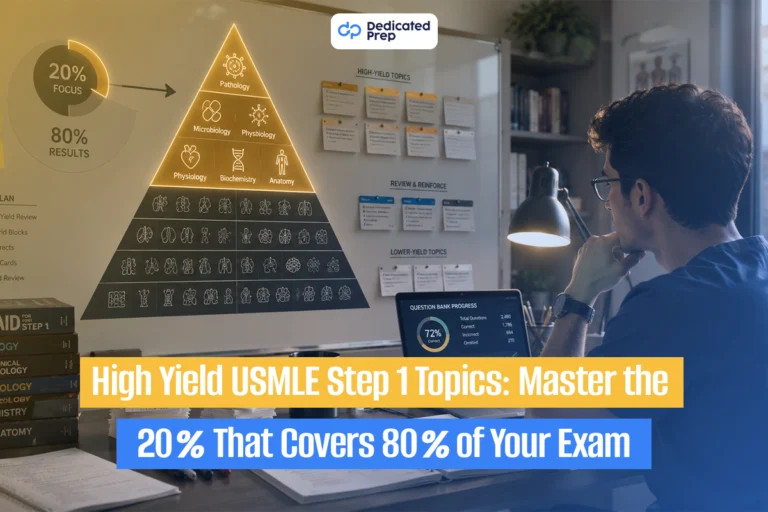
The most high-yield topics for USMLE Step 1 include physiology and pathophysiology, pharmacology, microbiology, anatomy, biochemistry and molecular biology, and behavioral sciences. These subjects form the foundation of effective medical practice and appear across the highest proportion of exam questions.
The Six Subjects that Drive the Highest Question Volume on the Exam
| Subject | Why It’s High-Yield | Best Resource |
| Pathology | Present in nearly every clinical vignette | Pathoma Chapters 1–3 first |
| Pharmacology | Mechanisms and side effects were tested heavily | Sketchy Pharm |
| Microbiology | High question density, very learnable | Sketchy Micro |
| Physiology | Foundation for understanding disease mechanisms | Boards and Beyond |
| Biochemistry | Metabolic pathways tested with clinical hooks | First Aid and UWorld |
| Biostatistics | Predictable, learnable, and most neglected | 20 minutes daily from Week 1 |
Which One Subject Most Students Ignore Until It’s Too Late
Biostatistics and ethics are predictable and high-yield topics on Step 1, yet many students ignore them until the final week, assuming they’ll pick them up quickly later, which often results in lost points on test day that a few minutes of daily review from Week 1 would have prevented.
Twenty focused minutes on biostatistics every single day from week one requires no cramming by exam week. It is the easiest recoverable point on the entire exam and the most consistently wasted by otherwise well-prepared students.
10 Best Tips for Studying USMLE Step 1 to Score Higher in 2026
1. Start Earlier Than You Think You Need To
Most authorities recommend 2–3 months of dedicated study time, treating it like a full-time job requiring 6–8 hours per day, six days a week. But the students who perform best don’t wait for a dedicated period; they build their foundation during their first and second years.
Start integrating Step 1 resources alongside your coursework from day one. By the time the dedicated period arrives, you’re reviewing, not learning from scratch.
2. Build Your Study Schedule Around the Exam Structure
A study schedule that doesn’t match how Step 1 is actually tested is wasted time. The exam tests your ability to apply basic science concepts, anatomy, biochemistry, pathology, pharmacology, and microbiology to clinical scenarios. Questions are case-based, focused on understanding disease mechanisms, not clinical decision-making.
Your schedule should reflect this. Don’t memorize isolated facts; study mechanisms and connect them to clinical presentations.
Sample weekly structure:
- Monday-Friday: Subject-based content review (3–4 hours) and UWorld blocks (2–3 hours)
- Saturday: Full-time practice block and review
- Sunday: Anki review of the weak area consolidation
3. Use First Aid for USMLE Step 1 as Your Anchor
There are several useful USMLE Step 1 books you can use as a resource, including First Aid for the USMLE Step 1, Kaplan USMLE Step 1 Lecture Notes, and Pathoma Fundamentals of Pathology. Among these, First Aid is your non-negotiable home base.
Every piece of content you study, whether from videos, question banks, or lectures, should be mapped back to First Aid. Annotate it heavily. By exam day, it should look like your own personalized study guide.
4. Do Questions from Day One, Not Just at the End
This is where most students go wrong. They spend weeks reading before touching a question bank, then panic when they perform poorly on practice tests.
A good rule of thumb is to begin by spending 90% of your time reading and 10% on question banks, gradually shifting so that by the last week, you are spending 90% on question banks and 10% reading.
Start UWorld early, even if you get questions wrong. Wrong answers with thorough explanations are your most valuable study tool.
5. Use Anki for Spaced Repetition but Don’t Overdo It
Anki enables repetition to solidify concepts. Cards with wrong answers are automatically reviewed more often, while easy cards get pushed into the future, making your studying more high-yield by forcing you to focus on weaknesses.
Use a pre-made deck like AnKing or Zanki as your base. Add your own cards for things you keep getting wrong. But remember, at the end of the day, Anki is just a tool, and having good test-taking skills and a firm grasp of general concepts beats memorizing minutiae.
6. Master the High-Yield Topics First
Not all Step 1 content is created equal. Focus your early energy on the highest-tested subjects:
| High-Yield Subject | Why It Matters |
| Pathology | Appears in nearly every clinical vignette |
| Pharmacology | Mechanisms and side effects are heavily tested |
| Microbiology | High question density, very learnable |
| Physiology | Foundation for understanding disease mechanisms |
| Biochemistry | Frequently tested metabolic pathways |
Refer to the official USMLE Step 1 Content Outline at usmle.org for the exact subject weightings before you build your schedule.
7. Take NBME Practice Exams Regularly
NBME self-assessments are your most reliable predictor of readiness. Take one every 2–3 weeks during your dedicated period. Use your scores to identify weak areas, not to predict your exact result, but to guide where you spend your remaining time.
Don’t ignore low-scoring subjects hoping they won’t appear. Step 1 is an integrated exam that pulls from multiple areas to assess whether you understand the knowledge and can make connections across subjects.
8. Simulate Real Exam Conditions
Studying content is one thing. Performing under exam conditions is another skill entirely. You should practice full-length exams to build the mental stamina required for the 7-block, 8-hour day.
At least 2–3 weeks before your exam date, run full 7-block practice days under timed conditions. No phone. No breaks beyond what you’d take on the real exam. This trains your brain to sustain focus through block 7 when most students fade.
9. Don’t Neglect Your Weak Areas
It feels better to keep doing what you’re good at. Resist that instinct. Most students who fail Step 1 have performed poorly across multiple content areas, meaning a different study strategy, not more of the same approach, is what’s needed.
Use your UWorld performance data and NBME feedback to build a targeted weak-area review list. Spend dedicated time on your bottom three subjects every week.
10. Protect Your Sleep, Health, and Mental State
This sounds soft. It isn’t. A clear, well-rested mind is critical for exam success. Scheduling regular breaks, healthy meals, and time outdoors is not optional; it’s part of your preparation strategy.
Students who burn out in week 4 of the dedicated period perform worse than students who studied steadily with good sleep hygiene. Treat rest as part of your study plan, not a reward for finishing.
How to Start Studying for USMLE Step 1: Tips and Proven Schedule
A 6-week study schedule for USMLE Step 1 requires studying 6 out of 7 days per week, devoting 12 or more hours per day, making it viable only for students with a strong preclinical foundation already in place. For most students, 8 weeks with 8–10 hours daily is the right target.
The 8-Week Framework Is the Standard- Here Is Why
| Phase | Weeks | Daily Priority | Milestone |
| Foundation | 1–2 | First Aid system review and UWorld tutor mode (40 Qs) | Baseline NBME — Week 1 |
| Build | 3–5 | Timed UWorld blocks (80 Qs/day), Anki, and Pathoma | NBME #2 — Week 4 |
| Intensify | 6–7 | Full random UWorld blocks of weak area targeting | NBME #3 — Week 6 |
| Final | 8 | Rapid First Aid review and Free 120 for rest day pre-exam | UWSA2 — Week 7 |
Adjust this based on your school’s dedicated period length and your baseline NBME performance.
When to Consider a USMLE Step 1 Tutor and Tutoring Services
Some students benefit significantly from structured one-on-one guidance, particularly if they are:
- Scoring below passing on consecutive NBME exams
- Struggling to build a consistent study schedule
- Retaking Step 1 after a failed first attempt
- IMGs are preparing without a structured medical school curriculum
A good Step 1 tutor helps you identify exactly where your knowledge gaps are and builds a targeted plan to close them efficiently, saving both time and money compared to unfocused self-study.
Dedicated Prep offers one-on-one USMLE Step 1 tutoring that is built around your specific weak areas, your timeline, and your residency goals.
Final Verdict: Ace your USMLE Step 1 on your first Attempt
Pass rates are falling, and the exam has not gotten easier. The students who pass confidently in 2026 are not working more hours; they are working inside a system: UWorld from day one, First Aid as the anchor, NBME scores as the objective readiness signal, and full exam simulations built into the final 2 weeks. This approach works for US MD students, DO students, and IMGs who build their own structured, dedicated period. When you execute that system consistently, passing Step 1 on the first attempt is the expected outcome, not a lucky one.
If you want that system built around your specific baseline, timeline, and residency goals, book a Step 1 strategy session with Dedicated Prep and walk away with a plan you can start tomorrow.
FAQ about Study Tips for USMLE Step 1
Q: What are the best study tips for USMLE Step 1 if I only have 6 weeks?
Six weeks is workable if your preclinical foundation is solid and your baseline NBME is above 60%. Prioritize timed UWorld blocks of 80 questions daily, a single fast First Aid pass for annotation, and NBME assessments every 10 days. Cut any resource that isn’t UWorld, First Aid, or Pathoma. Six weeks leave no room for resource-switching, commit to UFAPS and execute.
Q: How do I start studying for the USMLE Step 1 tips if I’m a first-year student?
Start with 1–2 hours daily, integrating Step 1 materials alongside coursework. Use Anki for spaced repetition from year one, read Pathoma alongside your pathology classes, and do light UWorld in tutor mode by the second year. Students who build this habit early arrive at a dedicated period reviewing, not learning from scratch.
Q: What is a realistic USMLE Step 1 study schedule for IMGs?
IMGs typically need 10–12 weeks of structured, dedicated study, 8–10 hours per day, with weekly NBME tracking from week one. The biggest difference from US MD preparation is the absence of a school-provided structure, which you build yourself or with a tutor, because without it, preparation time expands without producing score improvement.
Q: Is First Aid for USMLE Step 1 still the best book in 2026?
Yes. First Aid remains the highest-yield single resource for USMLE Step 1 study calendar content review. Its value multiplies when you annotate it with UWorld explanations and NBME feedback throughout your preparation. By exam week, a well-annotated First Aid is worth more than any additional resource you could add.
Q: How many NBME practice exams should I take before Step 1?
A minimum of 4 full NBME self-assessments, starting with a baseline on day one of your dedicated period. Take one every 2 weeks, and add UWSA1 and UWSA2 in your final 2 weeks. Your exam date should be set when your NBME scores show consistent readiness, not when your calendar says time is up.