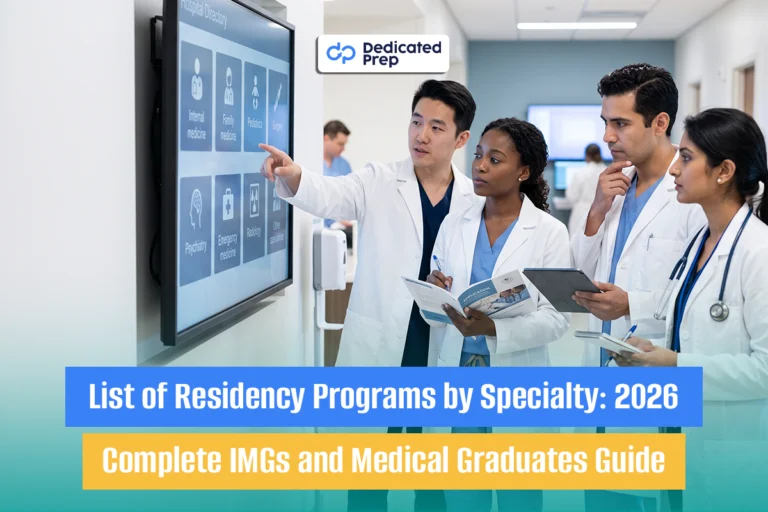

There are 13,762 ACGME-accredited programs listed across the United States right now. That number includes 5,380 speciality programs and 7,024 subspecialty programs and it grew by 457 programs in the last 2years alone.
You are probably a medical student in the final stretch, or an IMG who has spent months trying to decode a system that was not built with you in mind. You need a real list filtered by speciality, by state, by duration, and by how friendly each program actually is to international graduates.
The problem is that no single list gives you everything. Some databases show program names but no match data. Others show IMG percentages but not visa policies. And the ACGME’s own search tool lists programs without telling you anything about competitiveness.
Apply to the wrong programs, and you burn through thousands in ERAS fees with nothing to show for it. Apply without knowing your IMG odds by speciality, and you waste your best shots on programs that will never look at your file.
This guide breaks it all down: a list of residency programs by speciality, database by database, with real numbers from last year’s Match.
Quick Summary: List of Residency Programs by Speciality
- ACGME total: 13,762 accredited programs in 2024-2025, across speciality and subspecialty programs
- Primary search tools: FREIDA (AMA), ERAS Participating Programs (AAMC), and Residency Explorer each serve a different purpose
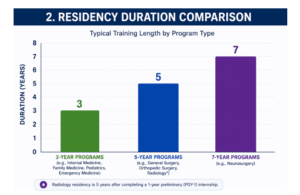
- Shortest programs: Family medicine, internal medicine, paediatrics, and emergency medicine all 3 years
- Longest program: Neurosurgery at 7 years
- IMG-friendliest specialities: Internal medicine, family medicine, psychiatry, pathology, and paediatrics
- IMG match rate: 60.8% overall; 67.8% for US-IMGs, 58% for non-US IMGs
- Largest IMG entry point: Internal medicine 4,718 IMGs matched recently, roughly 29% of all PGY-1 positions
What Is the Full List of ACGME-Accredited Programs, and Where Do You Find It
Most applicants waste weeks searching for a single spreadsheet. It does not exist. What exists is better than three purpose-built databases that each show you something different.
- FREIDA (AMA Residency and Fellowship Database) covers more than 13,000 ACGME-accredited programs. It filters by speciality, state, visa type, IMG percentage, first-year salary, and work schedule. Use it when you want to understand individual program requirements and cut your list by location or visa policy.
- ERAS Participating Programs (AAMC) shows every program accepting applications in a given cycle. Click any speciality name and the complete program list appears. This is the tool for building your actual ERAS application list.
- Residency Explorer (AAMC) gives source-verified match data, not self-reported numbers. It shows how applicants who actually matched looked on paper: Step scores, research output, demographics. As of October, the download feature was removed, but all data remains fully searchable within the tool.
If you want expert guidance on using these tools to build a competitive application list, Dedicated Prep’s Residency Match Support walks you through program selection, ERAS strategy, and interview prep as a complete package.
List of residency programs by speciality: What each database shows that the others do not.
| Database | Best For | IMG Data | Visa Info | Match Stats |
| FREIDA (AMA) | Program filtering | Yes % IMGs | Yes | No |
| ERAS Programs | Active application programs | Partial | No | No |
| Residency Explorer | Competitiveness assessment | Yes | No | Yes |
| ACGME ADS | Official accreditation status | No | No | No |
PRO TIP: Use FREIDA to filter by speciality and IMG percentage, Residency Explorer to check your competitiveness at each shortlisted program, and ERAS to submit. Running all three in sequence before applying cuts wasted applications significantly.
Types of Medical Residency Programs in the USA: By Speciality and Duration
A 2019 AAMC survey found that 42% of residents considered training length a significant factor when choosing their speciality. For IMGs who graduate later and carry financial pressure, that number is probably higher.
Duration is not just a lifestyle preference. It determines when you start earning an attending salary.
Here is the full list of residency programs by speciality and training length:
- Family medicine: 3 years. Most positions available for IMGs. Broadest scope of any primary care speciality.
- Internal medicine: 3 years. Highest raw IMG match volume in the country.
- Paediatrics: 3 years. Over 50% of new pediatric residents last year were IMGs.
- Emergency medicine: 3 years. High demand; one of the top four specialities for matched IMGs in the last year.
- Psychiatry: 4 years. Consistently among the most IMG-accessible specialities proportionally.
- General surgery: 5 years. Moderately competitive; harder for non-US IMGs.
- Radiology: 5 years after a preliminary year. Stronger for US graduates.
- Orthopaedic surgery: 5 years. 94% fill rate by MD/DO students. Extremely limited for IMGs.
- Plastic surgery: 6 years integrated. Among the least IMG-friendly specialities.
- Neurosurgery: 7 years. The longest residency program in the US.
The 3-year primary care programs are the realistic and strategic entry point for most IMGs. That is not a compromise. Internal medicine alone placed roughly 3,698 non-US IMGs in the 2025 Match, more than any other speciality by volume.
KEY TAKEAWAY: If you are an IMG choosing between specialities, internal medicine gives you the most positions by volume. But the list of family medicine residency programs and psychiatry gives you proportionally better match odds relative to competition.
Residency Programs in the USA for IMGs: What the Data Actually Shows
Non-US IMGs filled 17.66% of all PGY-1 positions in 2026, up from 13.03% five years earlier. That is a 57.6% increase in match volume over five years. More programs are open to international graduates than they were even recently.
The overall 60.8% match rate hides enormous variation by speciality.
But “IMG-friendly” is a spectrum, not a fixed category.
Around 72% of the list of IMG-friendly residency programs that successfully matched landed in one of the primary care specialities, with internal medicine accounting for the largest share. Family medicine, emergency medicine, and paediatrics followed. Surgical specialities plastic surgery, orthopaedic surgery, dermatology- remain the hardest for IMGs to enter.
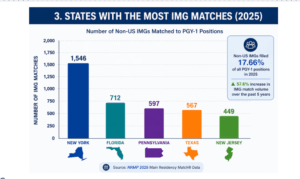
States matter too. New York accepted 1,546 IMGs in the past year’s Match. Florida accepted 712. Pennsylvania accepted 597. If you are building a residency program list by state, those three are your anchor points. Texas and New Jersey round out the top five.
What actually makes a program genuinely IMG-friendly? Four things: a documented history of matching IMGs, J-1 or H-1B visa sponsorship, no hard restriction on years since graduation, and a meaningful percentage of current residents who are international graduates. Programs with all four are the ones to prioritise. Programs that claim openness on paper but have not matched an IMG in three years are not worth your application fee.
IMPORTANT: Never rely on a program’s stated policy alone. Always cross-reference with its actual historical match percentage in FREIDA or Residency Explorer. The gap between what programs claim and what they actually do is significant at many institutions.
According to NRMP research, match probability for students stabilises after 100 to 170 programs, depending on your qualifications and speciality. That is a large volume of applications. Use FREIDA pre-filtering to make sure those 100-plus applications are going to programs that will actually open your file.
New Residency Programs Just Opened: Why They Matter More Than You Think
The 457 list of residency programs by speciality was newly accredited in 2024-2025. That is 71 more than the previous year and the fastest growth rate in recent memory.
New programs matter for two reasons. First, they have no established resident preferences or alumni networks, which makes them significantly more open to all applicants with non-traditional profiles. Second, they tend to be at community hospitals and regional medical centres rather than academic giants, which means more hands-on procedures faster, and less competition for cases.
The ACGME list of programs by speciality publishes its full list of newly accredited programs through the Accreditation Data System at apps.acgme.org. Filter by speciality and sort by accreditation date. These are programs your competition has not researched yet. That is a real edge.
PRO TIP: New programs often interview more applicants per position than established ones. They are building their reputation and genuinely need strong residents. Apply broadly across new and established programs; do not skip new ones out of unfamiliarity.
Top List of Residency Programs by Speciality: How to Identify Them for Your Profile
Top residency programs by speciality mean different things depending on whether you are a US MD senior. For US graduates targeting academic medicine, top programs are Harvard-affiliated, Johns Hopkins, Stanford, and Mayo Clinic, all consistently at the peak of speciality rankings and research output.
For students, “top” means something more strategic: the program with the highest combined score of applicants percentage, visa sponsorship, reasonable Step 2 CK expectations, and no hard graduation year restriction.
A program ranked 40th nationally that matches 35%, sponsors J-1 visas, and has no five-year graduation limit is a better target than a program ranked 10th that has matched zero non-US students in four years.
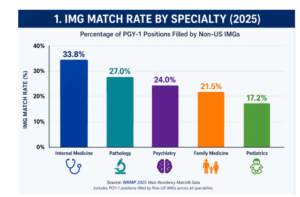
Per NRMP’s 2025 Match data, the specialities with the highest IMG fill rates included internal medicine (33.8% non-US fill rate), pathology (27.1%), family medicine, and psychiatry. These are the specialities where your application will receive a genuine read regardless of your country of graduation.
Use the speciality fill rate as your starting filter. Then narrow by program-level data in FREIDA.
Before finalising your program list, read Dedicated Prep’s complete ERAS Application Guide. It covers how to build your experiences section, personal statement, and submission timeline to maximise interview invites.
Final Verdict: List of Residency Programs by Speciality Explained
Use FREIDA to build your speciality-specific shortlist, cross-reference with Residency Explorer for real match data, and confirm active participation through ERAS before applying. For students, start with internal medicine, family medicine, or psychiatry. These three specialities account for the majority of successful matches and offer J-1 visa sponsorship at scale.
This approach works when sorting your list of residency programs by speciality, whether you are a US graduate targeting a competitive speciality or an international graduate finding programs where your application gets a fair read. Pick your speciality based on your profile and career goals. Then use the right databases to build the right list.
When you are ready to move from research to action, Dedicated Prep offers one-on-one residency match support from ERAS strategy and personal statement to interview coaching built specifically for students who need to get this right.
FAQs about the list of residency programs by speciality
Where can I find a complete list of all residency programs by speciality?
The ACGME Accreditation Data System at apps.acgme.org lists all 13,762 accredited programs searchable by speciality. FREIDA, the AMA’s database, adds filtering by percentage, visa type, and first-year salary, making it far more useful for actual program selection.
What are the friendly residency programs in the USA for international students?
Internal medicine, family medicine, psychiatry, pathology, and paediatrics consistently have the highest match rates. In the 2025 Match, internal medicine alone placed 4,718 applicants, and over half of all new pediatric residents that year were international graduates.
Which of the shortest residency programs are available in the USA?
Family medicine, internal medicine, paediatrics, and emergency medicine are all 3-year residency programs. These are also among the most accessible for all and the fastest route to independent practice and an attending-level income.
How do I find new residency programs just opened recently?
Check the ACGME ADS filtered by recent accreditation dates. 457 programs were newly accredited. New programs have no established preferences and are often more open to IMGs and non-traditional applicants than established ones.
Which states have the best emergency medicine residency programs?
New York, Florida, Pennsylvania, Texas, and New Jersey consistently rank as the top five states by raw applicant placements. These states have high program density and large hospital systems that rely on applicants to fill positions across multiple specialities each Match cycle.