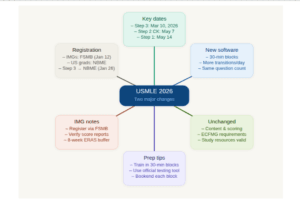
The biggest USMLE insights for 2026 centre on two structural shifts: a completed service transition consolidating all registration and score delivery under FSMB and NBME, and a new test delivery software rolling out across all three Steps. Step 3 moved to the new platform on March 10, 2026; Step 2 CK follows on May 7, and Step 1 on May 14. Content, scoring, and total question counts are unchanged. But the block structure is shorter and more frequent, which changes how you need to pace and practice.
Two major structural shifts hit the USMLE this year. Both are official. Both are already in motion. And both affect you differently depending on whether you’re a US graduate or an IMG.
The first: a full-service transition that moved all registration and score delivery from ECFMG to FSMB for IMGs, and centralised Step 3 services with NBME for US students. If you’ve applied since January 2026, you’ve already felt this. If you haven’t yet, you will.
The second: a redesigned test delivery platform rolling out across all three Steps in 2026. This isn’t just a cosmetic update. The block structure is fundamentally different, and students who don’t practice under the new format before test day will feel the rhythm shift mid-exam.
What makes this confusing is that most resources bury the actual operational details. They explain that things changed but not what you need to do about it, not how the block structure actually feels different, and not what the service transition means for your score report timeline or your ERAS application. This guide closes that gap. You will get the verified facts from FSMB, NBME, and USMLE.org, a clear breakdown of what changed, what didn’t, and what to adjust in your prep right now.
Quick Summary: USMLE Insights 2026
|
What Did the USMLE Service Transition Actually Change
Most students heard the phrase ‘service transition’ and moved on. That’s a mistake. This change directly affects which portal you use, where your score report lands, and who you contact when something goes wrong.
The Core Change: One Year, Two Phases
Before 2026, the administrative pipeline was fragmented. IMGs registered through ECFMG’s MyIntealth portal for Step 1 and Step 2 CK, and through FSMB for Step 3. US graduates used NBME for Steps 1 and 2 CK, and FSMB for Step 3.
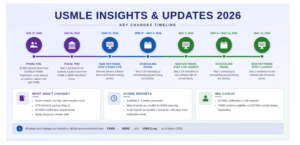
- Phase One (January 12, 2026): All IMG services shifted from ECFMG’s MyIntealth portal to FSMB’s USMLE portal. Every Step exam service for IMGs, including registration, score delivery, and customer support, now lives with FSMB.
- Phase Two (January 26, 2026): Step 3 services for US students and graduates moved from FSMB to NBME’s MyUSMLE Portal. US students now use NBME for all three Steps.
ECFMG certification is still required for IMGs. That hasn’t changed. ECFMG still determines eligibility; FSMB simply confirms it during the registration process. Don’t confuse the administrative shift with a change in the underlying requirements.
| Who You Are | Register Step 1 & 2 CK | Register Step 3 | Score Reports From |
| US Student/Graduate (LCME/COCA) | NBME- MyUSMLE Portal | NBME- MyUSMLE Portal | NBME (via MyUSMLE) |
| IMG (outside US, ECFMG-eligible) | FSMB- USMLE Portal | FSMB- USMLE Portal | FSMB (USMLE portal) |
| Canadian Grad (LCME-accredited) | NBME- MyUSMLE Portal | NBME- MyUSMLE Portal | NBME (via MyUSMLE) |
| IMG- Step 3 (post-residency yr 1) | FSMB- USMLE Portal | FSMB- USMLE Portal | FSMB (USMLE portal) |
| WARNING If you submitted an incomplete application before the January transition and it wasn’t processed in time, you will need to resubmit it through the new portal. Applications don’t auto-transfer. Score reports posted in ECFMG’s old portal within the prior 365 days were transferred to FSMB’s portal, but verify this directly. |
How the New Test Delivery Software Changes Your Exam Day
This is the section most competitors skip. The software update isn’t just a new interface; it restructures the cognitive rhythm of your exam day. Understanding exactly how a smooth test day differs from one where you’re recalibrating your pacing mid-exam.
What Is the New Platform and Why Did USMLE Switch
NBME self-assessments and other official practice materials have already been running on the updated software for some time. The change to the live exams aligns Step testing with what students have been practising on, creating a more consistent experience throughout the USMLE journey.
According to the official USMLE announcement on March 10, 2026, Step 3 exams transitioned first, with Step 2 CK following on May 7 and Step 1 on May 14. Scheduling and rescheduling for Step 2 CK is paused from April 27 through May 6; for Step 1, from May 9 through May 13.
The Block Structure Change: What It Feels Like
Here’s what competitors get wrong: they say blocks are ‘shorter’ and move on. The practical implication is more significant.
- Step 2 CK: shifts from 8 blocks of 60 minutes to 16 blocks of 30 minutes: same 232 questions, same total time. But you now face 16 distinct start-stop cycles instead of 8.
- Step 1: shifts from 7 blocks to 14 blocks, each 30 minutes. Same question count, same total duration.
Each 30-minute block contains roughly 18 to 20 questions. That’s a faster pace per question within each block, combined with significantly more transitions between blocks. Settling-in time at the start of each block matters more when it happens 16 times instead of 8.
What the Research Says About Cognitive Load and Block Length
A 2024 correction notice in academic literature addressed the article ‘How Does ChatGPT Perform on the USMLE? The Implications of Large Language Models for Medical Education and Knowledge Assessment highlights ongoing scholarly scrutiny of how cognitive demand interacts with exam structure and time pressure in medical licensure testing. The same block-endurance principles apply to human examinees: mental fatigue compounds across transitions, not just within sustained blocks.
This is why practising in 20-question blocks timed to 30 minutes isn’t optional for May 2026 candidates. It’s the single most important format adjustment to make now.
| PRO TIP Use the official USMLE testing experience tool at USMLE.org before your exam. It shows the exact interface for your Step, including keyboard shortcuts, image contrast controls, and the new navigation flow. Muscle memory built before test day costs nothing; confusion on test day costs points. |
What Stayed the Same: The Facts That End the Panic
Every time a structural change rolls out, anxiety spikes in student forums. Most of it is unfounded. Here’s what’s verified as unchanged from official sources.
Content, Scoring, and ECFMG Requirements
Exam content for all three Steps is unchanged. The basic science blueprint for Step 1, the clinical knowledge framework for Step 2 CK, and the clinical decision-making structure of Step 3 are all exactly as they were.
Step 1 remains pass/fail. Step 2 CK and Step 3 retain numerical scoring. The computer-based case simulations (CCS) in Step 3 are completely unchanged, both in format and scoring.
For IMGs, ECFMG Certification requirements remain intact. ECFMG still requires IMGs to pass Step 1 and Step 2 CK to meet the medical science examination requirement. The service transition didn’t touch any of this.
Study resources that were valid in 2025 are still valid. UWorld, First Aid, NBME self-assessments, and AMBOSS all remain aligned to the current content blueprint. Your question bank isn’t obsolete.
That split is now gone. Also, you can read our complete guide on the USMLE exams overview that might help students navigate this transition since it was announced, and the biggest issue we see is students submitting applications to the wrong portal.
| KEY TAKEAWAY Content didn’t change. Scoring didn’t change. ECFMG requirements didn’t change. The format of how you sit the exam has changed. Separate these two things in your prep planning. |
What IMGs Need to Know That Most Guides Don’t Cover
The 2026 USMLE insights that hit IMGs hardest aren’t the software changes. They’re the administrative changes. And the operational details that affect your timeline most are the ones buried in the official addendum.
Your Score Report Location Changed So Check Before You Apply.
If you tested before January 12, 2026, your score report was in ECFMG’s portal. After the transition, reports posted within the prior 365 days were transferred to FSMB’s USMLE portal.
Before using a score report for ERAS or any licensure application, log into FSMB’s portal and verify that the report is there. Don’t assume. Score reports transferred, but document access during portal outages (January 8 to 12 for Phase One) confused some students.
According to the USMLE 2026 Bulletin of Information, score reports remain accessible in the portal for approximately 365 days from the date of the email notification. After that window, you’ll need to request a transcript from FSMB directly.
In our experience working with IMG candidates, the most common source of ERAS delays isn’t exam performance. It’s administrative snags around transcript delivery. This year, with a new portal system, allow extra lead time before the application season opens.
How to Adjust Your Prep for the New Block Structure
Here’s the honest take: if you’re testing before May 7 for Step 2 CK or before May 14 for Step 1, nothing in your practice approach needs to change. The old format is still in place.
If you’re testing after those dates, one specific adjustment matters more than anything else.
Train in 30-Minute Blocks, Starting Now
Every question bank you’re using allows custom block lengths. Set them to 18 to 20 questions with a 30-minute timer. Do this for every practice session from now until your exam. The goal isn’t just pacing; it’s training the mental reset that needs to happen 16 times in a row on test day for Step 2 CK.
The new interface also includes image contrast controls and improved keyboard navigation. Radiograph and dermatology images that look washed out under Prometric lighting can now be adjusted. Practice the contrast adjustment on the official USMLE testing experience tool so it’s instinctive, not a distraction.
For students working with Dedicated Prep’s tutoring program, we’ve already updated our session structures to mirror the new block rhythm. But even without formal tutoring, the adjustment is straightforward: short blocks, more transitions, same content.
| PRO TIP The first and last questions of each block are where pacing slippage happens most. Start each block with 2 seconds of deliberate settling. End each block with a 30-second mark-review scan. These bookend habits prevent the compounding time debt that kills scores in high-block-count exams. |
What No One Says Out Loud About Preparing Through a Transition Year
There’s a specific kind of stress that comes with prepping for a high-stakes exam during a year when the infrastructure itself is changing. You’re not just managing content anxiety. You’re managing the uncertainty of not knowing which portal to use, whether your old score report transferred, or whether the format you’re practising for is the one you’ll actually sit.
That uncertainty is legitimate. And it compounds if you try to resolve it by reading student forums instead of official sources.
The practical solution is straightforward: go to USMLE.org and the official FSMB or NBME portals for administrative questions. For everything prep-related, the resources haven’t changed, and the content blueprint hasn’t changed. Nail those two things, and the noise around the transition becomes manageable.
| KEY TAKEAWAY Official sources only for policy and portal questions. USMLE.org, FSMB.org, NBME.org. Student forums can’t tell you which portal to use. The official sites can. |
Final Verdict: USMLE Insights for 2026 explained
Two things changed this year that actually affect you: where you register and how the exam day is structured. The content, the scoring, and the preparation resources are exactly as they were.
If you’re an IMG, verify your score report is in FSMB’s portal before ERAS season. If you’re testing after May 7 (Step 2 CK) or May 14 (Step 1), practice in 30-minute blocks with the new interface tutorial. That’s the whole adjustment.
This matters most for students testing in the second half of 2026, particularly those with ERAS applications depending on timely score delivery. If that’s you, start adjusting your practice format now, not the week before your exam.
The students who score well this year won’t be the ones who panicked about the transition. They’ll be the ones who verified the facts, adjusted their block practice, and stayed focused on content. Dedicated Prep’s team is here when you need personalised guidance on exactly that.
FAQs about USMLE insights2026
1. Do IMGs still need ECFMG certification after the 2026 service transition?
Yes. ECFMG certification is still a core requirement for IMGs to take any USMLE Step. The service transition moved registration to FSMB, but ECFMG still determines certification eligibility and shares that status with FSMB for registration purposes.
2. If my Step 1 exam is scheduled for May 20, 2026, will I be using the new software?
Yes. All Step 1 exams administered on or after May 14, 2026, use the new test delivery software with 30-minute blocks. Review the official Step 1 testing experience tool and tutorial at USMLE.org before your exam date.
3. How long does it take to receive a USMLE score report in 2026?
Score reports are typically available two to four weeks after your test date. For ERAS and residency planning, allow a full eight weeks as a buffer. Reports remain accessible in the portal for approximately 365 days from the notification email.
4. Can I still use UWorld and First Aid to prepare for USMLE 2026?
Yes. The content blueprints for Step 1, Step 2 CK, and Step 3 are unchanged. All major question banks and study resources remain fully valid. The new software changes the interface and block structure, not what’s being tested.
5. What happens if I submitted a Step 3 application to FSMB before January 26, 2026, but it wasn’t processed?
Incomplete applications not processed before the Phase Two transition must be resubmitted with NBME through the MyUSMLE Portal. This applies to US students and graduates only. Contact NBME directly through the Portal for assistance.