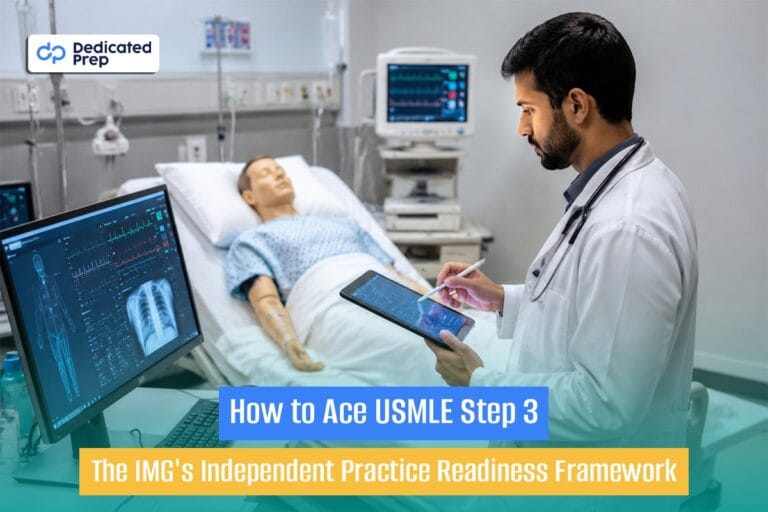

To Ace USMLE Step 3 as an IMG means closing three gaps at once: mastering Foundation of Independent Practice content on Day 1, building CCS-based clinical judgment for Day 2, and adapting to US-specific documentation and practice norms that Step 1 and Step 2 CK never tested. A structured 8- to 12-week plan built around UWorld Step 3, NBME self-assessments, and deliberate CCS practice is the fastest route to a first-attempt pass.
USMLE Step 3 is the last checkpoint before a physician can practice medicine without supervision in the United States. For international medical graduates, it is also the step most likely to expose gaps that Step 1 and Step 2 CK never tested, because Step 3 assumes familiarity with how US hospitals actually run. This guide breaks down what makes Step 3 different for IMGs specifically, how the two-day format and CCS component work, and the readiness framework that turns strong medical knowledge into a passing, independent-practice-ready score.
What Is USMLE Step 3
USMLE Step 3 is the final examination in the United States Medical Licensing Examination sequence. It evaluates whether a physician possesses the medical knowledge and clinical understanding necessary to practice medicine independently, without direct supervision. Unlike Step 1, which tests foundational science, and Step 2 CK, which tests clinical knowledge in a supervised training context, Step 3 tests whether a candidate can be trusted to manage real patients on their own. Most US MD and DO programs allow students to sit for Step 3 during residency, while many IMGs take it earlier, sometimes before starting residency, to strengthen their residency application.
How Does USMLE Step 3 Work?
Step 3 is delivered over two separate testing days, which can be scheduled on consecutive days or weeks apart depending on availability. Day 1 covers the Foundation of Independent Practice (FIP), built from multiple-choice questions on basic science, biostatistics, epidemiology, patient safety, and medical ethics. Day 2 covers Advanced Clinical Medicine (ACM), which combines multiple-choice questions with Computer-based Case Simulations, or CCS, where the candidate manages a virtual patient in real time by ordering tests, prescribing treatment, and adjusting the plan as the case evolves.
This structure is the core reason Step 3 cannot be prepared for the same way as Step 1 or Step 2 CK. Recognising a diagnosis on a multiple-choice question is a different skill than sequencing an entire admission, from history and physical through discharge planning, inside a simulated hospital environment with a ticking clock.
Types: The Two Components of Step 3
| Component | Day | Format | Primary Skill Tested |
| Foundation of Independent Practice (FIP) | Day 1 | Multiple-choice questions, approximately 6 hours | Foundational and applied medical knowledge |
| Advanced Clinical Medicine (ACM) | Day 2 | Multiple-choice questions plus CCS cases, approximately 9 hours | Independent clinical judgment and patient management |
Features of the Step 3 Exam
- Two-day format that separates foundational knowledge from applied clinical management.
- Computer-based Case Simulations that require managing a patient across an entire encounter rather than answering a single question.
- Heavier weighting toward internal medicine, family medicine, and outpatient longitudinal care compared to Step 2 CK.
- Content drawn from US clinical guidelines, US healthcare system structure, and US documentation conventions.
- Scoring that factors in efficient, safe, and cost-conscious decision-making, not just correct diagnoses.
Why Step 3 Is Different for IMGs
US MD and DO graduates typically sit Step 3 mid-residency, after months of hands-on exposure to US rounding structure, EMR documentation, and interdisciplinary workflows. Many IMGs take Step 3 without that exposure, which creates three specific readiness gaps.
1. US Healthcare System Fluency
CCS cases assume familiarity with how a US hospital actually functions: what a nurse can do without a physician order, when a consult is appropriate, how insurance and cost considerations shape ordering decisions, and what counts as standard follow-up. Candidates trained entirely outside the US system often know the correct clinical answer but lose points on workflow and sequencing.
2. Documentation Norms
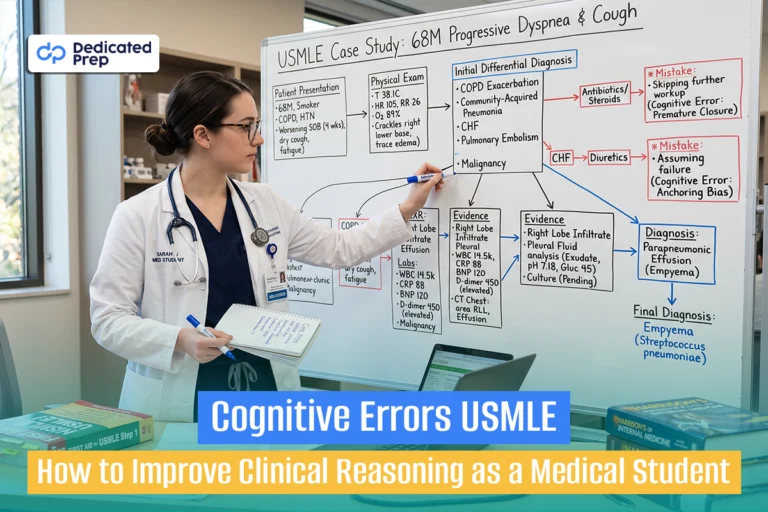
Step 3 rewards SOAP-based reasoning: Subjective, Objective, Assessment, Plan. IMGs coming from systems with different charting conventions need deliberate practice translating clinical reasoning into this specific structure, since CCS cases are scored on the logic and completeness of the plan entered, not just the final diagnosis.
3. Independent Clinical Judgment Under Time Pressure
Step 1 and Step 2 CK reward recognition. Step 3 rewards sequencing: knowing not just what to order, but when, and what to do while waiting for results. This is a skill that develops through repeated CCS practice, not through additional content review alone.
Benefits of Building an Independent Practice Readiness Framework
- Reduces the risk of a Step 3 failure that could delay residency start dates or licensure timelines.
- Builds documentation habits that carry directly into residency, reducing the adjustment period once training begins.
- Strengthens an IMG’s residency and match application, since many programs view an early Step 3 pass as a signal of readiness.
- Improves confidence going into supervised practice, since the exam itself simulates unsupervised decision-making.
Applications: Who Should Use This Framework
This readiness framework applies most directly to IMGs who trained outside the US and are approaching Step 3 either before starting residency or during PGY-1, as well as to US graduates who want a more structured, CCS-heavy study plan than a general review course provides. It is also relevant to candidates who passed Step 1 and Step 2 CK comfortably but felt less prepared for patient-management-style questions, since that is precisely the skill Step 3 tests most heavily.
The Independent Practice Readiness Process to ACE USMLE exams
Step 1: Confirm Eligibility
IMGs must hold ECFMG certification and typically must have passed Step 1 and Step 2 CK, and in most states must be enrolled in or have completed an ACGME-accredited residency program, before sitting Step 3. Eligibility requirements vary by state medical board, so confirming the specific state’s rules early avoids scheduling delays.
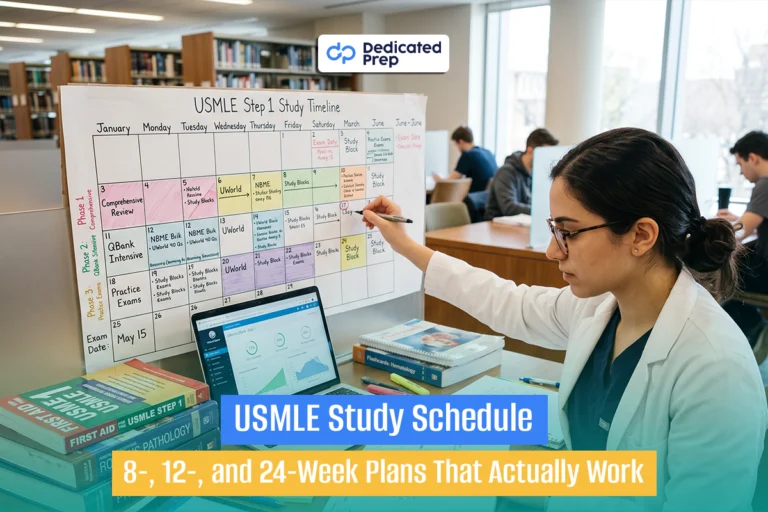
Step 2: Build an 8 to 12 Week Study Timeline
Most candidates need 8 to 12 weeks of dedicated preparation, longer if working clinical hours during residency. The timeline should split roughly into a first phase of content review and FIP-focused question practice, followed by a second phase weighted toward ACM questions and CCS case simulations.
Step 3: Work a High-Yield Question Bank Daily
UWorld Step 3 is the most widely used resource because its explanations mirror the clinical-reasoning style Step 3 rewards. Daily blocks, reviewed in detail rather than rushed through, build both content recall and the pattern recognition Step 3 questions test.
Step 4: Practice CCS Cases Deliberately
CCS practice should start early, not in the final week. Candidates should practice full cases under timed conditions, then review not just whether the diagnosis was correct but whether the sequencing, order, timing, and follow-up plan were efficient and safe.
Step 5: Take NBME Self-Assessments to Benchmark Readiness
NBME Step 3 self-assessments are the closest to the real exam’s format and difficulty. Scheduling one at the midpoint and one near the end of the study timeline gives an objective readiness signal and highlights which organ systems or case types need more attention.
Step 6: Rehearse US Documentation Structure
Practising SOAP-format note writing and order sequencing, ideally with feedback from someone familiar with US clinical workflows, closes the documentation gap that catches many IMGs off guard on test day.
A Sample 10-Week Step 3 Study Plan for IMGs to Ace USMLE with high scores
| Weeks | Focus | Key Activities |
| 1 to 3 | FIP content review | Systems-based review, biostatistics and ethics questions, UWorld FIP blocks |
| 4 to 6 | ACM content and question volume | Internal medicine and outpatient-heavy question blocks, first NBME self-assessment |
| 7 to 8 | CCS case immersion | Daily timed CCS cases, SOAP documentation drills, workflow review |
| 9 | Full-length practice and review | Second NBME self-assessment, targeted review of weak systems |
| 10 | Final consolidation | Light review, rest, logistics check for both test days |
Comparison: How to Ace USMLE Step 3 vs Step 1 vs Step 2 CK
| Factor | Step 1 | Step 2 CK | Step 3 |
| Primary Focus | Basic science mechanisms | Clinical knowledge in supervised settings | Independent, unsupervised patient management |
| Format | One-day, multiple-choice | One-day, multiple-choice | Two-day, multiple-choice plus CCS |
| Skill Tested | Recognition and mechanism | Diagnosis and next best step | Sequencing and ongoing management |
| IMG-Specific Gap | Minimal | Moderate | US workflow and documentation fluency |
Step 3 by the Numbers
- Step 3 is required in every US state and territory before a physician can obtain an unrestricted medical license, according to the Federation of State Medical Boards.
- The USMLE program, jointly sponsored by the National Board of Medical Examiners and the Federation of State Medical Boards, structures Step 3 as the final of three steps assessing readiness for unsupervised practice.
- According to NBME data on Step 3 performance, first-time takers who are IMGs historically pass at somewhat lower rates than first-time US and Canadian graduates, a gap most closely associated with unfamiliarity with US clinical workflows rather than medical knowledge itself.
Pros and Cons of Taking Step 3 Before Residency
| Pros | Cons |
| Strengthens a residency application by demonstrating readiness | No clinical rotation experience yet to draw on for CCS pacing |
| Removes Step 3 from an already demanding PGY-1 schedule | Requires self-directed exposure to US workflows and documentation |
| Signals confidence to residency program directors | Eligibility rules vary by state, so timing must be confirmed early |
Best Practices for Passing Step 3 on the First Attempt
- Start CCS practice at least six weeks before the exam, not in the final days.
- Review every UWorld explanation in full, including the answers marked correct, to reinforce reasoning patterns.
- Treat NBME self-assessments as diagnostic tools, not just score predictors, and rebuild a study plan around the weak areas they reveal.
- Practice writing SOAP-format plans by hand or on a keyboard, since documentation speed matters under CCS time pressure.
- Schedule both test days with enough buffer to review FIP performance trends before sitting for ACM.
Common Mistakes in Step 3 Preparation
- Treating Step 3 like a longer version of Step 2 CK and skipping dedicated CCS practice.
- Under-scheduling outpatient and preventive medicine content, which is weighted more heavily on Step 3 than on earlier steps.
- Ignoring US-specific workflow details, such as order-of-operations in an emergency department versus an outpatient clinic.
- Taking only one NBME self-assessment, which leaves no way to measure improvement over the study period.
- Waiting until the week before the exam to confirm state-specific eligibility and scheduling requirements.
Final Thoughts: Ace USMLE in 2026 with Dedicated Prep
USMLE Step 3 tests something none of the earlier steps does directly: whether a physician can be trusted to manage patients without supervision. For IMGs, passing on the first attempt means treating the exam as three parallel goals rather than one: building FIP content mastery, developing CCS-based clinical judgment, and closing the US healthcare system and documentation gaps that US-trained graduates absorb during clinical rotations. A structured 8- to 12-week plan anchored in UWorld Step 3, deliberate CCS practice, and NBME self-assessments gives IMG candidates the clearest path to independent practice readiness.
Ready to Build Your Step 3 Plan?
We have a great team to pair USMLE candidates with 260-plus scoring tutors who build personalised study plans for Step 1, Step 2 CK, and Step 3, and our tutors have mentored over 1,000 students toward their target scores. If a structured, CCS-focused Step 3 plan built around your specific readiness gaps sounds useful, book a free strategy session with a Dedicated Prep tutor to get a roadmap built around your timeline.
FAQ’s
1. How long should I study for USMLE Step 3?
To ace USMLE, most candidates need 8 to 12 weeks of dedicated preparation, with the timeline extending for those studying part-time alongside residency duties.
2. What is the best resource for USMLE Step 3?
UWorld Step 3 is the most widely used question bank because its explanations mirror the clinical-reasoning style the exam rewards, paired with NBME self-assessments for benchmarking.
3. What is CCS on USMLE Step 3?
CCS stands for Computer-based Case Simulation, an interactive component on Day 2 where candidates manage a virtual patient over time by ordering tests, prescribing treatment, and adjusting the plan as the case evolves.
4. Can international medical graduates take USMLE Step 3 before residency?
In many states, yes, provided ECFMG certification and Step 1 and Step 2 CK are complete, though some states require enrollment in or completion of an ACGME-accredited residency first. Eligibility should be confirmed with the specific state medical board.
5. Why do IMGs struggle more with Step 3 than Step 1 or Step 2 CK?
Step 3 tests independent clinical judgment within US healthcare workflows and documentation norms, which IMGs often have less direct exposure to compared to US-trained graduates who absorb these patterns during clinical rotations.
6. How many practice questions should I complete before Step 3?
There is no universal number, but working through a full UWorld Step 3 question bank at least once, with thorough review of explanations, is the common baseline most successful candidates report.