
You know the material. You have done practice questions worth hundreds of hours on UWorld, First Aid, and Anki. Yet your practice exam scores still don’t reflect the hours you’ve put in.
If that sounds familiar, the problem probably isn’t your knowledge base. It’s your test-taking skill.
Every year, thousands of medical students and IMGs walk into the testing center with strong content knowledge and walk out with a score that doesn’t reflect their actual preparation. The gap between “knowing medicine” and “scoring well on the USMLE” is a skill set of its own, one built on pacing, question interpretation, answer-elimination logic, and exam-day stamina.
This guide breaks down exactly how to become a better test taker for the USMLE, with practical, research-backed strategies you can start using in your very next practice block.
Why Test-Taking Skills Matter as Much as Content Knowledge
The USMLE isn’t a memory test. It’s a clinical reasoning test disguised as multiple-choice questions.
Step 1 uses seven blocks of 40 questions in one hour each, while Step 2 CK uses eight blocks of 38 to 40 questions per hour. That pace leaves you roughly 90 seconds per question, including reading a dense clinical vignette.
Research on USMLE Step 2 CK performance backs this up. A systematic review of predictors of Step 2 CK scores found that changing answers and spending more time per question were both associated with higher scores, meaning careful, deliberate test-taking behavior genuinely moves the needle, independent of raw content mastery.
In other words, two students with identical knowledge can walk away with a 15-20 point score gap purely based on how they approach the exam itself. That’s the gap effective test-taking strategies for the USMLE are designed to close.
Understand the Exam Format Before You Build a Strategy
You can’t out-strategize an exam you don’t fully understand. Before drilling test-taking tactics, get clear on the structure you’re preparing for.
- Step 1: 7 blocks, 40 questions each, 60 minutes per block, pass/fail scoring.
- Step 2 CK: 8 blocks, 38-40 questions each, 60 minutes per block, scored 1-300.
- NBME and CBSE practice exams mirror this format in condensed form, typically 4-6 blocks of 50 questions, and are the closest simulation you’ll get to test day.
Knowing the rhythm of the real exam, how long a block feels, when fatigue sets in, and how breaks are structured is the foundation on which everything else in this guide is built. If you’re still getting oriented with the exam itself, our full breakdown of what the USMLE exam actually tests is a good place to start.
10 Proven Strategies to Become a Better USMLE Test Taker
1. Read the Last Line First, Then the Vignette
Long vignettes are designed to test whether you can filter signals from noise. Jump to the final question before reading the case, and you’ll immediately know what you’re looking for: a diagnosis, a next step, a mechanism, a lab value.
This single habit can cut your reading time by 10-15 seconds per question, which adds up to several extra minutes per block.
2. Predict the Answer Before Looking at the Choices
Once you’ve read the vignette, form your own answer in your head before scanning the options. This protects you from being pulled toward a distractor that “sounds right” but doesn’t match the clinical picture you just built.
If your predicted answer is sitting right there among the choices, you can move on with confidence instead of second-guessing.
3. Master Strategic Answer Elimination
When you’re unsure, don’t try to find the right answer; try to eliminate the wrong ones. Cross off any choice that:
- Contradicts a fact stated in the vignette
- Would be correct for a different but similar-sounding condition
- Is an extreme or absolute statement (“never,” “always,” “only”)
Even eliminating one or two options meaningfully improves your odds on an educated guess, and this approach to answer elimination on the USMLE works even when you’re not fully confident in the content.
4. Manage Your Pace With Checkpoints, Not the Clock
Watching the countdown timer creates anxiety and tunnel vision. Instead, set mental checkpoints: by question 10, you should be roughly 15 minutes in; by question 20, around 30 minutes.
If you’re behind at a checkpoint, flag the question, make your best guess, and move on. You can return during review time if any remains.
5. Don’t Be Afraid to Change an Answer When You Have a Good Reason
The old advice to “always trust your gut” isn’t fully supported by the evidence. Research on Step 2 CK performance found that answer changes were actually associated with higher scores when they were driven by re-reading the question or catching a misread detail.
The rule of thumb: change your answer if you spot new information or realize you misread something, not simply because a different choice suddenly “feels” better.
6. Simulate Real Test Conditions Every Time You Practice
Practising in short, low-pressure bursts doesn’t train the stamina the actual exam demands. Once you’re past the early content-building phase, shift to full-length, timed NBME and UWorld blocks under real testing conditions, same start time, same break structure, same environment.
This builds the mental endurance needed to stay sharp through hour seven or eight, when concentration naturally dips and careless errors spike.
7. Review Every Practice Question, Right and Wrong
The score on a practice block is far less valuable than the review that follows it. For every question, ask:
- Why is the correct answer correct?
- Why is my answer wrong (if it was)?
- Why is every other wrong answer wrong?
- What was the trick, and how do I recognise it next time?
This step is where improving your USMLE test-taking skills actually happens; it’s pattern recognition training, not just content review.
8. Learn to Recognise Common Distractor Patterns
USMLE writers reuse the same distractor logic across thousands of questions. Common traps include:
- A choice that’s correct for the “textbook” version of a disease but wrong given the specific detail in the vignette
- A second-best or “almost right” next step that’s tempting but not the most appropriate first action
- A true statement about the patient that isn’t actually what the question is asking for
Learning to spot these patterns is one of the fastest ways to raise your score without learning a single new fact.
9. Protect Your Mental Stamina on Exam Day
A seven-to-nine-hour exam is as much a physical and psychological test as a cognitive one. Fatigue quietly erodes accuracy in the final blocks, even for well-prepared students.
- Eat something with protein and slow-release carbs before and during breaks
- Stand up and move during every scheduled break, even briefly
- Use brief breathing resets between blocks to reset focus
- Avoid reviewing flagged questions from a prior block during a break; it just adds stress
10. Debrief Every Full-Length Practice Exam Like a Coach Would
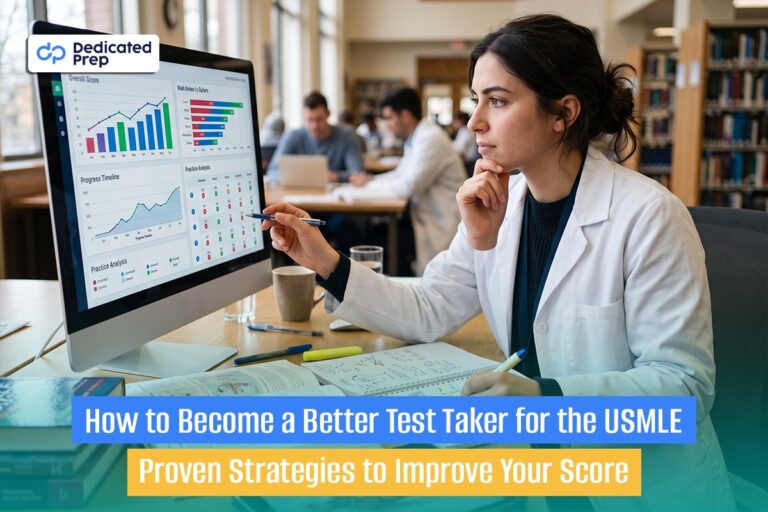
After each NBME or full UWorld simulation, don’t just look at your percentage. Break your errors into categories: content gaps, misread questions, timing issues, or second-guessing.
Tracking these categories over multiple practice exams shows you exactly which test-taking habit is costing you the most points, and that’s the habit to fix first.
Common Test-Taking Mistakes That Quietly Cost Points
Even strong students fall into these patterns without realising it. Here is how to become a better test taker for the USMLE, avoiding the following mistakes:
- Over-reading the vignette and getting lost in irrelevant details instead of anchoring on the final question stem
- Second-guessing a confident first answer without a clear reason
- Rushing the last block because time ran short earlier in the day
- Ignoring the pattern in missed questions and simply moving on to the next practice set
- Studying content in isolation from timed, question-based practice until very late in preparation
Recognising which of these applies to you is often more valuable than another week of content review.
How a USMLE Tutor Can Sharpen Your Test-Taking Approach
Content review can be self-directed. Test-taking skills are much harder to diagnose on your own, because your blind spots are, by definition, invisible to you.
An experienced tutor can watch how you approach a block in real time, flag exactly where you’re losing points, misreads, pacing, elimination logic, and second-guessing, and build a targeted plan around it instead of a generic one.
At Dedicated Prep, our tutors work with Step 1 and Step 2 CK students to fix these exact patterns, pairing high-yield content review with structured test-taking coaching. If you already know your content but your practice scores aren’t moving, USMLE tutoring built around your specific weak points is often the fastest way to close the gap.
Conclusion: How to become a better test taker for the USMLE Explained!
Scoring well on the USMLE isn’t only about how much you know; it’s about how efficiently you can turn that knowledge into correct answers under real exam pressure.
The strategies above, reading the last line first, predicting answers, disciplined pacing, pattern-based elimination, and honest post-exam debriefs, are skills, and like any skill, they improve with deliberate practice.
Start applying even two or three of these techniques in your next timed block. Track the difference. Small, consistent adjustments to how you take the exam compound into a meaningfully higher score by test day.
If you want a personalised diagnosis of exactly which test-taking habits are holding your score back, Dedicated Prep’s tutors can help you build a plan around your specific gaps rather than generic advice.
FAQs about how to become a better test taker for the USMLE
1. How can I become a better test taker for the USMLE quickly?
Start with pacing and answer-elimination drills in your next few timed blocks. Read the final question stem first, predict an answer before viewing choices, and review every missed question for the underlying pattern, not just the correct fact.
2. What is the biggest test-taking mistake on the USMLE?
Over-reading vignettes and losing time on irrelevant details is one of the most common mistakes. It leaves less time for later blocks and increases fatigue-driven errors near the end of the exam.
3. Should I change my answer if I’m unsure about the USMLE?
Only change an answer if you catch new information or realise you misread the question. Impulsive changes based on a “feeling” tend to hurt more than help; changes based on genuine re-analysis tend to help.
4. How much time should I spend per question on the USMLE?
You have roughly 90 seconds per question on both Step 1 and Step 2 CK. Use checkpoint pacing (for example, 15 minutes by question 10) rather than watching the clock continuously.
5. Can a tutor really improve my test-taking skills, not just my content knowledge?
Yes. A tutor can observe your live approach to timed blocks and pinpoint specific patterns, misreads, pacing issues, and elimination logic that are hard to self-diagnose, then build a targeted plan around them.
6. Does practising full-length NBME exams actually help my test-taking ability?
Yes. Full-length, timed practice under real conditions builds the mental stamina needed to stay accurate through the final blocks, which is exactly where fatigue-driven errors are most common.