
USMLE Step 1 Blocks Breakdown: Format, Timing & Structure

The USMLE Step 1 blocks format can feel overwhelming when you first start studying, but understanding the structure is half the battle. This guide breaks down exactly what you face on test day from the 7 blocks in Step 1 to the clinical scenarios of Step 3 so you can walk into the testing center with confidence.

Navigating the path to becoming a licensed physician in the United States requires clearing three major hurdles. Whether you are a US medical student or an international graduate, knowing how the computer-based examination works for each step is crucial for managing your time and anxiety.
Short Summary 

  • Step 1: 7 blocks of 60 minutes each, max 40 questions per block (280 total). Pass/Fail.
  • Step 2 CK: 8 blocks of 60 minutes each, max 40 questions per block (318 total). Scored.
  • Step 3: Two-day exam. Day 1 (FIP) has 6 blocks; Day 2 (ACM) has 6 blocks + 13 Case Simulations.
  • Breaks: 45 minutes total break time (plus 15 min tutorial) for Steps 1 and 2.

What are the USMLE Step 1 blocks?

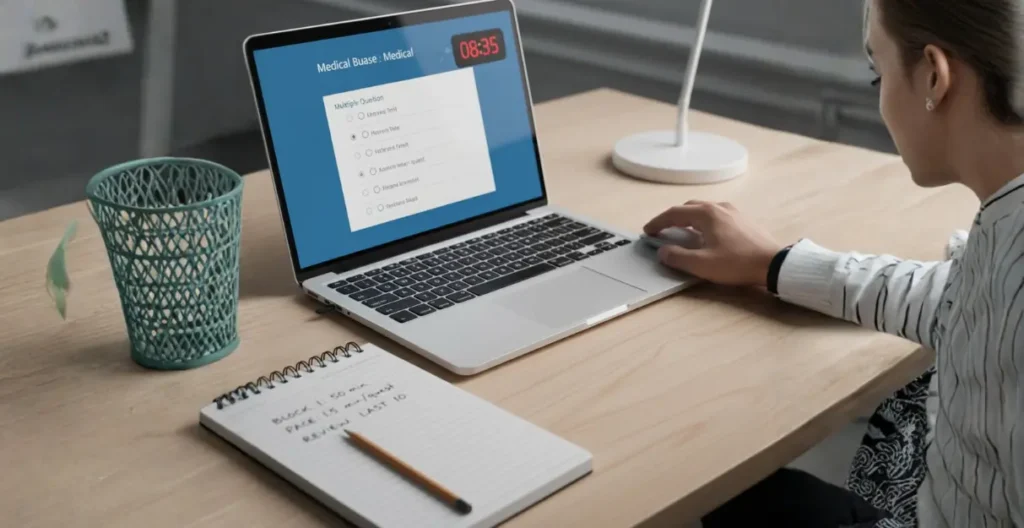
Close-up of a laptop screen with medical multiple-choice questions and a visible timer

The USMLE Step 1 is a one-day computer-based test that assesses whether you understand and can apply important concepts of the sciences basic to the practice of medicine. It emphasizes principles and mechanisms underlying health, disease, and modes of therapy.

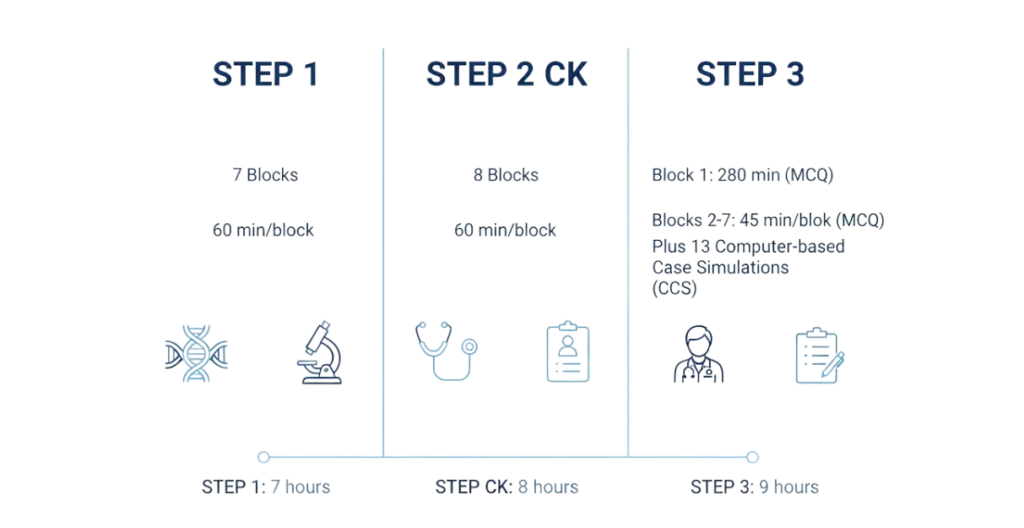
The exam day is divided into seven 60-minute blocks. The number of questions per block is a maximum of 40. This means the total number of items on the overall examination form will not exceed 280. You will have a total of 8 hours to complete the exam, which includes a 45-minute break time that you can use between blocks.
How does Step 2 CK differ from Step 1?

Step 1 vs Step 2 vs Step 3 Comparison

While Step 1 focuses on basic science, the USMLE Step 2 CK (Clinical Knowledge) assesses your ability to apply medical knowledge, skills, and understanding of clinical science essential for the provision of patient care.

Step 2 CK is slightly longer. It consists of eight 60-minute blocks administered in a single 9-hour testing session. The total number of items will not exceed 318. Unlike the pass/fail nature of Step 1, Step 2 CK remains a numerically scored exam, making it a critical metric for residency programs.

What happens during the USMLE Step 3 exam?

Step 3 is the final examination in the USMLE sequence and leads to a license to practice medicine without supervision. It is a two-day examination.

  • Day 1 (Foundations of Independent Practice): Approximately 7 hours. It includes roughly 232 multiple-choice items divided into 6 blocks of 60 minutes each.
  • Day 2 (Advanced Clinical Medicine): Approximately 9 hours. It includes about 180 multiple-choice items divided into 6 blocks of 45 minutes each, followed by 13 Computer-based Case Simulations (CCS).
here is a complete guide on how to choose the best USMLE Tutoring services in the USA and ace your exam in first attempt.

Why is time management critical for blocks?

Exam-Day Stamina & Focus

Pacing is everything. On USMLE Step 1 blocks, you have roughly 90 seconds per question. If you spend 5 minutes on a difficult genetics question, you compromise your ability to answer three easier questions later in the block.

Pro Tips for Test Day Success:

  • Skip and Mark: If you don’t know an answer in 60 seconds, mark it and move on.
  • Use the Tutorial: You can skip the 15-minute tutorial to add that time to your break bank.
  • Simulate Conditions: Practice full-length exams to build stamina for the 7th block.
  • Check the Clock: Glance at the timer every 10 questions to ensure you are on track.
Read our complete guide on how to choose the best USMLE Tutor online for better results and to maximize score.

Final Thoughts on Mastering the Blocks

Conquering the USMLE Step 1 blocks requires stamina as much as intelligence. By understanding the format 7 blocks, 280 questions, 8 hours you remove the fear of the unknown. Start practicing with timed blocks early to train your brain for the endurance required on test day.

Ready to test your stamina? Sign up for a free practice test today.

FAQ

How many blocks is Step 1?

The USMLE Step 1 exam consists of 7 blocks. Each block is 60 minutes long, and the entire exam session lasts 8 hours.

Is Step 1 pass/fail now?

Yes, as of January 2022, Step 1 reporting changed from a three-digit numeric score to a reporting of Pass/Fail. This shifts the emphasis for residency programs onto Step 2 CK scores.

Can I take breaks during the exam?

Yes. You have a minimum of 45 minutes of break time. If you finish a block early or skip the tutorial, that time is added to your total break time. You can take breaks between any of the blocks.

What subjects are covered in Step 1?

Content includes anatomy, behavioral sciences, biochemistry, microbiology, pathology, pharmacology, and physiology, as well as interdisciplinary areas like genetics, aging, and immunology.

When should I take Step 1?

Most US medical students take Step 1 at the end of their second year of medical school, after completing the basic sciences curriculum and before starting clerkships.

Recent Posts

USMLE Step 2 Score Percentile Guide
USMLE Step 2 Score Percentile Guide 2026: What Every Number Means for Your Residency
Medical student reviewing a failed USMLE Step 1 score report and planning a recovery strategy for retaking the exam.
What Happens If You Fail USMLE Step 1: A Complete 2026 Recovery Guide
Medical residency programs for IMGs showing IMG-friendly residency match rates, rank list strategy, and U.S. residency application planning
Medical Residency Programs for IMGs: How to Build an IMG-Friendly Rank List
USMLE prep options infographic showing affordable courses, exam costs, free resources, tutoring, and study plans for 2026
Best Affordable USMLE Prep Options in 2026: Costs, Free Resources and Tutoring Services
USMLE Anki study guide showing spaced repetition flashcards, high-yield medical concepts, and effective exam preparation for Step 1, Step 2 CK, and Step 3
Anki USMLE: How to Use Flashcards to Maximise Your Step 1, Step 2 CK, and Step 3 Prep
ERAS residency timeline 2026 showing key dates, deadlines, Match Week, interviews, and residency application milestones
What you need to know about ERAS Residency Timeline 2026: Key Dates and Deadlines
Medical student preparing for USMLE Step 2 CK patient safety and ethical questions, reviewing bioethics, informed consent, confidentiality, and PSQI concepts on study notes and laptop.
How to Prepare for USMLE Patient Safety and Ethical Questions: Top Strategies to Follow
Confused about NBME vs USMLE? Learn the key differences, how predictive NBME exams are, best Step 1 & Step 2 CK forms, score interpretation, and when to postpone your exam.
NBME vs USMLE: What Every Medical Student Must Know in 2026
this image is about USMLE Step 1 Content Outline Explained updates for 2026
USMLE Step 1 Content Outline Explained: What's Actually Tested and How to Use It
how to review NBME incorrects
How to Review NBME Incorrects Using a Proven System That Converts Mistakes into Higher Scores