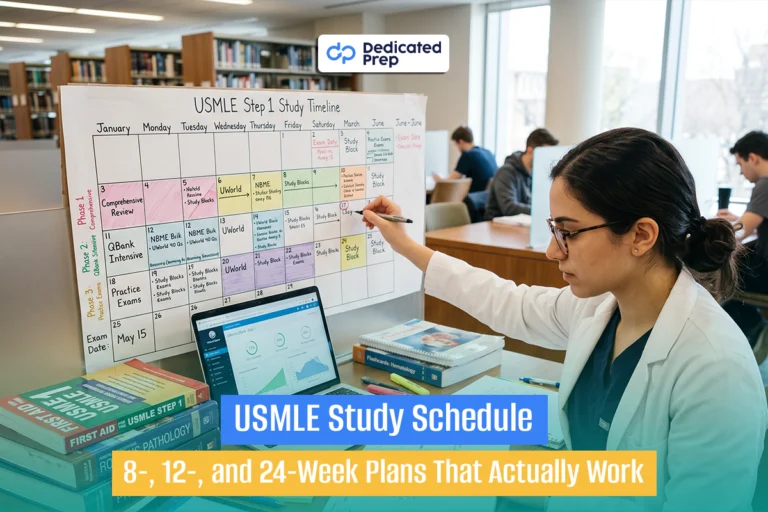

Building a schedule for your USMLEs that doesn’t put you on house arrest and helps you study while have your other tasks completed as well is actually a bit more difficult than the actual studying. Between full-length practice exams, UWorld pass-throughs, anatomy reviews, and clinical rotations, most plans collapse by week three. The result is rushed content review, panic-driven cramming, and a test date that arrives before the student feels ready.
This guide breaks down exactly how to build an 8-, 12-, or 24-week USMLE study schedule that holds up under pressure, and how to adjust it when life gets in the way.
What Is a USMLE Study Schedule & Why It Matters
A USMLE study schedule is a structured timeline that maps content review, question banks, and practice exams against a fixed test date. It is not a generic checklist but rather a structured plan made out on a weekly basis based on the student’s baseline knowledge, available study hours, and target score.
Step exams (Step 1, Step 2 CK, and to a lesser extent Step 3) reward consistency over intensity. A student who studies 6 focused hours daily for 12 weeks generally outperforms one who tries to cram 10+ hours daily for 4 weeks, because retention depends on spaced repetition, not raw exposure time.
For US medical students, scheduling matters even more due to residency timeline pressure. Step 2 CK scores are now central to most residency applications, and many programs expect scores submitted before ERAS opens in September. A poorly timed study block can push a student’s application cycle back an entire year.
How a USMLE Study Schedule Works: Process Explained
A well-built schedule isn’t just “review content, then do questions.” It follows a deliberate sequence:
- Baseline assessment first: a diagnostic NBME or free120 before content review begins, not after, to identify true weak areas instead of assumed ones.
- Content review blocks are organized by system, not by resource chapter order, so cardiology, renal, and pharmacology are studied in overlapping passes rather than isolated silos.
- Daily UWorld blocks calibrated to score level: lower scorers benefit from untimed, tutor-mode blocks early on; higher scorers shift to timed, random blocks sooner.
- Weekly self-assessment exams (NBMEs): spaced every 1–2 weeks during the back half of the schedule to track score trajectory, not just confidence.
- A dedicated tapering period in the final 5–7 days focused on review, sleep normalization, and light question review rather than new content.
- Built-in buffer days: at minimum one buffer day per week to absorb sick days, slow content, or family obligations without derailing the entire plan.
This sequencing is what separates a Step 1 study plan or Step 2 CK schedule that produces real score gains from one that just feels productive.
Why This Matters for USMLE Test-Takers in the US
US medical students face a specific set of pressures that make scheduling discipline non-negotiable.
Residency competitiveness means even a few additional correct answers can change which speciality or program tier becomes realistic. A disorganised, dedicated study period often shows up directly in the final score, not because the student didn’t study enough, but because study time wasn’t allocated to the highest-yield gaps.
Burnout is also a real cost. Students who build vague, hour-count-only schedules (“study 10 hours a day”) tend to front-load enthusiasm and crash by week 2, leading to inconsistent UWorld performance and exam-day fatigue. A structured USMLE study schedule protects against this by building in recovery and variety.
Financial cost matters too. Test rescheduling fees, extended Step 1/CK leave from rotations, and delayed residency applications all carry real costs, both monetary and in lost time. A realistic schedule reduces the odds of needing a reschedule in the first place.
Best USMLE Study Schedule Formats: 8, 12, and 24 Weeks
- The 24-Week Plan is best for students early in their dedicated study period planning, or those who scored below target on diagnostic NBMEs. It works because it allows two full content-review passes plus an extended UWorld phase, smoothing out weak foundational areas before high-yield review begins.
- The 12-Week Plan: The most common USMLE study schedule length for students with a solid preclinical foundation. It works because it compresses content review into a focused single pass while still leaving 4–5 weeks for full-length practice exams and targeted remediation.
- The 8-Week Plan is best suited for Step 2 CK or for Step 1 students who already scored well on diagnostics and mainly need question-bank reps and exam stamina. It works because it skips redundant content review and prioritises high-yield review books alongside intensive UWorld and NBME blocks.
- The Hybrid Rotation-Integrated Plan: A modified schedule built for students studying alongside clinical rotations rather than during a fully dedicated period. It works because it uses lighter daily question blocks (20–30 questions) instead of full content-review days, preserving momentum without requiring full-time hours.
USMLE Study Resources: Purpose & Why They Matter
| Item | Purpose | Why It Matters |
| UWorld Qbank | Primary question bank for applied content review | Closest resource to actual exam style and reasoning format |
| NBME Self-Assessments | Score prediction and pacing checks | Most reliable indicator of real exam-day performance |
| First Aid / high-yield review books | Condensed content reference | Efficient for final-pass review and quick-reference recall |
| Anki or spaced-repetition decks | Long-term retention of facts and associations | Reduces the forgetting curve over multi-week study periods |
| Pathoma / video resources | Mechanism-based content explanation | Builds conceptual understanding, not just memorisation |
| Free120 / official practice questions | Exam-format familiarity | Matches NBME software and question phrasing exactly |
Checklist: What to Look For in a USMLE Study Schedule
✔ Realistic Daily Hour Targets: A workable schedule accounts for actual sustainable study capacity, typically 8–10 focused hours during dedicated time, not aspirational hour counts that lead to burnout by week two.
✔ Built-In Buffer and Rest Days: At least one lighter or off day per week is essential. Schedules without buffer time collapse the first time illness, family needs, or slow content review occurs.
✔ Diagnostic-Driven Content Allocation: The plan should be based on actual NBME diagnostic results, not assumptions about which subjects “feel” weak, since perceived weak areas and tested weak areas often don’t match.
✔ Progressive UWorld Difficulty: Question blocks should shift from untimed/tutor mode toward timed/random mode as the test date approaches, mirroring actual exam conditions.
✔ Scheduled Full-Length Practice Exams: At a minimum, 3–4 full-length NBMEs spaced across the back half of the plan, used to track score trajectory and adjust pacing in real time.
✔ A Defined Tapering Period: The final week should reduce new content and increase review and rest, since cramming new material in the last 48 hours rarely improves performance and often increases anxiety.
Expert Tip
Score-prediction research consistently shows that NBME self-assessment performance in the final 2–3 weeks before the exam correlates more strongly with actual Step scores than performance from earlier diagnostic exams, making late-stage NBMEs a critical scheduling checkpoint, not just a confidence exercise.
USMLE Prep Cost & Value Guide
| Service / Option | Price Range | Notes |
| UWorld Qbank (Step 1 or CK) | ~$200–$400 | Pricing varies by subscription length and bundle |
| NBME Self-Assessments | ~$60–$80 per exam | Official practice exams, priced per attempt |
| Commercial review courses | ~$300–$1,500+ | Range depends on format (self-paced vs. live) and resource bundle |
| 1:1 USMLE tutoring/coaching | Varies widely by provider | Often priced per hour or per study-block package |
| Personalized study schedule planning | Varies by provider | Typically priced as a standalone service or bundled with tutoring |
Prices vary by provider, subscription length, and current promotions. No outcome or score guarantee should be assumed from any pricing tier.
Conclusion
A strong USMLE study schedule isn’t about packing in more hours; it’s about sequencing content review, question practice, and self-assessment in a way that actually builds retention and exam stamina. Whether a student needs an 8-week sprint, a 12-week core plan, or a full 24-week rebuild, the structure matters more than the length.
For students who want a schedule built around their actual diagnostic data rather than a generic template, Dedicated Prep offers personalised USMLE study planning and tutoring support designed to fit real timelines, real weak areas, and real residency deadlines.
FAQs
- How many weeks should I dedicate to USMLE Step 1 studying?
Most students use 8–24 weeks, depending on baseline NBME scores and preclinical preparation. A diagnostic exam before committing to a length gives the most accurate answer.
- Is 8 weeks enough for Step 2 CK?
For students with strong clinical-year knowledge and recent rotation exposure, 8 weeks is often sufficient. Students returning to material after a gap typically benefit from 10–12 weeks.
- How many UWorld questions should I do per day?
Most schedules target 40–80 questions daily during dedicated study, adjusted based on content review pace and energy levels.
- Should I take a break during my study schedule?
Yes, most successful schedules include at least one lighter or rest day per week to prevent burnout and support retention.
- What if I fall behind on my study schedule?
Falling behind is common. The key is adjusting the plan immediately, extending the timeline if possible, or reallocating remaining days toward the highest-yield weak areas rather than trying to cover everything equally.